 Ferndale Siding
 One Product, One Standard
Homeowners in Ferndale sometimes ask why we don't carry a broader lineup — why we don't offer vinyl for budget jobs, LP SmartSide for a cheaper engineered-wood option, or cedar for the traditional look. The honest answer is that we made a decision years ago to install one siding system, James Hardie fiber cement, and to get very good at installing it correctly rather than being average at five different products. That's not a marketing angle. It's a practical response to what actually holds up in Whatcom County weather and what doesn't.
Ferndale sits close enough to Bellingham Bay and the Strait of Georgia that salt-laden air is a real factor on the west and north sides of most homes. Add driving rain off the Sound, a moss and algae season that can run eight or nine months out of the year under our tree cover and cloud ceiling, and freeze-thaw cycles that aren't severe but are frequent, and you have a climate that is genuinely hard on exterior cladding. We'd rather install one product we trust completely in these conditions than stock a catalog and let homeowners guess.
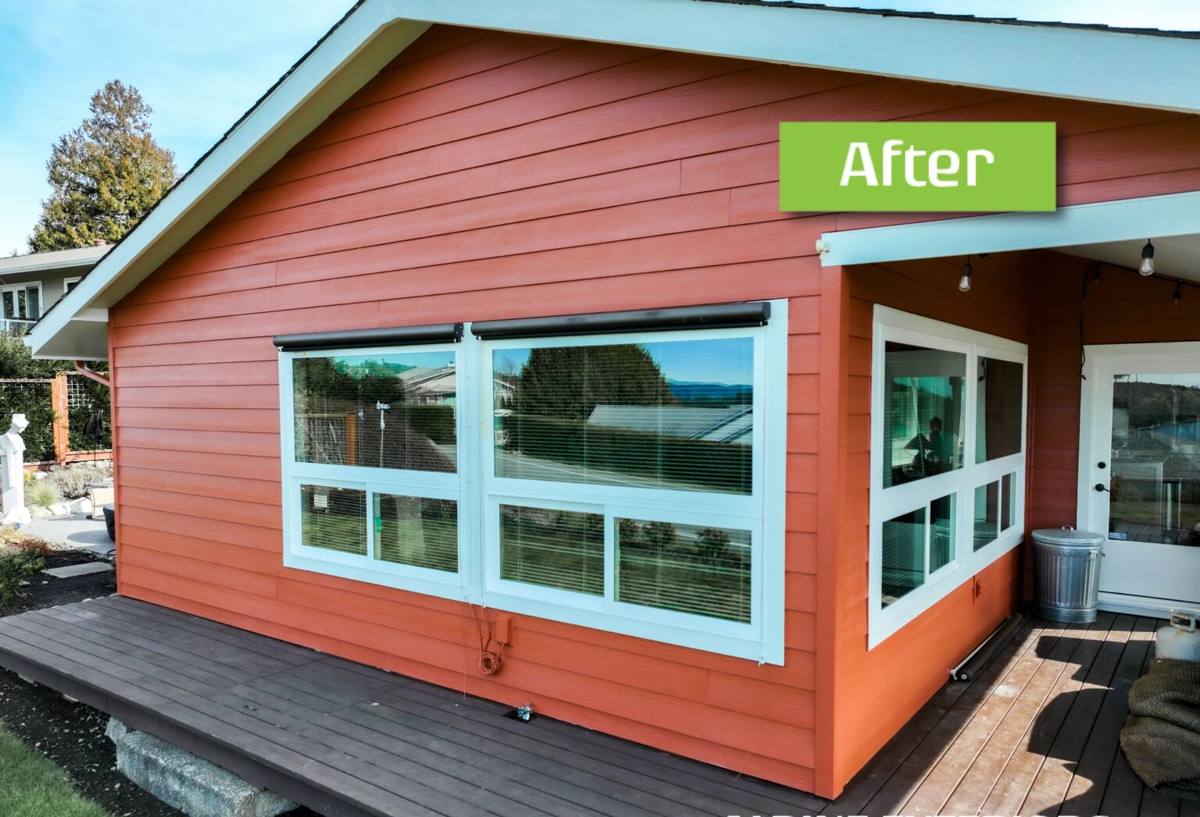
What Fiber Cement Actually Is
James Hardie siding is made from a mix of Portland cement, sand, and cellulose fiber, cured into rigid boards and panels. It is not a plastic product like vinyl, and it is not a wood composite like LP SmartSide. That distinction matters more than most sales literature explains.
Why the composition matters
- It will not rot, because there's no wood sugar content for fungus to feed on.
- It is non-combustible, which carries real weight for insurance underwriting and for homes near wildland-urban interface areas east of Ferndale.
- It doesn't expand and contract with temperature the way vinyl does, so it holds paint and caulk lines better over time.
- It's dense enough to resist the kind of woodpecker and insect damage that shows up on wood-based sidings around the wooded lots common in this area.
None of this makes fiber cement maintenance-free. It still needs to be installed with correct clearances, caulked at the right joints, and repainted eventually if you don't choose a factory-finished color. But the failure modes we see with other products — swelling, cracking, moss colonization in seams, fading — are dramatically reduced with cement board.
The HZ5 Engineering Behind the Product
James Hardie doesn't sell one formulation nationwide. The company engineers its boards by climate zone, and the Pacific Northwest falls under the HZ5 designation, built specifically for high-moisture, freeze-prone regions. That's a meaningful difference from a generic siding product sold the same way in Arizona and Washington.
The HZ5 formulation is engineered for greater moisture resistance and impact resistance than the standard product sold in milder, drier climates. For a Ferndale home taking on months of steady rain and periodic wind off the water, that engineering isn't a bonus feature — it's the reason the product performs here the way it's supposed to.
Product lines we work with
| Line | Best Use | What It Offers |
|---|---|---|
| HardiePlank lap siding | Whole-home siding, most common choice | Traditional lap profile, multiple textures, the workhorse of the lineup |
| HardiePanel vertical siding | Accent walls, gables, modern facades | Clean vertical lines, often paired with board-and-batten trim |
| HardieShingle | Accent sections, Craftsman-style detailing | Staggered or straight-edge shingle profiles without cedar's maintenance |
| HardieTrim | Corners, fascia, window and door trim | Matches the field siding so trim doesn't weather at a different rate |
| HardieSoffit | Vented and non-vented soffit panels | Keeps the whole envelope in one material system |
ColorPlus Factory Finish
One of the biggest practical differences between Hardie and most alternatives is the ColorPlus finishing process. Instead of the siding being painted on site after installation, the boards arrive from the factory with a baked-on, multi-coat finish applied under controlled conditions.
What that means in real terms
- No waiting for a dry stretch of Whatcom County weather to get a topcoat on — the finish is already cured before it arrives.
- More consistent color and coverage than field-applied paint, since it isn't dependent on job-site humidity or application technique.
- A longer color warranty than standard field painting typically carries, because the finish and the substrate are backed by the same manufacturer.
- Touch-up product is formulated to match, so nail heads and minor scuffs don't turn into a mismatched patch.
Primed boards that require field painting are still an option through Hardie, and there are legitimate reasons to choose that route — custom color matching for an HOA, for example. But for most homeowners, ColorPlus removes a maintenance variable that becomes a real headache in a climate where good exterior-paint weather windows are limited.
Why We Don't Install the Alternatives
We get asked directly about this, so we'll answer directly. Vinyl siding is inexpensive and low-maintenance in the sense that it doesn't need painting, but it's a thin plastic product that can crack in impact, deform near heat sources, and fade unevenly over years of UV exposure — and it can't be painted a different color down the road without voiding warranties on many products. LP SmartSide is a wood-strand composite that performs reasonably well when installation details are followed exactly, but it's still an engineered wood product, and wood-based sidings depend heavily on flawless caulking and clearance to avoid moisture intrusion at cut edges and seams — a much higher-stakes install in a region that sees rain this often.
Cedar and primed wood siding look excellent when new, but they demand a maintenance schedule most homeowners don't keep up with: re-staining or repainting every few years, ongoing moss and mildew treatment, and vigilance about caulk failure. In Ferndale's moss season, that maintenance burden is steep. We're not telling homeowners these products are junk — vinyl, LP, and cedar all have a place in the market and plenty of homes wear them fine. We're telling you why we, specifically, standardized on one product we can install to a consistent spec and warranty every time, instead of splitting our crews' expertise across several very different materials with very different failure points.
What Correct Installation Actually Involves
Fiber cement's reputation problems almost always trace back to installation, not the material. Hardie publishes detailed installation requirements, and skipping them is how a 30-to-50-year product ends up with 10-year problems.
The details that matter most
- Clearance from grade and hardscape — a minimum gap from soil, decks, and pavement so splash-back moisture doesn't sit against the board.
- Proper fastener pattern and depth — nails driven flush, not overdriven, in the pattern Hardie specifies for the wind and seismic zone.
- Correct joint treatment and caulking — butt joints and penetrations sealed with a compatible sealant, not left to weather naturally.
- Weather-resistive barrier and flashing — the housewrap, window flashing, and kick-out flashing behind the siding matter as much as the siding itself.
- Painted or factory-finished cut edges — any field cut needs to be sealed before it goes on the wall, every time.
This is the part of the job that doesn't show up in a sales brochure but determines whether the siding performs for decades or develops moisture problems in five years. It's also why we'd rather have crews who install one product exceptionally well than crews rotating between five products and half-remembering the spec for each.
The Warranty Behind the Product
James Hardie backs its fiber cement siding with a non-prorated limited warranty that is transferable if you sell the home, and ColorPlus finishes carry their own separate finish warranty. The specifics vary by product line and are spelled out in Hardie's published warranty documents, which we'll walk through with you before any job starts — we're not going to quote you numbers here that you can't verify yourself against the manufacturer's current terms.
What we will say plainly: a manufacturer warranty is only as good as the installation behind it. Hardie's warranty terms typically require installation according to their published instructions, which is one more reason installation discipline isn't optional on our end — it's what keeps the warranty you're paying for actually valid.
What This Means for Your Project
Because we work exclusively in this product system, our estimates, our crews' training, and our warranty conversations are all built around one set of specs instead of general familiarity with several. For a Ferndale home dealing with salt air off the water, sustained rain, and a moss season that tests every seam and joint in a siding system, that focus is the point — not a limitation on your options, but a decision about which option we're willing to put our name behind.
If you're planning a siding project and want to talk through what James Hardie would look like on your specific home — colors, profiles, budget range, and what your existing siding condition tells us about the job ahead — we're glad to come take a look. The estimate is free, there's no pressure, and we'll give you a straight answer about what your home actually needs.