 Ferndale Siding
 Cemplank Isn't a Bad Product — It's Just Not the One We Put Our Name On
If you've been pricing out siding in Ferndale or anywhere else in Whatcom County, you've probably run across Cemplank fiber cement siding, usually offered by a contractor as a lower-cost alternative to James Hardie. We get asked about it often enough that we want to lay out, plainly, why our crews don't install it. This isn't a takedown of Cemplank as a manufacturer. It's an explanation of the trade-offs we weighed and why we decided one product line was worth standardizing on for homes that have to survive Pacific Northwest weather for the next 30-plus years.
Cemplank is a fiber cement siding product manufactured by Plycem, distributed in North America primarily through Beacon Building Products. It's a real fiber cement product — sand, cement, and cellulose fiber, autoclave-cured, sold as lap siding, panels, and trim. On paper, it competes directly with James Hardie. In practice, the differences that matter most show up years after installation, not on the day the crew finishes up and drives away.
Ferndale's Climate Is Not a Gentle Testing Ground
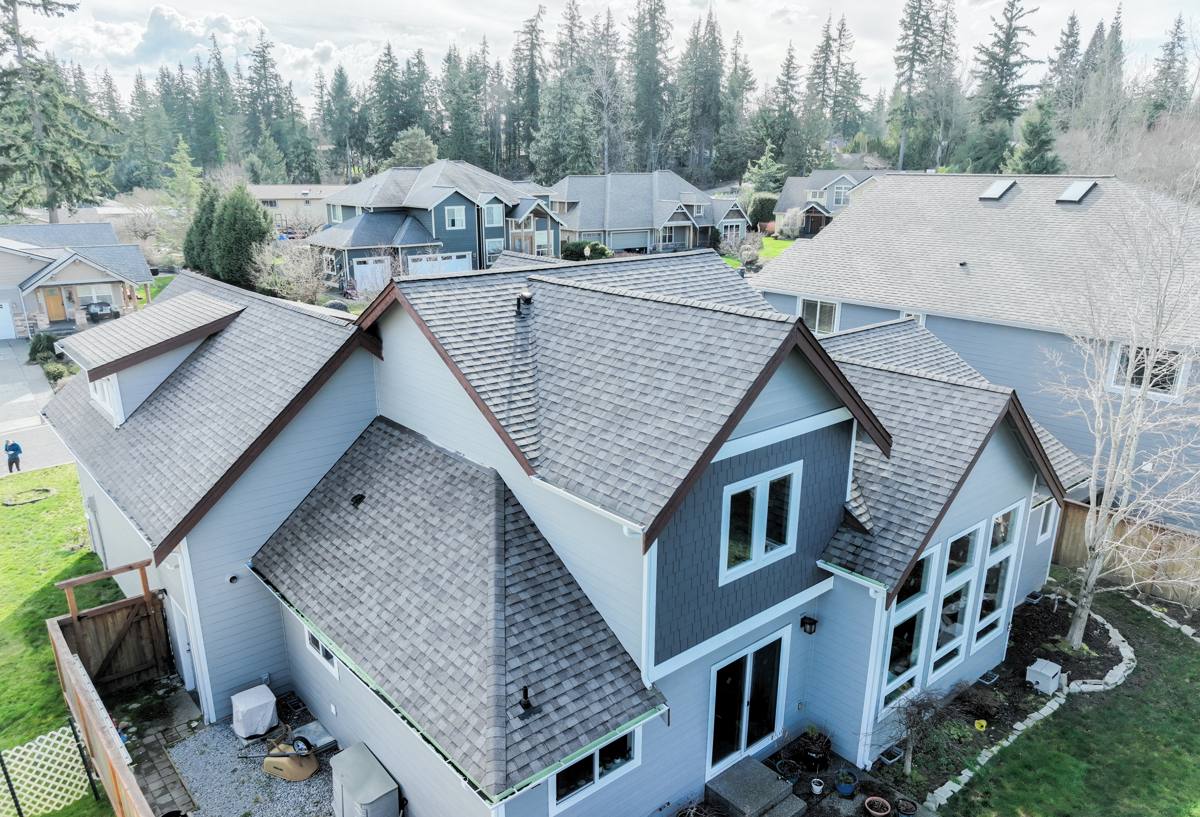
Whatcom County siding takes a beating that a lot of homeowners underestimate until they've lived through a few winters here. Ferndale sits close enough to the Strait of Georgia and Bellingham Bay that salt-laden air is a regular visitor, especially with a west or northwest wind. Add in driving rain that comes in sideways off the water during fall and winter storms, and a moss and algae season that can run eight or nine months out of the year in the shade of a Douglas fir canopy, and you've got a climate that tests every seam, fastener, and factory finish on a house.
This matters because not all fiber cement siding is engineered the same way for the same climate. James Hardie makes region-specific HZ5 formulations built around freeze-thaw cycling and moisture exposure patterns common to the Pacific Northwest. Cemplank's product line is not regionally engineered in the same way — it's a more general-purpose fiber cement board sold nationally. For a home in a drier, milder climate, that difference might never show up. For a home two miles from tidal water in Ferndale, it can.
What Salt Air and Driving Rain Actually Do to Siding
- Accelerate corrosion at any exposed or improperly coated fastener heads
- Push moisture into end cuts and seams that weren't properly sealed or back-primed
- Wear down factory finishes faster than the same product would weather inland
- Create ideal conditions for moss, algae, and mildew to take hold on north- and shade-facing walls
- Stress caulk joints and trim intersections through repeated wet-dry cycling
Factory Finish: Where the Real Difference Shows Up
The single biggest reason we standardized on James Hardie is the ColorPlus factory finish system. Hardie bakes on a color finish at the factory, in a controlled environment, with a warranty specifically covering that finish against fading and peeling. Cemplank's finish options vary by distributor and product line, and in many cases the siding is intended to be field-primed and field-painted after installation, or comes with a less robust factory coating.
That distinction matters more in Ferndale than it would in a lot of the country. Field-applied paint has to be applied in the right weather window, at the right temperature and humidity, and it has to cure properly before the next rain event — not an easy ask in a region where a dry, mild multi-day stretch isn't guaranteed even in summer. A factory-applied finish, cured under controlled conditions before the siding ever reaches the jobsite, removes that variable entirely. We don't want a paint job's success or failure to hinge on a two-day dry window in October.
Installation Sensitivity and Long-Term Performance
Fiber cement siding, generally, is not a forgiving product to install poorly — any brand. Gaps, wrong fastener placement, missing back-priming on cut edges, or clearance mistakes at grade will eventually cause problems no matter whose name is on the board. But we've found that Hardie's installation documentation, regional building code approvals, and product-specific accessories (starter strips, trim systems, fastener specs) are more thoroughly developed and more consistently available through Pacific Northwest suppliers than Cemplank's. When something is site-specific — a tricky window flashing detail, an odd wall transition — having a well-documented, widely field-tested installation system reduces the number of judgment calls our crew has to make on the fly.
That's not a knock on any individual installer. It's about the depth of the system behind the product: fewer gray areas, fewer improvised details, more of the assembly already solved and tested by the manufacturer.
Warranty Structure: Read the Fine Print
Every siding warranty sounds good until you read what it actually covers and who has to prove what. Here's a general comparison of how these product categories tend to differ — always confirm exact current terms directly with a manufacturer before making a decision.
| Factor | James Hardie (HZ5, ColorPlus) | Cemplank |
|---|---|---|
| Substrate warranty | Long-term, non-prorated in many cases | Varies by distributor/region |
| Factory finish warranty | Separate, dedicated ColorPlus finish warranty | Depends on finish option chosen |
| Transferability | Transferable to subsequent owners under stated terms | Varies |
| Regional climate engineering | HZ5 zone specifically built for PNW conditions | General national product line |
| Local installer network depth | Widely adopted; strong installer familiarity in WA | Less commonly installed in this region |
That last row matters more than homeowners usually expect. A warranty is only as useful as the number of qualified installers and supply channels available to honor it fifteen years from now. Hardie's dominant market share in the Pacific Northwest means parts, matching profiles, and experienced installers are easy to find well into the future. A less common product can become harder to service, match, or repair down the road — even if the original installation was flawless.
Cost: Why the Upfront Number Isn't the Whole Story
We won't pretend Cemplank isn't usually cheaper per square foot than James Hardie — it often is, and for a homeowner working with a tight budget, that gap is real and worth acknowledging. But the honest comparison has to include more than the invoice total.
- Field-finishing cost and risk — if a product needs field priming or painting, factor in that labor and the weather-dependent risk of doing it right the first time in a wet climate
- Maintenance cadence — a factory finish rated for Pacific Northwest conditions typically needs less frequent attention than a field-applied one
- Resale and appraisal familiarity — appraisers, inspectors, and buyers in this region recognize James Hardie by name; lesser-known fiber cement brands sometimes prompt more questions during a sale
- Long-run cost per year owned — a somewhat higher install cost spread over a genuinely longer service life without repainting often lands close to, or below, the cheaper option's true lifetime cost
We'd rather walk a homeowner through that full picture upfront than have them find out about it when a lower-cost job needs attention sooner than expected.
What We Actually Install, and Why
Every job our crews do uses James Hardie fiber cement siding — non-combustible, factory-finished with ColorPlus technology, and specified in the HZ5 line built for climates like ours. That standardization isn't about brand loyalty for its own sake. It's because after years of working on homes throughout Whatcom County, we've seen how siding performs against salt air, sideways rain, and a moss season that doesn't take much of a break. We'd rather install one product system well, understand its installation details cold, and stand behind a warranty structure we trust, than offer a menu of fiber cement options and hope each one holds up the same way.
If a homeowner specifically wants a different fiber cement brand installed, we're upfront that it's outside what we do — not because we think every alternative is a bad product, but because we've made a professional call about what we're willing to warranty our labor against, and we'd rather be honest about that boundary than take a job we're not fully confident in.
Questions Worth Asking Any Siding Contractor
- Which fiber cement brand and product line are they quoting, specifically?
- Is the finish factory-applied or field-applied, and what's the finish warranty?
- Is the product rated or engineered for coastal Pacific Northwest exposure?
- Who backs the labor warranty if something goes wrong — the installer, the manufacturer, or both?
- How many jobs has this crew actually installed using this specific product?
Get an Honest Look at Your Siding Options
If your Ferndale home needs new siding — whether it's showing moss buildup, failing caulk joints, or just nearing the end of its service life — we're happy to walk the exterior with you, point out what we're actually seeing, and explain why James Hardie is what we recommend and install. There's no pressure and no obligation. Reach out through the form below to schedule a free estimate.