 Ferndale Siding
 What Whatcom County Weather Does to a House Over Time
Bellingham and Ferndale sit close enough to Bellingham Bay and the Salish Sea that salt-laden air is a constant, low-grade factor in how exteriors age here. It's not the dramatic hurricane-force salt exposure of an oceanfront town, but it's steady, and steady wins over decades. Add in the driving rain that comes through on southwest storm systems, and you have a climate that pushes moisture sideways into walls, not just straight down onto roofs.
Whatcom County also holds onto moisture longer than drier parts of the state. Overcast stretches, high humidity, and shaded north- and east-facing walls create ideal conditions for moss and algae to take hold on siding, trim, and roofing. None of this is unusual for western Washington, but it does mean exterior materials here work harder, for longer stretches of the year, than the same materials would in a drier climate.
The Three Things We See Most Often
- Wind-driven rain finding its way behind poorly flashed siding and trim, especially around windows and butt joints
- Moss and algae staining on shaded sides of the house, particularly where gutters overflow or where siding sits close to landscaping
- Paint and caulk failure on wood-based products, which opens the door to moisture intrusion long before it's visible from the ground
Why the Siding Material You Choose Matters More Here
In a drier inland climate, a homeowner can get away with a lower-grade siding product and simply repaint every several years. In a marine climate like this one, that maintenance cycle compresses. Paint fails faster under constant damp exposure, caulk joints open sooner, and any product that isn't dimensionally stable in the presence of moisture tends to show it — cupping, swelling, or soft spots at the bottom courses where rain sheets down and sits.
This is the whole reason we standardized on one product line rather than offering a menu of options. We install James Hardie fiber cement siding exclusively. We don't install vinyl, LP SmartSide, Cemplank, Allura, primed spruce, or cedar, and we're upfront with homeowners about why.
Where the Alternatives Fall Short in This Climate
Vinyl is inexpensive and low-maintenance in the sense that it doesn't need paint, but it's a poor match for a region with real temperature swings between summer and winter — it expands and contracts more than fiber cement, and impact damage (a stray branch, a ladder, a thrown rock) tends to crack it rather than dent it. Wood-based composite siding depends entirely on an intact factory coating and careful field sealing of every cut edge; in a climate this wet, any breach in that coating starts a clock on moisture damage that isn't always visible until it's serious. Primed wood and cedar are beautiful materials, but they ask a homeowner to commit to a repainting and caulking schedule that a marine climate makes more frequent and less forgiving to skip.
None of these products are junk — they all have a legitimate place in the market. They're just not what we're willing to warranty our workmanship on, given what we watch this climate do to exteriors year after year.
James Hardie: Built for Exactly This Kind of Weather
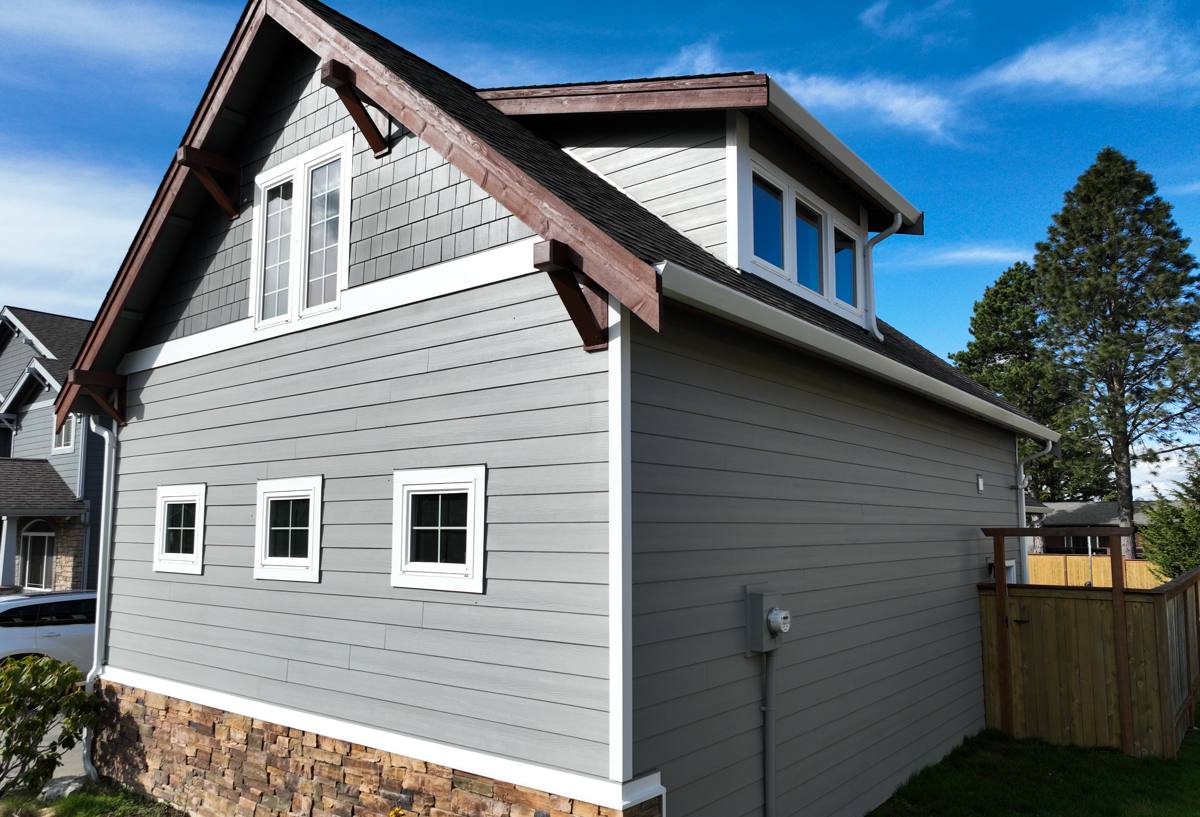
James Hardie engineers its siding by climate zone, and the HZ5 product line is formulated for regions with the freeze-thaw cycling, moisture exposure, and temperature swings found throughout the Pacific Northwest. Fiber cement itself doesn't rot, warp, or feed moss and mildew the way wood-based products can, and it's non-combustible — a genuine advantage during the dry summer months when wildfire smoke and regional fire risk are a real concern even this far north.
The ColorPlus factory finish is the other half of the equation. Rather than relying on field-applied paint that has to cure and bond correctly in damp job-site conditions, the color is baked on in a controlled factory environment, backed by its own finish warranty. In a climate where field-painted surfaces are fighting humidity from day one, a factory finish is a meaningful edge, not a marketing detail.
What Correct Installation Actually Involves
Hardie siding performs the way it's designed to only when it's installed to the manufacturer's specification — and in a wet climate, the installation details matter as much as the product itself. That means:
- Correct nail placement and fastening pattern so panels aren't over-driven or under-driven
- Proper clearance from grade, roof lines, and decks so water can't wick into the bottom edge
- Rain-screen or drainage-plane detailing behind the siding so any moisture that does get past the cladding can drain and dry rather than sit against the wall sheathing
- Correctly lapped and sealed joints, with factory-cut or properly sealed field cuts
- Flashing integrated correctly at windows, doors, and any wall penetration
This is also why we don't treat siding installation as a generic carpentry task. A crew that installs Hardie board every week, in this exact climate, catches details that a crew installing it occasionally will miss.
Beyond Siding: The Rest of the Exterior Envelope
Siding doesn't work in isolation — it's one piece of an exterior system that includes the roof, the windows, and any attached decking, and in a wet climate those pieces need to work together.
Roofing
Roofs in this area deal with the same moss pressure as siding, plus the added stress of sustained rain volume during fall and winter storm seasons. Proper underlayment, ventilation, and flashing at valleys and penetrations matter more here than in drier climates, since a marginal roof detail that might go unnoticed for years elsewhere tends to show up as a leak much sooner in Whatcom County.
Windows
Window flashing and integration with the siding plane is one of the most common failure points we find on older homes in this area. Wind-driven rain finds gaps around window frames before it finds almost anywhere else on the exterior. Replacing siding is a natural point to also address window flashing and, where it makes sense, upgrade aging windows at the same time rather than reopening the same wall twice.
Decks
Decks in this climate see near-constant dampness for months at a stretch, which makes ledger board flashing and proper drainage away from the house critical — a poorly flashed deck ledger is a common, hidden source of wall rot on homes throughout this region.
Why a Local Crew Makes a Real Difference
A contractor based in this region sees the same failure patterns repeatedly: the same moss lines, the same rot pockets behind old trim, the same window flashing shortcuts on homes built during certain eras of local construction. That familiarity shapes how a job gets bid and built — a crew that knows what Whatcom County weather does to an exterior over ten or twenty years builds differently than one working from a generic spec sheet.
Local presence also matters for something more basic: being reachable. If a question comes up two years after installation, or a storm knocks something loose, a local crew can be back at the house without it being a special trip.
What Siding Replacement Typically Costs to Consider
Every home is different, and an accurate number requires an on-site look at square footage, existing wall condition, trim complexity, and access. But the factors below are the ones that move a project's cost the most, and they're worth understanding before you start collecting quotes.
| Cost Factor | Why It Matters |
|---|---|
| Existing wall condition | Hidden rot or moisture damage found once old siding comes off adds repair scope that can't be fully priced until the wall is open |
| Home size and wall complexity | More corners, gables, and dormers mean more cutting, flashing, and labor time per square foot |
| Trim and accent details | Board-and-batten sections, window trim upgrades, and accent colors add material and labor beyond flat panel siding |
| Access | Steep lots, tight setbacks, or multi-story walls affect staging, scaffolding, and time on site |
| Tear-off vs. overlay | Full removal of old siding costs more up front but allows inspection and repair of the wall assembly underneath |
A Homeowner's Checklist Before Hiring Anyone
Whether you end up working with us or another contractor, these are the questions worth asking before signing anything:
- Is the bid based on a physical walk-around of the house, or a rough estimate over the phone?
- Does the quote specify the exact siding product, including line and profile — not just "fiber cement" or "Hardie" generically?
- Who handles moisture, rot, or framing issues discovered once the old siding is removed, and how is that priced?
- What does the workmanship warranty cover, separately from the manufacturer's material warranty?
- Is the crew doing the installation direct employees, or subcontracted out, and who is actually on site day to day?
- Are permits pulled and inspections scheduled where the scope of work requires them?
If you're weighing a siding, roofing, window, or deck project on a home in Bellingham or Ferndale, we're glad to take a look and walk you through what we're seeing and what it would take to fix it right. The estimate is free, there's no pressure attached to it, and you can use the form below to get started.