 Ferndale Siding
 Exterior Contracting for Lummi Nation Homes
Lummi Nation sits along the water in Whatcom County, and that location shapes everything about how a home's exterior ages here. Between the salt air coming off Bellingham Bay and the Strait of Georgia, the driving rain that blows in off the water during fall and winter storms, and a moss and mildew season that can stretch for most of the year in shaded, north-facing spots, homes in this part of the county take a different kind of beating than homes even a few miles inland. We're based in Ferndale and work throughout this corridor regularly, which means we're not guessing at what materials and installation details hold up here — we see the failures and the successes on a routine basis.
This page covers how we approach siding, roofing, windows, and decks for homes in and around Lummi Nation, what the local climate does to exterior materials over time, and what to look for when you're choosing a contractor for this kind of work.
What Salt Air and Coastal Exposure Do to a Home's Exterior
Proximity to saltwater is one of the more underestimated stressors on a building envelope. Salt-laden air doesn't just sit on a surface — it works its way into fasteners, flashing seams, and any exposed metal, accelerating corrosion in ways that inland homes never experience. Over years, this shows up as rust streaking below nail heads, corroded gutter hardware, and premature failure of lower-grade trim and flashing components.
Wood-based siding products are particularly vulnerable in this environment. Salt air holds moisture longer than dry inland air, which means painted wood, primed spruce, and even some engineered wood products stay damp longer after a storm, giving mold and rot more time to establish. Vinyl siding tends to hold up better against moisture intrusion itself, but it's not immune to the freeze-thaw and UV stress cycles common in this region, and it doesn't address the corrosion issue at all.
Why This Matters for Material Choice
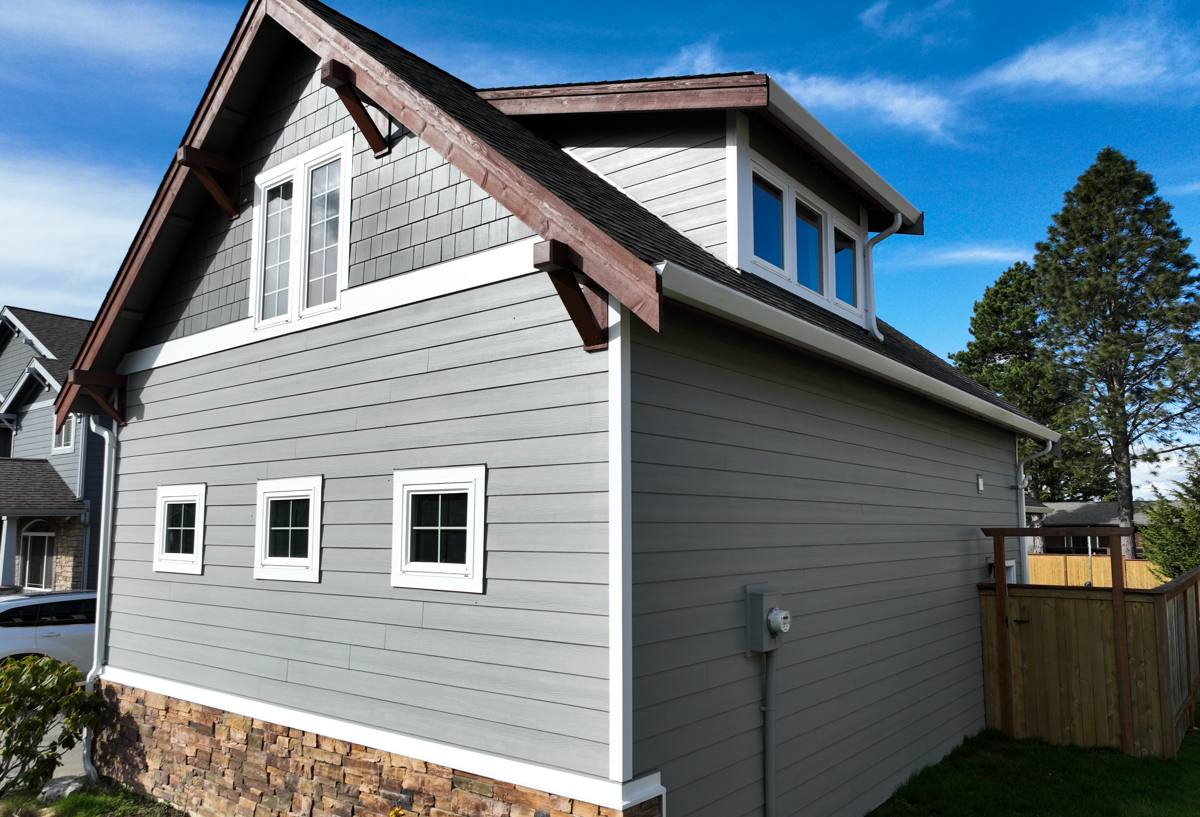
Any exterior product installed near the water needs to handle sustained dampness without swelling, warping, or feeding mold growth — and the fasteners and flashing details around it need to be corrosion-resistant, not just the field material. This is a big part of why we standardized on James Hardie fiber cement siding rather than wood-based or vinyl alternatives: it's a non-combustible, moisture-stable product that doesn't rot, and when it's installed with the right fastener and flashing spec, it's built for exactly this kind of exposure.
Driving Rain and Long Moss Seasons
Whatcom County gets a lot of rain, but it's the driving, wind-driven rain off the water that causes the most trouble for exteriors in this area. Rain that hits siding at an angle finds its way into laps, seams, and penetrations that vertical rain would never reach. That's why proper flashing, weather-resistant barrier installation, and correct lap spacing matter more here than in drier, more sheltered parts of the state.
The moss issue is separate but related. Shaded roof slopes and north-facing siding walls stay damp for extended stretches, especially under tree cover, which is common throughout this area. Moss and algae growth on roofing shortens shingle life by trapping moisture against the roof deck and lifting shingle edges over time. On siding, sustained dampness combined with organic growth is one of the main drivers of paint failure and substrate breakdown on wood products.
- Roofs with heavy tree cover need more frequent inspection and moss treatment than open, sun-exposed roofs
- Gutters clogged with needles and debris redirect water into fascia and siding laps rather than away from the house
- North- and west-facing walls typically show the earliest signs of moisture-related wear
- Ventilation gaps behind siding and in attics reduce trapped moisture that feeds moss and mildew
Siding: Why We Only Install James Hardie
We get asked fairly often why we don't offer vinyl, LP SmartSide, Cemplank, Allura, or primed wood siding alongside Hardie. The honest answer is that we made a decision as a company to specialize in one product system rather than carry several, and we picked the one we think performs best in this climate over the long run.
The Trade-Offs of the Alternatives
Vinyl siding is inexpensive and low-maintenance in terms of paint, but it's a thin plastic product that can crack in cold snaps, fade under UV exposure over the years, and it doesn't offer the fire resistance or the solid, substantial feel that fiber cement does. LP SmartSide and other engineered wood products use a treated wood-strand substrate that performs reasonably well when installation and caulking are kept up perfectly, but any breach in that protective layer — a missed caulk joint, a cracked panel, a poorly sealed cut edge — gives moisture a path into a wood-based core, and wood-based cores swell and deteriorate once wet. In a climate with this much sustained dampness and salt-laden air, that margin for error concerns us. Cemplank and Allura are both fiber cement products similar in composition to Hardie, and they're reasonable products — our decision to specialize in Hardie specifically comes down to their ColorPlus factory finish process, their HZ5 product line engineered for the Pacific Northwest's moisture exposure, and the strength of their transferable warranty, not a claim that competing fiber cement is inferior material.
Why James Hardie Specifically
Hardie fiber cement is non-combustible, doesn't rot or support pest damage the way wood-based products can, and the ColorPlus finish is baked on at the factory under controlled conditions rather than field-painted, which gives it better fade and chip resistance than a job-site paint job. The HZ5 line is engineered for exactly the kind of moisture and temperature swings the Puget Sound and Salish Sea region sees. It's not a cheap product, and it's not the fastest one to install — correct installation requires specific fastening patterns, clearances, and caulking details — but done right, it's a siding system built to hold up against salt air and driving rain rather than just tolerate it for a few years.
Roofing for This Area
Roofing decisions near Lummi Nation come down to two main factors: how much moss and organic buildup a roof will face given its sun exposure and tree cover, and how well the roofing system sheds wind-driven rain at valleys, penetrations, and eaves. We install and repair roofing with attention to proper underlayment, ice-and-water shield at vulnerable areas, and ventilation that reduces the trapped moisture that accelerates moss growth and shingle degradation.
| Roofing Factor | Why It Matters Locally |
|---|---|
| Underlayment quality | Wind-driven rain pushes water further under shingles than typical rainfall |
| Attic/roof ventilation | Reduces trapped moisture that feeds moss and shortens shingle life |
| Valley and flashing detail | Highest-risk leak points during heavy coastal storms |
| Gutter sizing and maintenance | Undersized or clogged gutters back water up into roof edges and fascia |
Windows: Managing Moisture and Air Infiltration
Older or poorly sealed windows are a common weak point on homes in this area, mainly because wind-driven rain finds gaps that vertical rain wouldn't expose. Failed seals, deteriorated caulking, and outdated flashing around window openings let moisture into wall cavities, which is a slow, hidden problem that often isn't noticed until siding or interior finishes start showing damage. When we replace windows, we pay close attention to flashing integration with the surrounding wall assembly — a well-sealed window with poor flashing detail will still leak eventually, especially with the amount of driving rain this area sees.
Newer window units also bring real efficiency gains in a climate with this many overcast, damp months, cutting down on condensation issues that are common with older single-pane or poorly sealed units.
Signs a Window Needs Attention
- Fogging or condensation between panes on double-glazed units
- Soft or discolored trim or siding immediately around the window frame
- Difficulty opening, closing, or locking due to frame swelling
- Visible gaps in exterior caulking or sealant
- Drafts or noticeable temperature differences near the window in winter
Decks: Built for Wet, Shaded Conditions
Deck materials in this area need to handle sustained moisture exposure and, in many yards, significant shade from surrounding trees. That combination is tough on wood decking in particular — shaded, damp boards are exactly the conditions that accelerate rot, fungal staining, and slip hazards from algae buildup. Composite decking has become a popular option locally because it resists moisture absorption and doesn't need the recurring sealing and staining that wood decking requires to keep up with this climate. Whichever material a homeowner chooses, proper joist spacing, ledger board flashing, and drainage beneath the deck all matter more here than in a drier climate, since trapped moisture under a deck structure is a slow but steady path to structural problems.
What to Look for in a Local Contractor
Whatcom County's coastal exposure means installation details that would be minor elsewhere — a flashing lap, a caulk joint, a fastener spacing — carry more consequence here. A contractor who mainly works inland or in drier parts of the state may not build in the same margins for wind-driven rain and salt air that a crew based in Ferndale and working this corridor regularly will.
- Ask how they handle flashing and moisture barrier detail specifically for wind-driven rain
- Ask what siding, roofing, and window products they install and why they chose them
- Ask about warranty coverage — both material and labor — and what voids it
- Get a clear, written scope of work rather than a vague verbal estimate
- Ask how they handle moss and organic growth prevention on roofing and siding
Working With Us
We're a Ferndale-based crew, and Lummi Nation is well within the area we work regularly, so we're familiar with the exposure this stretch of coastline deals with. We handle siding, roofing, windows, and decks, and on siding specifically, we install James Hardie fiber cement exclusively because we think it's the product best suited to hold up against salt air, driving rain, and moss over the long term without the maintenance burden or moisture risk of the alternatives.
If you're dealing with an aging roof, siding showing wear, drafty windows, or a deck that's seen better days, we're happy to take a look and talk through honest options — no pressure, no upsell. Reach out for a free estimate and we'll walk the property with you.