 Ferndale Siding
 LP SmartSide Isn't a Bad Product — It's the Wrong Fit for This Climate
We get asked about LP SmartSide often enough that it's worth answering honestly instead of dodging the question. It's an engineered wood siding — strand-based wood fiber, resin, and wax pressed under heat, then coated with a resin-saturated overlay and factory primer. It's lighter than fiber cement, easier on saw blades, and it costs less per square foot installed. For a lot of markets, particularly drier inland climates, it holds up fine for years.
Ferndale isn't that market. We're a Whatcom County town sitting close to the Salish Sea, and our homes take a steady beating from salt-laden marine air, long stretches of driving rain off the water, and a moss season that can run from October through May in shaded, north-facing exposures. Those three conditions together are the exact combination that engineered wood products struggle with over a 20-30 year service life. That's the honest reason we don't install it, and it's worth walking through in detail rather than just taking our word for it.
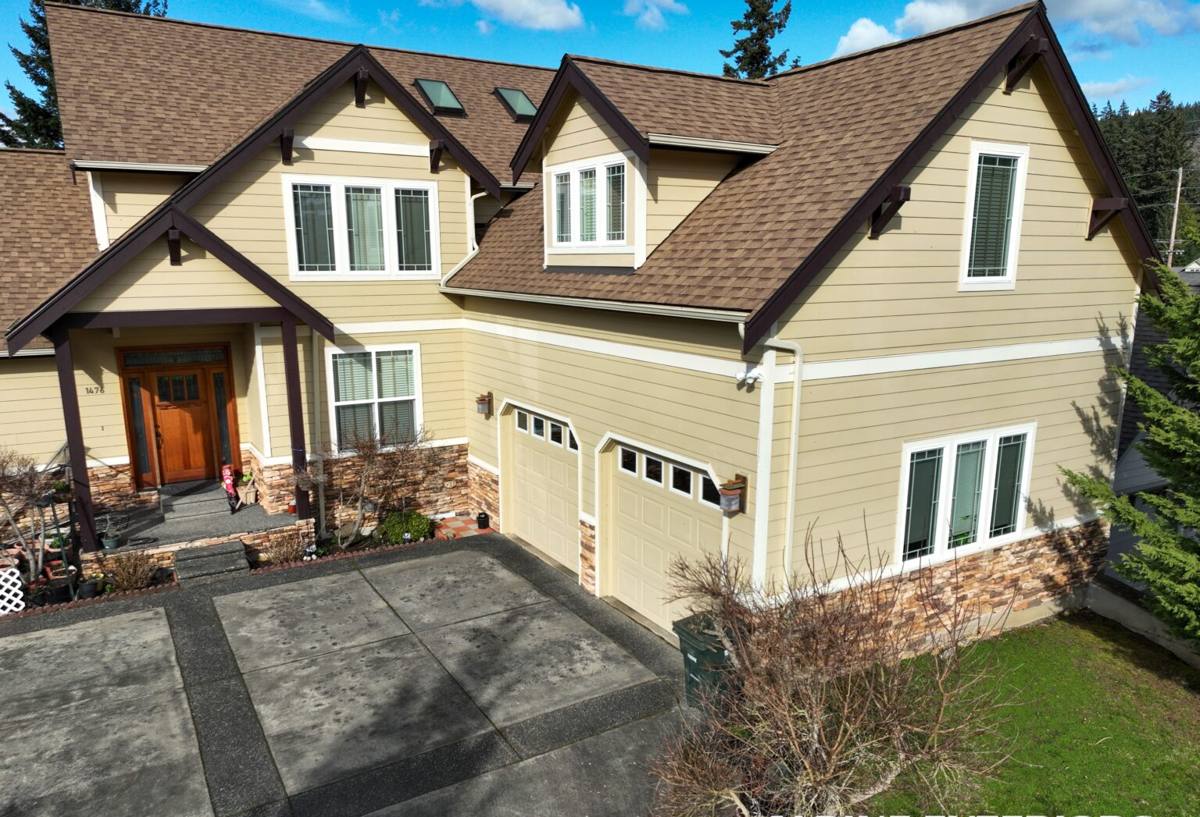
What LP SmartSide Gets Right
Give credit where it's due. LP's manufacturing process has genuinely improved since the OSB-based siding failures of the 1990s that gave engineered wood a bad name industry-wide. Current SmartSide products (the Trim & Siding line, ExpertFinish prefinished options) use a proprietary SmartGuard treatment process meant to resist fungal decay and moisture absorption better than the old generation. It takes paint well, it's easy to nail and cut on site, and homeowners who want a traditional lap or panel look at a lower installed cost than fiber cement have a legitimate reason to consider it.
We're not disputing any of that. Our position isn't "this product is junk" — it's that after installing and repairing siding across Whatcom County for years, we've made a professional call about what we're willing to put our name behind, and we settled on one system: James Hardie fiber cement.
Why Ferndale's Climate Is Genuinely Different
Salt Air and Marine Moisture
Homes within a few miles of Bellingham Bay and the surrounding shoreline deal with airborne salt that accelerates the breakdown of coatings and fasteners over time. It doesn't matter as much what the siding core is made of when you're dealing with corrosion at fastener heads and seams — but it matters a lot when the core itself is wood fiber, because any coating failure exposes a substrate that can absorb moisture rather than shed it.
Driving Rain, Not Just Rain
Western Washington gets rain everyone already knows about. What catches people off guard is how often it comes sideways off Georgia Strait and Bellingham Bay during winter storms, driving water into laps, corners, and butt joints instead of just falling straight down and running off. Wood-based siding depends entirely on its factory coating and field-sealed cut edges to keep that water out. Once wind-driven rain finds a gap, wood fiber siding behaves like wood — it swells, and swelling doesn't reverse itself.
Moss Season
North and east-facing walls under trees or eaves in Ferndale stay damp for months at a stretch. Moss and algae growth on siding isn't just cosmetic — it holds moisture against the surface far longer than open, sun-exposed walls do. On a wood-fiber substrate, that extended dampness is exactly the condition manufacturers warn installers to avoid.
The Real Failure Point: Cut Edges and Field Seams
Every engineered wood siding product, LP SmartSide included, ships with a factory-applied protective coating on the face and back of the board. That coating is the primary moisture barrier. The problem is what happens on the job site: every time a board gets cut to fit a window, a corner, or a utility penetration, that cut exposes raw, uncoated wood fiber. Manufacturer installation instructions require field-sealing every cut edge with an approved sealant before installation, and re-sealing top laps and butt joints per spec.
In practice, this is the single most common place engineered wood siding installations fail — not because the product is defective, but because field sealing is tedious, easy to shortcut, and impossible to inspect after the fact once siding is up. On a house with a lot of window trim, corners, and roof lines (which describes most homes in this area), that's dozens of vulnerable cut edges per elevation. We don't think it's realistic to guarantee 25-30 years of trouble-free performance on a product whose long-term durability hinges on perfect field execution of a step nobody can verify after the crew leaves.
Warranty Language Worth Reading Closely
LP's warranties are real and the company stands behind documented manufacturing defects. But like most engineered wood siding warranties, coverage is conditioned on installation exactly to spec, including that field-sealing step, correct fastening, proper clearance from grade and roof lines, and paint maintenance on a set schedule. Any deviation — including issues that show up years later and can't be traced back with certainty — can put a claim in dispute. That's a structural feature of how these warranties are written, not unique to any one brand, but it's a real cost homeowners take on that doesn't show up in the sticker price.
Side-by-Side: What Actually Differs
| Factor | LP SmartSide (engineered wood) | James Hardie (fiber cement) |
|---|---|---|
| Core material | Wood strand fiber + resin | Cement, sand, cellulose fiber |
| Combustibility | Combustible (wood-based) | Non-combustible |
| Moisture response | Can swell/delaminate if coating or seals fail | Does not swell or rot; engineered for wet climates |
| Cut-edge risk | Requires field sealing on every cut | Factory-primed; far less field-dependent |
| Finish | Field or shop-primed, repaint on a cycle | ColorPlus factory finish, 15-year finish warranty option |
| Installed cost | Lower | Moderate-to-higher |
| Typical service life claim | ~20-30 years with maintenance | 30+ years documented in similar coastal climates |
Why We Standardized on James Hardie Instead
A Core That Doesn't Care About Moisture the Same Way
Fiber cement's core material is inorganic — cement, sand, and cellulose fiber under pressure. It doesn't swell, delaminate, or feed fungal growth the way a wood-fiber core can if moisture gets past the surface. That single difference is why we're comfortable putting a stronger long-term guarantee behind it on homes exposed to Ferndale's rain and salt air.
Climate-Engineered Product Lines
Hardie builds region-specific formulations (their HZ5 line, for example) engineered for wetter, higher-moisture climates like ours, as opposed to a single national formulation. That's a meaningful difference for a house a few miles from Bellingham Bay versus one in a dry inland valley.
Factory Finish, Not Field-Dependent Coating
ColorPlus is baked on in a controlled factory environment and backed by its own finish warranty, rather than relying on job-site priming and a homeowner repaint cycle. It also holds up better against the fading and streaking that moss, algae, and salt air cause on painted wood-based products over time.
Non-Combustible
Fiber cement doesn't burn. That's a genuine, meaningful difference from any wood-based siding product, and it's part of why insurers increasingly recognize it.
Warranty That Doesn't Hinge on One Perfect Field Step
Hardie's transferable warranty structure is still conditioned on proper installation, but it isn't riding on a single easy-to-miss field task the way engineered wood's cut-edge sealing requirement is. That gives us — and you — a lot more confidence signing off on it.
A Checklist Before You Choose Any Siding Product
- Ask what the core material actually is, not just the brand name — wood-based, fiber cement, or vinyl behave very differently in wet climates.
- Ask how cut edges and field seams are supposed to be sealed, and get it in writing that the crew will do it on every cut, not just the visible ones.
- Read the warranty's installation requirements before you sign anything — not just the coverage headline.
- Ask how the product performs specifically in coastal, high-moss, high-moisture climates like Whatcom County, not just the manufacturer's general claims.
- Get the contractor's honest opinion on trade-offs, not just a sales pitch — a contractor who won't discuss downsides of any product isn't giving you the full picture.
- Confirm who is licensed and insured to do the work, and ask for their manufacturer certification if one applies.
Making the Right Call for Your Ferndale Home
None of this means LP SmartSide is a scam or that everyone who has it on their house made a mistake. It means we looked at our specific climate — the salt air, the driving winter rain, the long moss season — and decided we weren't willing to install a product whose long-term performance here depends heavily on perfect field execution of a step that can't be inspected once the siding is up. James Hardie fiber cement gave us a system we could stand behind with a straight face for the next three decades, not just the next five years.
If you're planning a siding replacement or new build in Ferndale and want a straight answer about what will actually hold up on your specific house, exposure, and budget, we're happy to walk the property with you and give you a free, no-pressure estimate — no obligation, just an honest read on what your home needs.