 Ferndale Siding
 Exterior Work on Lummi Island: A Different Kind of Job
Lummi Island sits apart from the mainland in more than one sense. Reaching it means a ferry crossing, and that simple fact changes how exterior projects need to be planned. Materials, crews, and equipment all have to be scheduled around ferry sailings rather than just a drive across town. Homeowners on the island already know this rhythm well — it affects everything from grocery runs to contractor visits. When we take on a siding, roofing, window, or deck project out there, we build the ferry schedule into our planning from day one so the job runs on the timeline we promise, not one that gets stretched out by logistics nobody accounted for.
That same isolation is part of what makes the island's climate tough on homes. Surrounded by water, exposed to wind off the Salish Sea, and shaded by dense evergreen cover on many lots, Lummi Island properties face a combination of salt air, driving rain, and a long moss season that hits harder here than in more sheltered parts of Whatcom County. A house on the island needs an exterior built for those specific conditions, not a generic siding job.
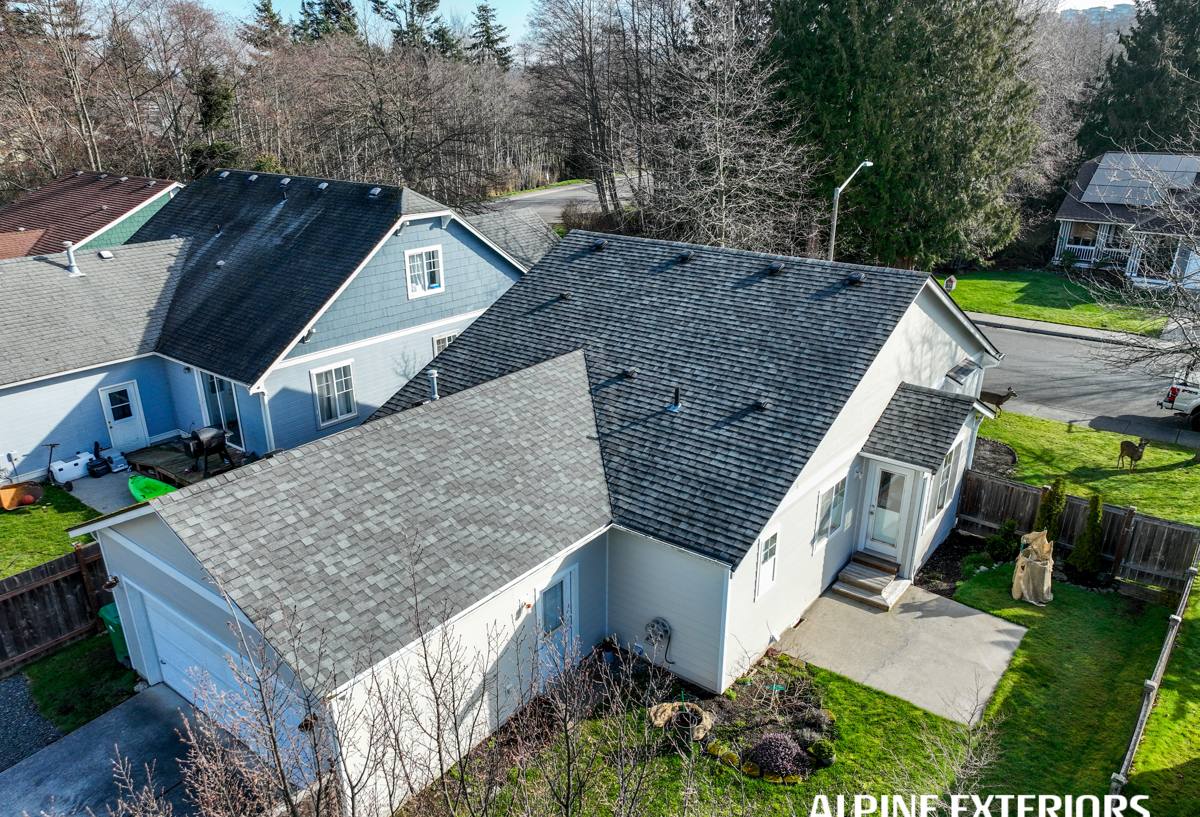
What the Island Climate Does to a Home's Exterior
Salt Air and Metal Fatigue
Homes closer to the shoreline take on a steady, low-level dose of salt-laden air. Over years, that salt exposure accelerates corrosion on fasteners, flashing, gutters, and any metal trim that isn't rated for a marine-adjacent environment. It also breaks down lesser paint systems faster than inland areas ever see, leading to premature fading and chalking on siding that isn't engineered to handle it.
Driving Rain and Wind-Driven Moisture
Storms coming off the water don't just drop rain straight down — wind pushes it sideways into wall assemblies, especially on west- and south-facing elevations. That kind of driving rain finds every gap in flashing, every poorly caulked seam, and every siding product that swells or wicks moisture at the joints. A house on Lummi Island needs a water-management strategy behind the siding, not just a good-looking finish on top of it.
Moss, Shade, and a Long Wet Season
Between the marine layer and heavy tree cover on many island lots, moss and algae get a long runway to establish themselves on roofs, siding, and decking. Once established, moss holds moisture against the surface it's growing on, which is exactly the wrong thing for wood-based products and painted surfaces. A siding material that resists moisture absorption at the surface makes moss and algae far easier to keep off — and far less damaging when they do show up.
Why We Only Install James Hardie Fiber Cement
Ferndale Siding Contractor made a deliberate decision to install James Hardie fiber cement exclusively — not vinyl, not LP SmartSide, not Cemplank, Allura, or primed wood products. On an island exterior facing salt air, driving rain, and constant moss pressure, that decision matters more than it would on a sheltered inland lot.
- Non-combustible core: Fiber cement doesn't feed a fire the way wood-based siding can, which matters anywhere embers or radiant heat could reach a home.
- Factory-applied ColorPlus finish: Baked-on color resists fading and chalking from UV and salt exposure far longer than field-applied paint.
- Moisture stability: Fiber cement doesn't swell, rot, or delaminate at the joints the way wood-based composite panels can when they take on water repeatedly.
- Climate-engineered HZ product lines: Hardie's HZ10 formulation is built for the wetter, cooler climates found throughout the Pacific Northwest, including marine-influenced areas like Lummi Island.
- Strong transferable warranty: A warranty that holds up matters more on a property where reaching a contractor for warranty work takes an extra ferry crossing.
We're not going to tell you every other product on the market is worthless — vinyl and engineered wood sidings have real uses and real customers. But we've seen what happens to lesser materials in this exact climate, and we decided we'd rather stand behind one product line we trust completely than offer several we'd have reservations about installing on a home exposed to this much salt air and rain.
Siding Installation Done Right for Island Conditions
Correct installation matters as much as the product itself, especially here. Hardie siding installed without proper flashing details, without correctly caulked and gapped joints, or without attention to the water-resistive barrier behind it will underperform no matter how good the material is. On Lummi Island specifically, we pay close attention to:
- Flashing and kick-out details at every roof-wall intersection, where wind-driven rain finds its way in fastest.
- Proper fastener selection and spacing rated for coastal exposure, reducing long-term corrosion risk.
- Correct clearance between siding and grade, decks, and roof lines to keep moss and moisture from taking hold at vulnerable transitions.
- Manufacturer-specified caulking and gapping at joints, so the assembly can handle the seasonal moisture swings the island sees.
Roofing, Windows, and Decks: The Rest of the Envelope
Siding is only part of what protects an island home. We handle roofing, window replacement, and deck construction as well, because a home's exterior only performs as a system when every component is doing its job.
Roofing
A roof on Lummi Island deals with the same moss pressure and wind-driven rain as the walls below it, often worse, since it's the first surface hit by weather coming off the water. Roof condition also directly affects how well siding performs — poor roof drainage or failed flashing at the roofline sends water straight down onto wall assemblies.
Windows
Aging windows are one of the most common sources of air and water infiltration on older island homes. Replacement windows with proper flashing integration into new or existing siding close off a major weak point, and better-performing glass helps with both moisture control and comfort in a home that gets more wind exposure than most.
Decks
Decks on the island take a similar beating from moss, shade, and moisture as siding does. Proper decking material choice, ledger flashing, and drainage planning underneath the deck all matter for keeping that structure — and the wall it's attached to — in good shape over time.
Cost Factors for an Island Siding Project
Every home is different, but a few factors consistently move the cost of a Lummi Island siding project up or down:
| Factor | Why It Matters |
|---|---|
| Ferry-dependent material and crew logistics | Deliveries and crew scheduling have to work around sailing times, which affects project sequencing |
| Existing siding condition | Hidden moisture damage behind old siding (common with wood-based products) can require sheathing repair before new siding goes up |
| Home size and wall complexity | More corners, dormers, and roof-wall intersections mean more flashing detail work |
| Trim and accessory selection | Hardie trim boards, soffit, and fascia add cost but keep the whole exterior in one coordinated, durable system |
| Access and site conditions | Tree cover, slope, and staging space on the lot affect how efficiently a crew can work |
What to Look for in an Island-Ready Contractor
Not every contractor is set up to work efficiently on Lummi Island, and that's worth vetting before you sign anything.
- Ask directly about their experience scheduling projects around ferry access — it's a legitimate logistical question, not a minor detail.
- Confirm they're a certified installer for whatever siding product they're proposing, and ask what training that certification actually involved.
- Ask how they handle warranty service calls for island properties, since a callback shouldn't mean weeks of delay over ferry timing.
- Get specifics on flashing and moisture-management details for your home's roof-wall intersections — a vague answer here is a red flag.
- Ask for a written scope of work that names the actual siding product, trim system, and fastening approach, not just a square-footage price.
A Local Crew That Understands the Island
We're based in Ferndale and work throughout Whatcom County, and Lummi Island is part of that service area we know well — not a place we occasionally drive out to when a lead comes in. Understanding the ferry schedule, the salt air exposure near the shoreline, and how moss behaves under the tree cover on many island lots isn't something we're learning on your project. It's something we plan around before we ever propose a scope of work.
If your siding, roof, windows, or deck are showing wear from years of salt air, driving rain, and moss, we're happy to take a look and talk through honest options — including whether James Hardie fiber cement is the right fit for your specific home. Reach out for a free, no-pressure estimate using the form below.