 Ferndale Siding
 Blaine's Coastal Climate and What It Does to a House Exterior
Blaine sits right where Whatcom County meets the water, with Semiahmoo Bay and Drayton Harbor on one side and the Canadian border a few minutes north. That location is part of what makes the area beautiful, and it's also exactly what makes exterior materials work harder here than they would twenty miles inland. Salt-laden air, near-constant winter rain pushed sideways by wind off the water, and long stretches of gray, damp weather all combine to shorten the life of siding, trim, and fasteners that aren't built for a marine climate.
We've worked on enough homes in this corner of Whatcom County to know that "it's just siding" isn't really true here. What goes on a Blaine home has to handle more than a typical Pacific Northwest house a few miles from the coast.
Salt Air and Slow Corrosion
Airborne salt doesn't just affect boats and dock hardware. It settles on siding, window frames, and fasteners, and over years it accelerates corrosion in anything metal that isn't rated for coastal exposure. Cheap or mismatched fasteners, uncoated flashing, and low-grade hardware fail faster near the water than they would inland. It's a slow process, which is exactly why it gets overlooked until paint is bubbling or trim is soft.
Wind-Driven Rain and Moisture Intrusion
Rain in Blaine rarely falls straight down. Wind off the bay drives it sideways into wall assemblies, which puts real pressure on seams, laps, and penetrations around windows and doors. A siding system that looks fine on a calm day can still be letting moisture behind it during a January storm if the flashing details and overlaps weren't done correctly. This is a detail issue more than a material issue — but the material has to be able to tolerate some moisture exposure without swelling, delaminating, or rotting when the installation isn't perfect.
Moss, Mildew, and the Long Wet Season
Whatcom County's wet season runs long, and homes with shaded north sides or tree cover hold moisture for weeks at a time. That's ideal territory for moss and mildew to take hold on roofs, siding, and trim. Materials that absorb moisture stay damp longer and give organic growth more time to establish itself, which means more maintenance, more pressure washing, and in some cases, real damage underneath.
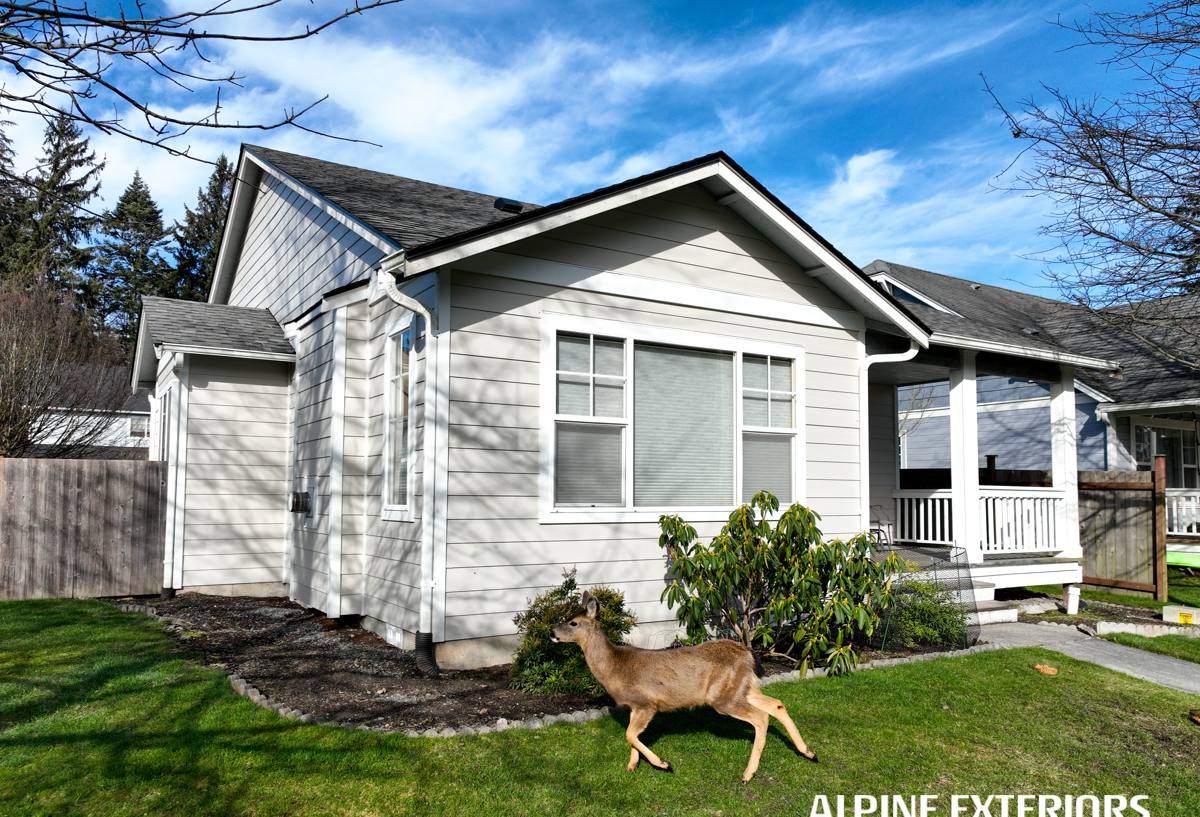
Why We Only Install James Hardie Fiber Cement Siding
We made a decision a while back to install one siding system: James Hardie fiber cement. Not because it's the cheapest option or the easiest to install, but because it's the one that consistently holds up to conditions like Blaine's without the maintenance headaches or moisture risk that come with the alternatives.
Non-Combustible and Dimensionally Stable
Fiber cement doesn't burn, and it doesn't expand and contract with moisture and temperature swings the way wood-based products do. That stability matters in a climate that cycles between soaking wet winters and drier summers — it's part of why Hardie siding holds paint lines and joints tighter over time instead of gapping or cupping.
ColorPlus Factory Finish
Most of the Hardie siding we install uses the ColorPlus finish, which is baked on in a controlled factory process rather than sprayed or brushed on site. It resists fading and chipping far better than field-applied paint, and it comes backed by its own finish warranty separate from the product warranty — which matters in a place where sun, salt, and rain all take a toll on exterior paint.
Engineered for the Pacific Northwest
James Hardie makes region-specific product lines (their HZ formulations) engineered around the climate zone they're going into. The version we install here is built for the wetter, milder Pacific Northwest rather than a generic national product. That's a meaningful difference for a town sitting on the water.
What We Considered — and Ruled Out
We don't install vinyl, LP SmartSide, Cemplank, Allura, or primed wood siding, and we think homeowners deserve an honest explanation why, not just a sales pitch for what we do sell.
- Vinyl siding is inexpensive and low-maintenance in mild climates, but it can warp or become brittle in temperature swings, and it doesn't offer the same fire resistance or the factory-baked finish durability that fiber cement does.
- LP SmartSide is a wood-strand product with real strengths, but it's an engineered wood product at its core, which means its long-term performance depends heavily on caulking, paint maintenance, and keeping end cuts sealed — a bigger ask in a climate with this much sustained moisture.
- Cemplank and Allura are also fiber cement products and are reasonable materials in general, but we standardized on one manufacturer's system so our crews install to one set of specs, one warranty structure, and one finish standard on every job — consistency we can stand behind.
- Primed spruce or cedar can look great, but natural wood siding demands ongoing refinishing and is more vulnerable to moisture and pest damage over time, especially in a marine environment with this much rainfall.
None of these are "bad" products in the abstract. They're just trade-offs we're not willing to put our name behind on a house that has to survive Blaine winters for the next 30-plus years.
How We Approach a Siding Project in Blaine
Inspection and Assessment
Every project starts with a real look at the existing exterior — not just the siding surface, but the condition of trim, flashing, window and door penetrations, and any signs of past moisture intrusion. In a coastal town, what's happening behind the siding often matters more than what's visible on it.
Installation to Manufacturer Spec
Fiber cement siding performs the way it's supposed to only when it's installed correctly — proper clearances from grade and roof lines, correct fastener spacing and type, and flashing details that actually shed wind-driven rain instead of trapping it. We install to James Hardie's published specifications because that's what keeps the warranty valid and keeps the wall assembly dry underneath.
Beyond Siding: Roofing, Windows, and Decks for the Same Climate
Roofing
A roof in Blaine deals with the same wind, rain, and moss pressure as the siding below it. We look at roofing as part of the whole exterior envelope, since a compromised roof edge or flashing detail can undermine even well-installed siding.
Windows
Window flashing and integration with the siding plane is one of the most common failure points on coastal homes. We treat window replacement and siding work as connected jobs, not separate ones, so the transitions between them are sealed and detailed correctly.
Decks
Decks take a direct hit from the same salt air and rain exposure, often with less protection than a wall assembly. Material choice and proper drainage away from the house matter just as much here as they do on the siding.
Comparing Exterior Cladding Options in a Marine Climate
| Material | Moisture Tolerance | Maintenance | Fire Resistance | Typical Lifespan |
|---|---|---|---|---|
| James Hardie Fiber Cement | High | Low — factory finish, occasional wash | Non-combustible | 30+ years with proper install |
| Vinyl Siding | Moderate | Low, but can crack/warp over time | Combustible | 20-30 years |
| LP SmartSide | Moderate, sensitive to unsealed cuts | Moderate — repaint/reseal cycle | Combustible (treated) | 20-30 years |
| Cedar / Primed Wood | Lower without diligent upkeep | High — regular refinishing | Combustible | 15-25 years, varies widely |
Lifespan figures are general industry ranges, not guarantees — actual performance always depends on installation quality, sun and wind exposure, and how consistently a home is maintained.
What to Expect When You Get Bids in Blaine
- Ask whether the crew installs to the manufacturer's written specifications, not just "how we've always done it."
- Confirm who is handling flashing and moisture detailing around windows, doors, and roof lines — not just the flat panel installation.
- Ask what siding product they're proposing and why, including how it performs specifically in a coastal, high-moisture environment.
- Get clarity on what's covered by the manufacturer's product warranty versus the contractor's workmanship warranty.
- Ask about fastener and flashing material — coastal air is hard on low-grade hardware, and it should be addressed directly, not skipped over.
Why a Local Crew Matters in Blaine and Whatcom County
A crew that works this part of Whatcom County regularly has already seen how salt air, wind direction off the water, and the region's wet season play out on real houses over years, not just on a spec sheet. That experience shows up in the small decisions — where extra flashing goes, which details get extra attention on a bayfront-facing wall, how a job gets sequenced around the area's weather patterns. It's the difference between siding that's installed correctly on paper and siding that's installed correctly for Blaine.
If you're weighing a siding, roofing, window, or deck project on a Blaine home, we're happy to take a look and talk through what your house actually needs — no pressure, no upsell, just a straight assessment. Reach out for a free estimate using the form below.