 Ferndale Siding
 A Peninsula That Takes More Weather Than Most
Point Roberts sits in an unusual spot. It's part of Whatcom County and part of the United States, but the only way to reach it by land is through Canada, since the peninsula hangs south of the border on its own patch of ground surrounded by water on three sides. That geography is exactly why homes there take a harder beating from the weather than most houses further inland around Ferndale and Bellingham. Wind off the water, salt in the air, and rain that doesn't let up for months at a stretch all combine to shorten the life of exterior materials that would hold up fine somewhere more sheltered.
We've worked on plenty of homes out that way over the years, and the pattern repeats: siding that looks tired well before its expected lifespan, trim that's soft at the corners, and moss creeping up the north-facing walls by late winter. None of that is a mystery once you look at what the site is actually exposed to.
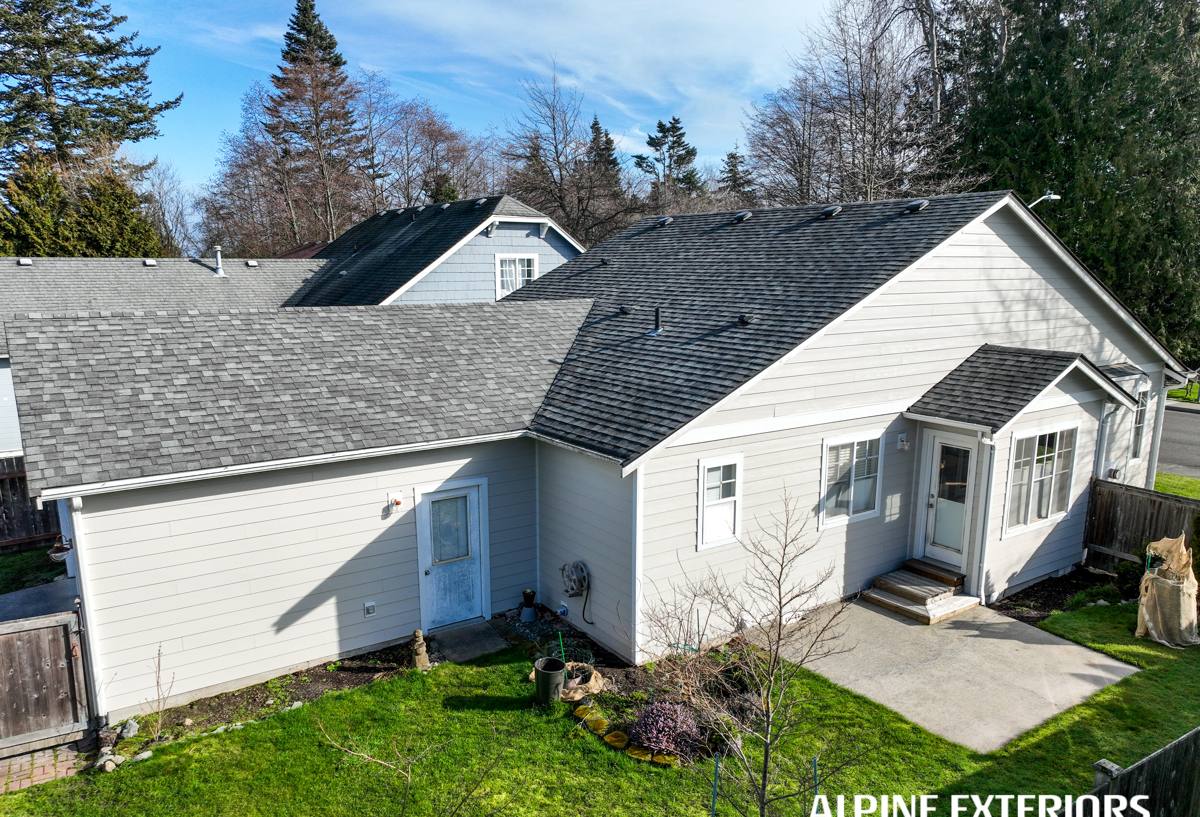
What Salt Air and Driving Rain Actually Do to a House
Moisture Intrusion Over Time
Whatcom County gets a long wet season regardless of where you live in it, but waterfront and near-waterfront properties like the ones on Point Roberts see wind-driven rain that doesn't just fall straight down — it gets pushed sideways into every seam, lap joint, and window flashing detail on a house. Materials that rely on paint film or caulk alone to stay watertight are the first to show problems: swelling at butt joints, soft spots at the bottom courses, and eventually rot in whatever's underneath the cladding.
Salt Air's Effect on Fasteners and Finishes
Airborne salt accelerates corrosion on anything metal — nail heads, flashing, hardware — and it breaks down paint and coatings faster than they'd wear inland. On wood-based or engineered wood siding, that means more frequent repainting just to keep the surface protected, and on lower-grade fastener systems it can mean streaking and rust spotting well before the siding itself has failed.
The Long Moss Season
Shaded north and west walls that stay damp for weeks at a time grow moss and algae readily in this climate, and Point Roberts' exposure and tree cover make it worse in spots than more open, sun-exposed sites. Moss holds moisture against the wall assembly, and on materials that aren't dimensionally stable or properly sealed, that trapped moisture is what eventually causes swelling, delamination, or rot at the substrate.
Why We Standardized on James Hardie Fiber Cement
We install James Hardie fiber cement siding exclusively. We don't install vinyl, LP SmartSide, Cemplank, Allura, primed spruce, or cedar — not because those products don't have a place in the market, but because we've made a professional call that fiber cement from Hardie is the right long-term answer for the climate conditions homes in this area actually face, and we'd rather stand fully behind one system we trust than split our attention across several.
Fiber cement is non-combustible, which matters on its own merits, but the bigger factor for a site like Point Roberts is how the material behaves in sustained moisture. It doesn't swell, delaminate, or rot the way wood-based products can when they take on water repeatedly over years of exposure. It holds paint and factory finish far longer than bare or primed wood products, which reduces the maintenance burden on a house that's already dealing with more weather than average.
ColorPlus Factory Finish
Hardie's ColorPlus finish is baked on at the factory under controlled conditions, rather than field-applied on site. That finish is engineered to resist fading and holds up better against UV and salt-air exposure than a job-site paint job, which matters when a home is getting more sun and salt cycling than a typical inland lot.
HardieZone Engineering for This Climate
Hardie engineers its products by climate zone — HZ5 for the wetter, more temperate zones like ours, versus HZ10 for hot-dry regions. That's not a marketing detail; the formulation and moisture-management performance is actually different between the two, and installing the zone-appropriate product is part of what keeps the warranty intact and the material performing as intended.
Comparing Exposure Factors by Material
| Factor | James Hardie Fiber Cement | Vinyl | Wood / Engineered Wood |
|---|---|---|---|
| Moisture / rot resistance | Does not rot; won't absorb and swell | Won't rot but can warp and gap over time | Vulnerable to swelling and rot without diligent upkeep |
| Salt air / coastal exposure | Factory finish holds up well | Can chalk and become brittle | Coatings break down faster; more frequent repainting |
| Fire resistance | Non-combustible | Melts and deforms with heat | Combustible |
| Typical repaint interval | Long-interval factory finish (ColorPlus) | Doesn't need paint but fades/chalks | Every 3-7 years depending on exposure |
| Moss/algae susceptibility | Low; doesn't provide organic food source | Low but can trap moisture at seams | Higher; organic material feeds growth |
Roofing, Windows, and Decks — Treating the Whole Exterior as One System
Siding doesn't work in isolation. Window flashing that isn't integrated correctly with the siding plane is one of the most common sources of hidden water intrusion we find when we open up a wall on an older Point Roberts home. Roofing that's shedding water improperly at the eaves can drive moisture down behind siding that would otherwise be fine. And decks exposed to the same wind and rain cycle need the same attention to fastener corrosion and moisture management that the walls do.
Because we handle siding, roofing, windows, and decks as one crew rather than subcontracting each trade out separately, we look at a property's exterior as a connected system. If a window is original to the house and the flashing details are questionable, we flag that during a siding project rather than installing new cladding around an old, marginal detail and calling it done.
Why a Local Crew Matters for a Site Like This
Point Roberts' geography adds real logistical wrinkles that an out-of-area contractor doesn't always plan for — material deliveries and crew scheduling both have to account for the border crossing through Canada, and that's easy to underestimate if you haven't done it before. A crew based in Ferndale that already works across Whatcom County treats that as a normal part of planning the job rather than a surprise that pushes the timeline.
There's also a knowledge factor that comes from working in this specific region repeatedly. We've seen firsthand which details fail first on waterfront and near-waterfront property here — where the moss takes hold, which wall orientations take the worst wind-driven rain, which older flashing details tend to be the weak point. That's not something you get from a general specification sheet; it comes from doing the work in this exact climate, on this exact type of exposed site, over and over.
What Our Siding Process Looks Like
A siding project on an exposed site like Point Roberts isn't just fastening panels to the wall. Here's what we're checking and doing along the way:
- Inspect the existing wall assembly for hidden moisture damage before covering anything up
- Correct or replace deficient window and door flashing as part of the siding scope, not as an afterthought
- Install a proper water-resistive barrier and rainscreen detailing suited to a high-exposure site
- Use fasteners and hardware rated for coastal/salt-air conditions
- Install James Hardie panels and trim to manufacturer spec, including the correct HZ5 product for this climate zone
- Flash and seal all penetrations, corners, and transitions to shed wind-driven rain rather than trap it
- Walk the finished job with the homeowner and explain what maintenance, if any, is actually needed going forward
Maintenance Realities for This Climate
Even with a durable, factory-finished material, an exposed coastal site benefits from a little routine attention. Homeowners on Point Roberts should plan on:
- A periodic rinse-down of north- and west-facing walls where moss and algae tend to establish first
- Keeping vegetation and tree cover trimmed back from siding so walls get more sun and airflow
- A yearly walk-around to check caulking at trim and penetrations, since sealant is the one component that does wear out over time regardless of the cladding material
- Prompt attention to any gutter or downspout issues, since concentrated runoff onto a wall accelerates whatever wear is already happening from ambient rain exposure
Get a Straight Answer on What Your Home Needs
If you own a home in Point Roberts and you're seeing moss buildup, soft trim, or siding that's clearly past its best years, it's worth having a local crew take a look before deciding what to do next. We'll tell you honestly what we see, what we'd recommend, and why — no pressure, no scare tactics. Reach out for a free estimate using the form below, and we'll walk the exterior with you and talk through siding, roofing, windows, or decks as needed.