 Ferndale Siding
 Two Very Different Materials, One Big Decision
Vinyl siding and James Hardie fiber cement siding get compared constantly because they're often the two products homeowners are choosing between when it's time to re-side a house. On paper they can look similar — both come in lap, shingle, and panel styles, both come pre-finished, both are sold as "low maintenance." In practice, they're not close. One is an extruded PVC plastic product engineered primarily around price. The other is a cement-based composite engineered around durability, paint retention, and resistance to moisture and fire. For a home in Ferndale, sitting between Bellingham Bay's salt air and the wet, moss-friendly forests of Whatcom County, that difference matters more than it would in a drier inland climate.
This page lays out the honest trade-offs between the two products so you can see why we standardized our business on James Hardie and don't install vinyl.
How Each Material Handles Ferndale's Climate
Ferndale sits close enough to Bellingham Bay and the Salish Sea that salt-laden air is a real factor on siding, trim, and fasteners. Add Whatcom County's long wet season, driving rain off the Strait, and shaded north-facing walls that stay damp for months at a time, and you have a climate that's genuinely hard on exterior materials.
Vinyl in this climate
Vinyl is a plastic product, so it doesn't rot or absorb water directly — that's a real advantage. But it expands and contracts significantly with temperature swings, which is why it's installed with loose nailing and hang strips rather than face-fastened tight. Over years of wind-driven rain, that same loose-fit design is what lets moisture work behind the panels toward the sheathing and house wrap, which is where the real damage happens on any home, vinyl or otherwise. Vinyl also becomes brittle in colder temperatures and can crack under impact, and salt air combined with UV exposure tends to dull and chalk the color coating faster than manufacturers' brochures suggest.
Fiber cement in this climate
James Hardie siding is made from cement, sand, and cellulose fiber, which means it doesn't expand and contract the way vinyl or wood do, doesn't support mold growth on the material itself, and isn't affected by salt corrosion the way metal components can be. Hardie's HZ5 product line is specifically engineered for regions with extended damp seasons and freeze-thaw cycling, which describes Whatcom County well. It's also the reason we can install it face-fastened and tight to the wall assembly without the same expansion concerns vinyl requires you to plan around.
Moss, Algae, and the Long Wet Season
Whatcom County's moss season is long, and it doesn't just grow on roofs — it colonizes anything that stays damp and shaded, including siding seams, J-channels, and vinyl's overlapping laps, which are effectively small ledges and pockets where organic debris can sit and hold moisture. Vinyl's factory finish is a thin color coating, not a paint film, and it has no fungicide or mildew resistance built in. James Hardie's ColorPlus finish is a baked-on, factory-applied acrylic topcoat that resists the kind of moisture-and-grime buildup that feeds moss and algae, and it holds up to the pressure washing needed to knock that growth back without stripping color the way a field-applied paint job on wood or a thin vinyl coating can.
Durability & Lifespan Comparison
| Factor | Vinyl Siding | James Hardie Fiber Cement |
|---|---|---|
| Material composition | Extruded PVC plastic | Cement, sand, cellulose fiber |
| Fire resistance | Combustible, can melt or warp near heat sources | Non-combustible |
| Impact resistance | Can crack, especially in cold weather | Resists impact from hail, debris, and general wear |
| Moisture behavior | Doesn't absorb water, but panel design allows water to travel behind it | Engineered for damp climates, installed with a drainage plane behind it |
| Expansion/contraction | Significant — requires loose-fit installation | Minimal — allows tighter, more dimensionally stable installation |
| Color retention | Thin color coating fades and chalks over time | Baked-on ColorPlus finish holds color substantially longer |
| Typical service life | Often replaced or showing serious wear inside 20-30 years | Manufacturer materials warranty runs decades with correct install |
Appearance & Curb Appeal
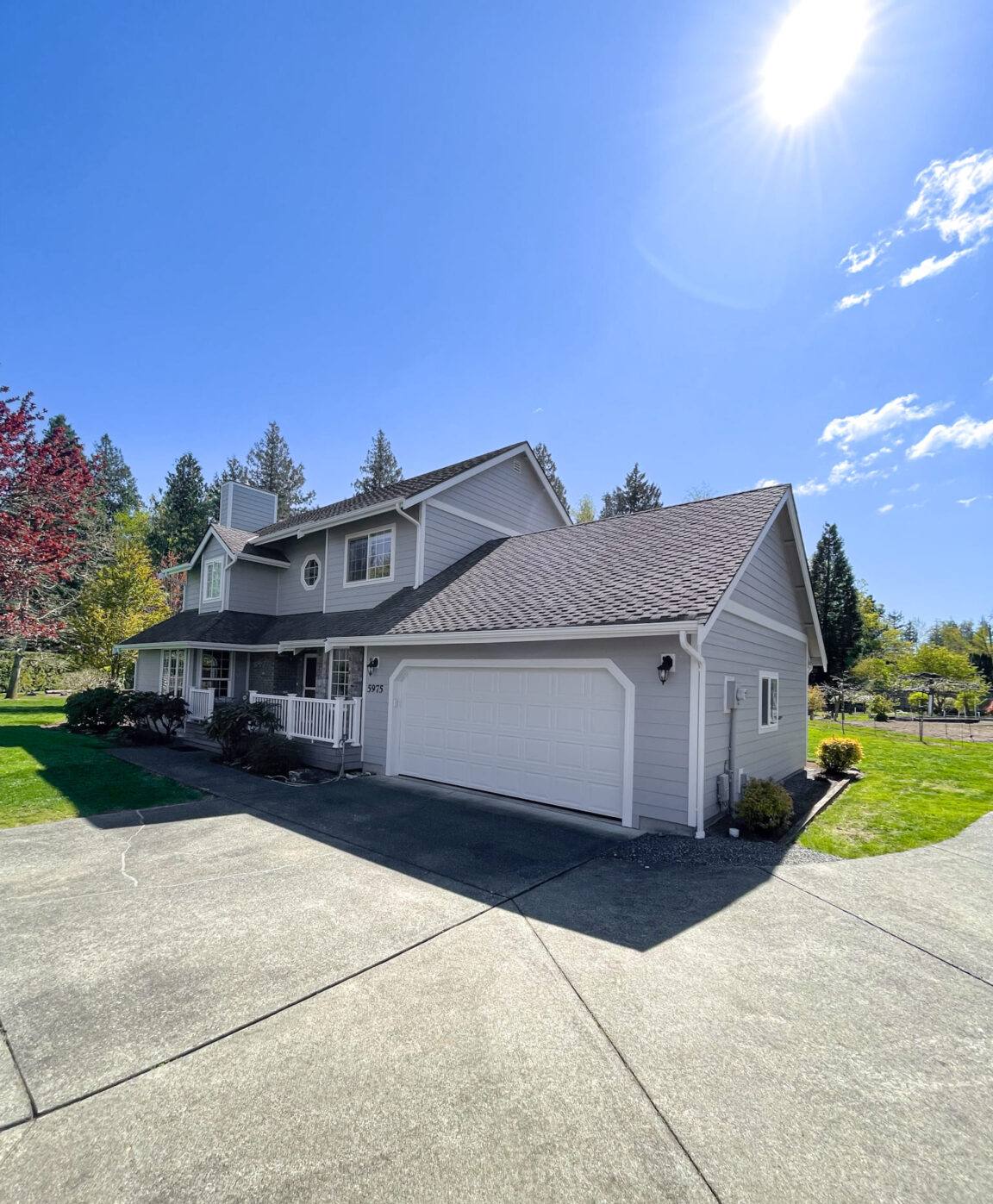
This is where the gap between the two products is most visible in person. Vinyl is a formed plastic panel — it has a shine and a slightly plasticky texture that's recognizable even from the street, and it flexes under hand pressure in a way that reads as "vinyl" to anyone who's paying attention. James Hardie's lap boards, shingle panels, and trim have a true wood-grain or smooth cement texture, real board thickness and shadow lines, and crisp corners that hold their shape. If you're trying to match a traditional Pacific Northwest farmhouse, craftsman, or Cape Cod look, fiber cement reads as the real material it's imitating in a way vinyl generally doesn't.
Maintenance: What Each Product Actually Requires
- Vinyl: periodic washing to prevent mildew and algae buildup in shaded, damp areas; inspection of loose or "oil-canned" panels after wind events; replacement of individual cracked panels (color matching gets harder as older vinyl fades); checking that panels haven't blown loose or been forced tight, which restricts the expansion gap and can buckle the wall.
- James Hardie: periodic washing (a garden hose and soft brush is usually enough); caulking at trim joints checked every few years as part of normal exterior upkeep; repainting is not required for the life of the ColorPlus finish under normal conditions, though it can be repainted later if you want a color change; no risk of insect damage or rot in the material itself.
Installation: Where Problems Actually Start
Both products fail early far more often from installation mistakes than material defects, but the two materials are sensitive to different mistakes. Vinyl has to be hung — not fastened tight — to allow for expansion, and it has to be flashed and lapped correctly at every window, door, and seam or water finds its way behind it with nowhere to drain. Fiber cement has its own installation discipline: correct fastener type and spacing, proper joint treatment, painted or factory-finished cut edges, and adequate clearance from grade, decks, and roof lines. Hardie publishes detailed installation specs, and following them is what the manufacturer's warranty is actually contingent on — which is a big part of why we train to that standard rather than mixing products and methods on a crew.
Cost Considerations
| Cost Factor | Vinyl | James Hardie |
|---|---|---|
| Material cost | Lower upfront cost per square | Higher upfront material cost |
| Installation labor | Generally faster to install | More labor-intensive; requires specific fastening and finishing steps |
| Repair/replacement cost over time | Individual panels are cheap but color-matching aged vinyl is difficult | Repairs are less frequent; ColorPlus finish minimizes fading mismatch |
| Resale/appraisal perception | Viewed as a standard, budget-friendly upgrade | Frequently recognized by appraisers and buyers as a premium, durable upgrade |
Vinyl will usually win on day-one price. Over a full ownership cycle — repainting avoided, panels not replaced, moss and algae easier to manage — the gap narrows, and for many homeowners in this climate the total cost of ownership tips toward fiber cement rather than away from it.
Warranty Structure
Vinyl siding warranties vary widely by manufacturer and are often prorated, meaning the payout shrinks the longer you've owned the siding — read the fine print before assuming "lifetime" means what it sounds like. James Hardie backs its siding with a non-prorated limited warranty on the material itself, and the ColorPlus factory finish carries its own separate finish warranty covering fading and peeling. Warranty coverage is also transferable to a new owner if you sell the home within the coverage window, which is worth mentioning to a buyer's agent or during a home inspection.
Why We Only Install James Hardie
We don't install vinyl siding, LP SmartSide, or the other composite and cement-board alternatives on the market. That's a deliberate standard, not an oversight — we'd rather install one product system correctly and stand behind it than stock five products and spread our crews' expertise thin. James Hardie's engineered climate-specific product lines, non-combustible material, factory-baked ColorPlus finish, and transferable warranty match what actually holds up on Whatcom County homes dealing with salt air, driving rain, and a moss season that doesn't quit. That's the whole reason it's the only siding on our trucks.
If you're weighing vinyl against fiber cement for your Ferndale home, we're glad to walk your property with you, look at your exposure, trim, and existing siding condition, and put together a straightforward, no-pressure estimate — no upsell script, just what we'd actually recommend for your house.