 Ferndale Siding
 Why a Repair Call in Bellingham Isn't a Small Job to Get Wrong
A siding repair call sounds like the simple version of the job — swap a cracked board, re-caulk a joint, move on. In Bellingham, it rarely stays that simple, because the same marine climate that damaged the original section is still sitting right outside the wall while the repair is happening. Salt-laden air off Bellingham Bay, wind-driven rain that hits walls from the side instead of straight down, and a moss season that runs across most of the year all mean a repair has to hold up to the same conditions that caused the problem in the first place, not just look fixed on the day the crew leaves.
We do a lot of repair work in and around Bellingham and Ferndale, and the pattern is consistent: the visible damage — a split board, a stained patch, a soft spot near a window — is usually the last stage of something that's been developing behind the siding for a while. A repair that only addresses the visible piece and skips the cause tends to come back within a couple of wet seasons. This page is about what a correct siding repair actually involves in this specific climate, and why we handle it the way we do.
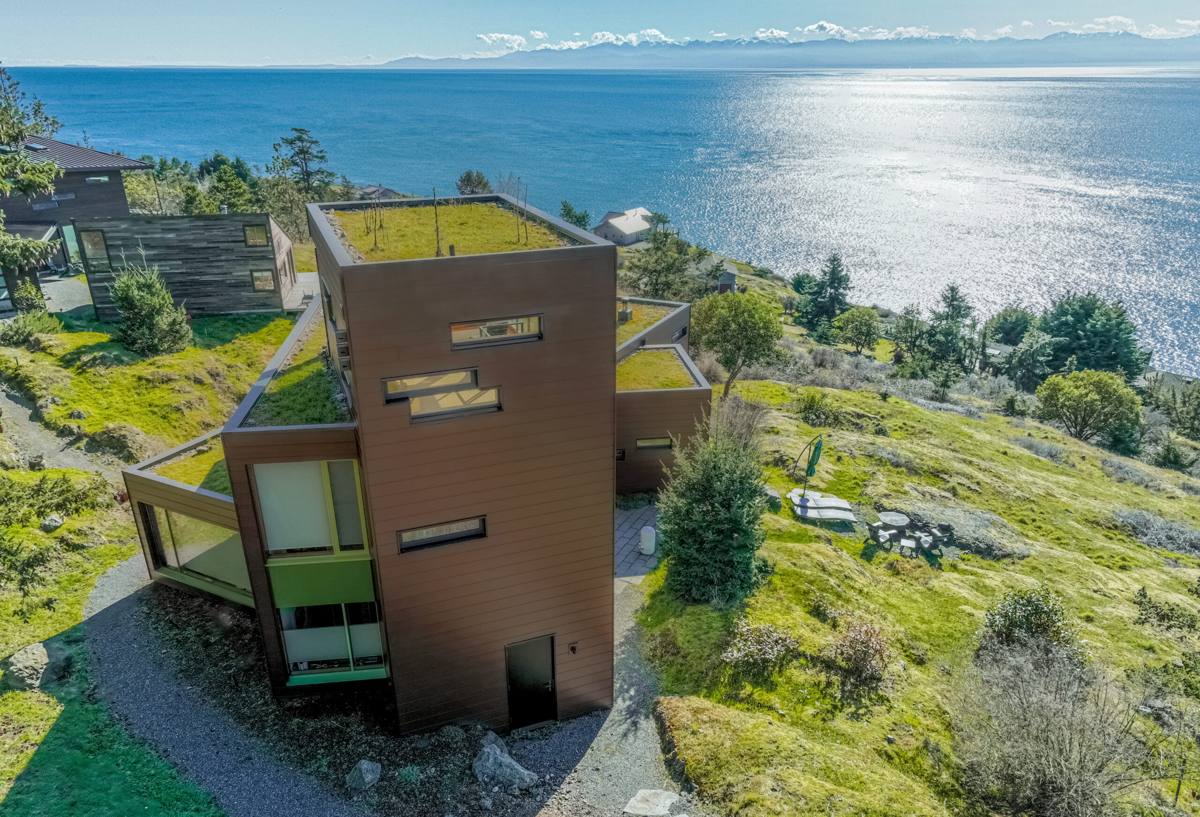
What Whatcom County's Climate Does to a Repair Job
Salt Air Off the Bay
Bellingham's proximity to the water means a steady flow of salt-tinged, moisture-heavy air moving across the city, not just on stormy days. That kind of exposure corrodes fasteners and metal flashing faster than an inland climate would, and a corroded fastener loses its grip and can open a small gap right where it penetrates the siding — exactly the kind of detail a repair has to account for, not just replace like-for-like.
Driving Rain
Rain here regularly comes in sideways, pushed by wind off the water, which means it tests laps, seams, and trim joints that a straight-down rainfall would never reach. A repair section that isn't flashed and lapped correctly with the surrounding siding can leak in the next storm even if the board itself is brand new.
A Long Moss Season
Mild temperatures and consistent dampness keep moss and mildew active on shaded and north-facing walls for much of the year in both Bellingham and Ferndale. Organic growth holds moisture against the siding surface longer than it would otherwise sit, which is part of why the same wall section can fail again if the moisture source behind it isn't addressed during the repair.
Signs Your Bellingham Home Is Still at the Repair Stage
Not every siding problem means a full re-side, and it's worth knowing what a repair-stage problem actually looks like before assuming the worst — or before assuming a quick patch will hold.
- A single cracked, split, or impact-damaged board surrounded by otherwise sound siding
- Soft or spongy siding isolated to one area, such as under a window or near a downspout
- A section that's come loose or separated at a seam after a windstorm
- Localized moss or staining that returns quickly in one spot but not across the whole wall
- Caulk joints that have cracked, shrunk, or pulled away at trim and corner boards
- Visible gaps where flashing or trim meets the siding, without broader signs of wall assembly failure
If the damage is isolated and the sheathing behind it turns out to be sound once we open it up, a repair is usually the right call. If the moisture has clearly been moving for a long time, that changes the conversation — more on that below.
Common Bellingham Repair Calls We See
| What Homeowners Notice | What's Usually Behind It | What a Correct Repair Involves |
|---|---|---|
| Cracked or split board after a storm | Wind-driven debris impact, or a fastener that backed out and let the board flex | Removing the damaged section back to the nearest structural support, checking the sheathing underneath, and installing a matched replacement piece |
| Soft siding below a window | Window flashing that was missed or installed out of sequence, letting water track down behind the siding | Pulling the affected siding, correcting the flashing detail, and confirming the sheathing is dry before closing the wall back up |
| Loose or bulging section near a corner | Fasteners that have corroded or backed out from repeated wet-dry cycling | Re-fastening with corrosion-resistant fasteners at correct spacing, or replacing the section if the board itself has taken on damage |
| Recurring moss patch in one spot | A wall orientation or shade pattern that keeps that section wetter than the rest of the house | Cleaning the surface, checking for trapped moisture behind it, and addressing drainage or clearance issues that keep the spot wet |
| Cracked caulk at trim and corner boards | Normal material movement and UV exposure over time, worse near the water | Removing old caulk fully, confirming the joint underneath is sound, and re-sealing with a product rated for the movement and exposure here |
What a Correct Siding Repair Actually Involves
A repair that's done right takes more steps than swapping one board for another, and skipping any of them is usually why a repair doesn't last.
Opening It Up, Not Just Covering It
Before anything gets replaced, we pull back the damaged section far enough to see what's actually happening behind it — whether the water-resistive barrier is intact, whether the sheathing has softened, and whether the problem is isolated or spreading. Patching over the top of hidden moisture just delays the same call a year or two later.
Matching Profile, Reveal, and Fastening
A repair section needs to match the existing siding's plank width, exposure, and fastening pattern, or it will stand out and, more importantly, may not shed water the same way the surrounding wall does. This matters more with lap siding than most homeowners expect — even a slightly different reveal can change how water sheds off that section.
Flashing and Sealant Done in the Right Order
Flashing has to be installed to work with the house wrap underneath it, not just caulked over the top afterward. A repair that relies on sealant alone to keep water out, instead of correcting the flashing sequence, tends to fail again at the first hard storm.
Confirming the Sheathing Is Dry Before Closing the Wall
If any moisture reached the sheathing, it needs to dry out — and in some cases be replaced — before new siding goes back over it. Closing a wall back up over damp sheathing just relocates the problem behind a fresh-looking repair.
Why We Repair With James Hardie, Not a Quick Patch Material
We install and repair with James Hardie fiber cement exclusively — we don't install LP SmartSide, vinyl, Cemplank, Allura, primed spruce, or cedar, and that includes repair work. A few reasons that matters specifically for a repair call rather than a full re-side:
- Dimensional stability: A Hardie repair section behaves the same way, over time, as the surrounding boards — it won't swell or cup differently than the rest of the wall the way a mismatched material can.
- ColorPlus color matching: Hardie's factory-applied ColorPlus finish gives us a much better shot at matching a repair section into existing siding than field-mixed paint, especially once the original siding has weathered for a few years.
- HZ5 performance in this climate: Hardie's HZ product line is engineered for regions with heavy sustained moisture, which is the same standard we're already holding the rest of the house to.
- One warranty, one system: Repairing with the same manufacturer's product keeps the wall under one coherent system instead of mixing materials with different expansion rates, moisture behavior, and warranty terms.
We understand that on some homes, an older or different siding product is already installed, and a homeowner may ask about patching it with whatever's already there. We'll always be straight about what we can and can't stand behind — if a home isn't already Hardie, that's a conversation worth having honestly before any repair work starts, rather than us quietly patching a product we wouldn't have chosen to install in the first place.
Our Bellingham Repair Process
- Inspection and diagnosis: We look at the damaged section and the surrounding wall, checking for signs the problem extends further than what's visible from the ground.
- Opening the wall: We remove siding back to a point beyond the visible damage, checking the water-resistive barrier and sheathing underneath before deciding on scope.
- Honest scope conversation: If the damage is isolated, we walk you through the repair plan and cost. If it's not, we tell you that plainly instead of proceeding with a patch that won't hold.
- Correcting the cause, not just the symptom: Any flashing, fastening, or drainage issue that caused the original damage gets corrected as part of the repair, not left in place under new siding.
- Matched replacement: New Hardie material is cut and installed to match the existing plank width, reveal, and color as closely as the product line allows.
- Final seal and cleanup: Joints are sealed correctly, the area is cleaned up, and we point out exactly what we found and fixed before we consider the job done.
Repair vs. Replace: How We Help Bellingham Homeowners Decide
| Factor | Points Toward Repair | Points Toward Full Replacement |
|---|---|---|
| Extent of damage | Isolated to one or two sections | Recurring across multiple walls or orientations |
| Sheathing condition | Dry and sound once opened up | Soft, discolored, or showing rot in more than one spot |
| Age of existing siding | Still well within its expected service life | Already at or past the age where the whole system is due |
| Material match | Existing siding is Hardie or a comparable product we can match cleanly | Existing siding is a product we wouldn't install today, or too weathered to match |
| Root cause | A single identifiable cause, like one storm event or one flashing gap | A systemic issue, like a wall assembly that's been trapping moisture for years |
We won't push a full re-side when a repair genuinely solves the problem, and we won't recommend a patch when we can see it's just delaying a bigger job. That call gets made after we've actually opened up the wall, not before.
Why Hiring a Crew That Already Works Bellingham Matters for a Repair Call
Repair work rewards local experience more than a full re-side does, because a repair crew has to make fast, accurate judgment calls about what's isolated damage and what's a symptom of something bigger — and that judgment gets sharper with repeated exposure to how this specific climate behaves on real houses. A crew that works Bellingham and Ferndale regularly already knows which wall orientations near the bay take the worst of the wind-driven rain, how long moss tends to sit on a shaded wall before it starts holding moisture against the siding, and what a corroded fastener from salt exposure looks like before it fails outright. That local pattern recognition is part of what keeps a repair from turning into a callback two winters later.
If you've got a damaged, soft, or aging section of siding on a Bellingham or Ferndale home and you'd like an honest read on whether it's a repair or something bigger, we're glad to take a look. Reach out using the form below for a free, no-pressure estimate.