 Ferndale Siding
 Board & Batten Siding for Bellingham Homes
Bellingham sits close enough to Ferndale that most of what applies to one applies to the other: the same weather rolls through both, the same builders and rooflines show up block to block, and homeowners face the same decision when their siding starts failing — repair the old stuff again, or replace it with something built for the coast. This page is about one specific answer to that question: board and batten siding, installed correctly, in James Hardie fiber cement, by a crew that already works this area.
Board and batten isn't just a look. It's a functional siding profile — wide vertical panels with narrow strips (battens) covering the seams between them — that's been used on Pacific Northwest homes for well over a century, originally in wood, now far more durably in engineered fiber cement. Done right, it sheds Bellingham's rain, resists the salt air off Bellingham Bay, and doesn't feed the moss and mildew that a shaded, damp Whatcom County lot practically guarantees. Done wrong — thin material, no drainage plane, sealed-tight seams — it traps water behind the panels and fails from the inside before anyone notices from the street.
What Bellingham's Climate Actually Does to Siding
Salt Air and Coastal Exposure
Homes closer to Bellingham Bay and the surrounding coastline take on airborne salt that accelerates corrosion of fasteners, staples, and any exposed metal trim. Over years, that corrosion shows up as rust streaking through paint, popped fastener heads, and — on lower-grade siding materials — swelling at the exact points where the fasteners penetrate the board.
Driving Rain
Whatcom County storms don't fall straight down. Wind off the water pushes rain sideways into wall assemblies, which is exactly the condition board and batten siding is supposed to handle — if it's installed with a real drainage gap behind it. Without one, wind-driven rain gets forced past the seams and battens and has nowhere to go but into the wall.
A Long Moss Season
Shaded north walls, mature tree cover, and months of damp, mild weather add up to a moss and algae season that runs most of the year in this part of Washington. Moss holds moisture against a wall long after the rain stops, and on wood or engineered-wood siding, that sustained dampness is often where rot starts — usually at board edges and batten joints, out of sight until the damage is well established.
Why the Board & Batten Profile Fits This Area
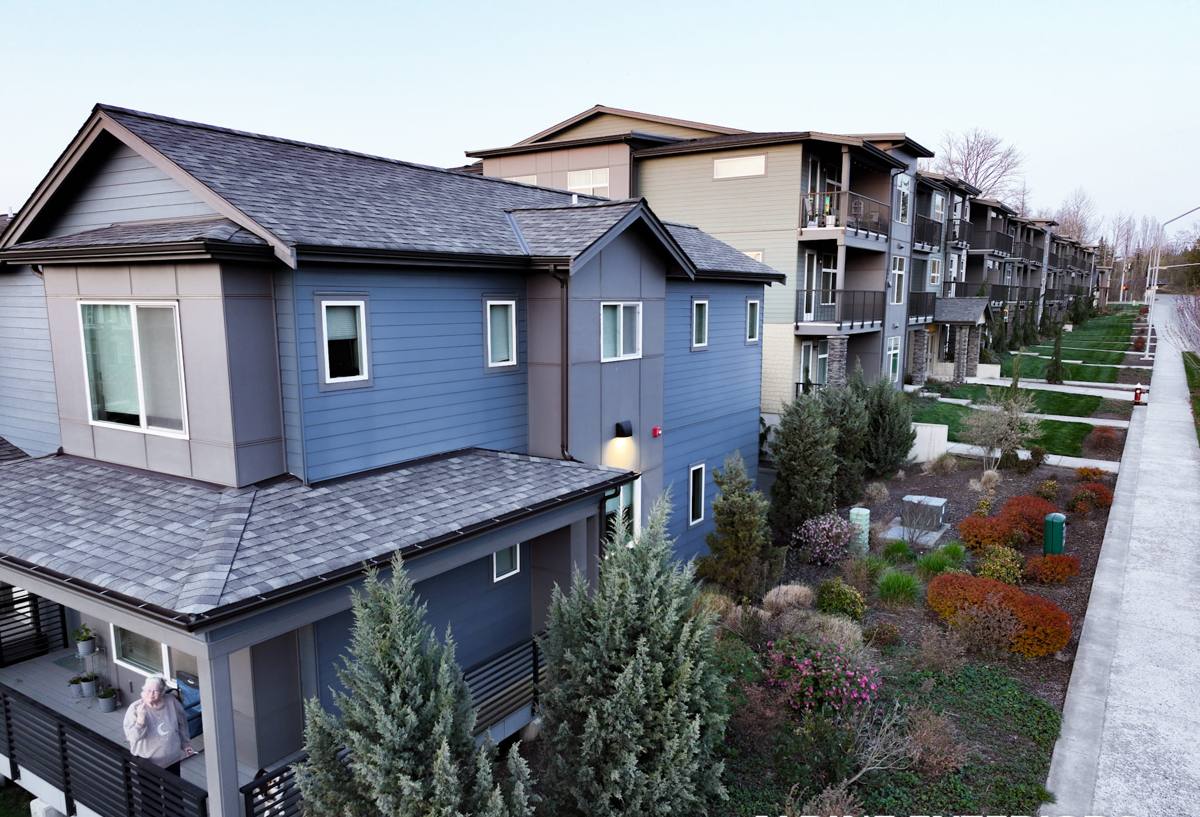
Board and batten reads as a deliberate, tailored look — strong vertical lines, crisp shadow lines at every batten, a style that suits both older farmhouse-style homes and newer builds around Bellingham and Ferndale. It works as a full-wall siding choice or as an accent on gables, dormers, and porch elements paired with horizontal lap siding on the rest of the house.
Beyond looks, the vertical profile has a practical edge in wet climates: water runs down the face of the panel and off the bottom edge rather than pooling on a horizontal ledge, which is part of why it's held up as a traditional choice in high-rainfall regions for so long. That advantage only holds, though, if the material underneath the paint doesn't degrade when it inevitably gets wet — which is the entire argument for fiber cement over wood or engineered wood in this style.
Why We Only Install This in James Hardie Fiber Cement
We don't install board and batten in cedar, primed spruce, LP SmartSide, or vinyl. Each of those has a real audience and a real use case — this isn't a claim that they're worthless. It's a statement of what we, as a crew, are willing to warranty our labor against in a climate like this one.
- Wood (cedar, primed spruce): Beautiful when new, but it needs consistent repainting and caulking to survive Whatcom County's damp season, and board and batten's exposed batten edges are a common failure point for rot once maintenance slips.
- LP SmartSide (engineered wood): Better moisture resistance than raw wood, but it's still a wood-strand product with a treated resin coating — edge exposure and long-term saturation are still real risks near the coast.
- Vinyl: Low maintenance, but it isn't rigid, doesn't hold factory paint the way fiber cement does, and doesn't produce the crisp, flat vertical panel look that makes board and batten worth choosing in the first place.
James Hardie's fiber cement panels are non-combustible, dimensionally stable once installed, and available in the HZ5 climate-engineered formulation built specifically for the wet, temperate Pacific Northwest. Paired with Hardie trim boards for the battens and a factory ColorPlus finish, the result is a board and batten system that doesn't rely on field-applied paint to keep water out — the color coat is baked on before the material ever reaches Bellingham.
What a Correct Board & Batten Installation Involves
Board and batten is less forgiving of shortcuts than standard lap siding, mainly because there are more seams — every batten is a joint, and every joint is a potential water path if it's not detailed correctly.
| Element | Correct approach | Common shortcut that causes problems |
|---|---|---|
| Drainage plane | Furring strips or a rainscreen gap behind the panels so any moisture that gets past the surface can drain and dry | Panels fastened flat against the weather barrier with no airspace, trapping any moisture that gets in |
| Panel joints | Battens installed with manufacturer-specified spacing and fastened per Hardie's fastening schedule, with gaps sized for expansion | Battens caulked tight edge-to-edge with no room to move, which cracks the seal within a few seasons |
| Flashing | Z-flashing and proper head flashing at every horizontal transition, window, and door | Caulk used in place of flashing, which fails long before the siding does |
| Bottom edge | Starter strip and clearance off grade, deck, and roof lines to keep the bottom edge from sitting in standing water | Panels run down to grade or hard against a deck surface |
| Fasteners | Corrosion-resistant fasteners driven per Hardie's spec, set flush without overdriving | Standard fasteners that rust and stain in salt air, or overdriven fasteners that crack the panel face |
Our Process for Bellingham Projects
We treat every Bellingham job as its own assessment rather than a copy-paste of the last one, because exposure varies a lot within a few miles here — a wall facing open water is dealing with something different than a shaded, tree-covered wall a half mile inland.
- On-site assessment: We look at existing siding condition, wall orientation, tree cover, and drainage before recommending anything — including telling you honestly if your current siding has more life left in it than you think.
- Moisture and sheathing check: Where old siding comes off, we check the sheathing underneath for hidden rot before it's covered back up, since that's the only real chance to catch it.
- Drainage plane and weather barrier: We install the rainscreen gap and weather-resistive barrier before any board and batten panel goes up — this step is invisible once the job is done, which is exactly why it's the one that gets skipped on rushed jobs.
- Panel and batten installation: Panels and battens go up per James Hardie's fastening and spacing specifications, not by eye.
- Flashing and trim detail: Every window, door, and horizontal transition gets proper flashing, not just caulk.
- Final walkthrough: We walk the finished job with you, panel by panel, before calling it done.
Board & Batten Compared to Other Siding Profiles
| Profile | Look | Best suited for | Maintenance in this climate |
|---|---|---|---|
| Board & batten (fiber cement) | Bold vertical lines, farmhouse or modern character | Full walls, gables, accent sections | Low — factory finish, no field paint needed |
| Horizontal lap siding | Traditional, widely used | Full-house siding, most common choice | Low with fiber cement, higher with wood |
| Shingle-style siding | Textured, cottage character | Accent gables, coastal-style homes | Moderate — more surface detail to inspect |
None of these is objectively "better" — the right profile depends on the home's style and what the walls are already doing. Board and batten tends to make the most sense as either the primary siding on homes built for that look, or as a deliberate accent against horizontal lap on the rest of the house.
Why a Ferndale-Based Crew Matters for a Bellingham Job
We're not driving in from out of the area to quote this job. Working Whatcom County regularly means we already know how exposure changes block to block between Ferndale and Bellingham, what local permitting looks like, and what tends to go wrong on homes built in the decades before rainscreen gaps were standard practice. That familiarity shows up in the estimate — we're not guessing at what your walls need, we're pattern-matching against homes we've already worked on nearby.
Keeping Board & Batten Siding Looking Right
- Rinse off accumulated grime and salt residue once or twice a year, especially on walls facing open water or heavy road spray.
- Keep gutters clear so overflow doesn't run down the wall face and sit against batten joints.
- Trim back vegetation and tree cover where it's keeping a wall shaded and damp longer than the rest of the house.
- Check caulking at window and door trim yearly — not the batten joints themselves, which shouldn't be sealed tight in the first place.
- Address any moss growth on the wall promptly rather than letting it establish, since it holds moisture against the surface.
If your Bellingham home is due for new siding, or you're weighing board and batten against another profile, we're happy to take a look and give you a straight answer — including telling you if it's not the right fit. Fill out the form below for a free, no-pressure estimate.