 Ferndale Siding
 Composite Decking Built for Birch Bay's Coastline
Birch Bay sits right on the water in Whatcom County, and that location puts decks here through more punishment than a deck built a few miles inland. Salt-laden air moves off the bay almost constantly, wind-driven rain gets pushed sideways into ledger boards and railing posts instead of just falling straight down, and a long, damp moss season keeps organic growth active on shaded boards for much of the year. A deck built or installed without that in mind tends to show it early — soft spots, stubborn algae film, corroding hardware, and boards that cup or fade faster than they should. We work in Birch Bay regularly, and this page covers what we've learned about building a composite deck that actually holds up here.
This page is specifically about composite decking in Birch Bay. If you're comparing composite to wood in general, or looking at decking anywhere else in our service area, the considerations shift somewhat — but for a waterfront or near-waterfront Birch Bay property, the points below are what matter most.
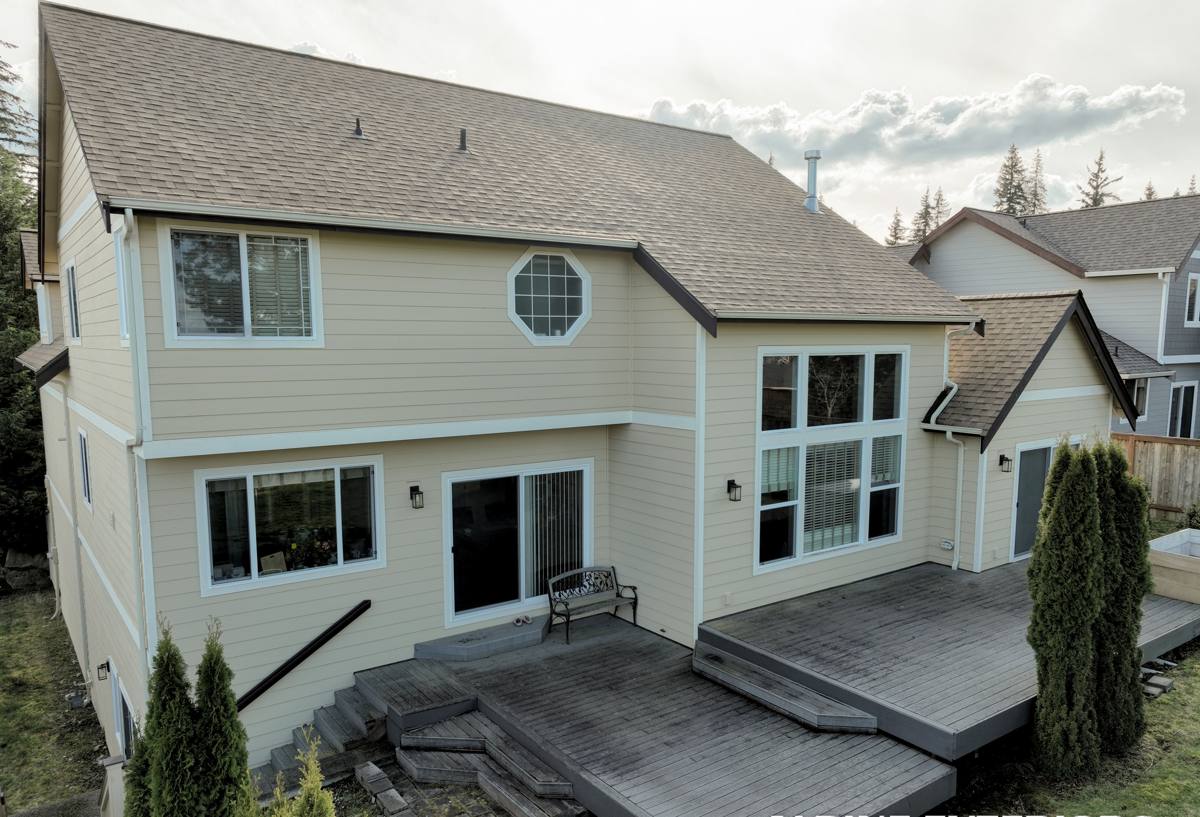
What Birch Bay's Climate Does to a Deck
Salt Air, Concentrated
The closer a property sits to the water, the more salt-laden moisture settles on every exposed surface, including deck boards, fasteners, and railing hardware. Salt air accelerates corrosion in lower-grade screws, brackets, and post hardware, and it can dull or chalk certain finishes faster than a drier inland site would. Fastener and hardware choice matters more in Birch Bay than it does on a sheltered lot a few miles east.
Wind-Driven Rain
Open water exposure means less windbreak, and wind is what turns rain into a sideways problem instead of a straight-down one. Rain gets driven under railings, into fastener heads, and against the house at the ledger board connection. A ledger that isn't flashed correctly is one of the more common places water finds its way into the wall behind a deck, and it's a much bigger risk on an exposed waterfront lot than on a calm inland yard.
A Long Moss and Algae Season
Coastal moisture and, in some yards, tree cover keep moss, algae, and mildew active on shaded or north-facing deck sections for a longer stretch of the year than most of the county sees. On wood decking that means regular scrubbing and refinishing just to keep footing safe. Composite decking resists this better than wood does, but it isn't immune — board selection and airflow underneath the deck still matter for how much maintenance a homeowner ends up doing.
Sun and Temperature Swings
Birch Bay decks that face open water get more direct sun exposure across the day than a deck tucked under trees or against a shaded elevation. Sustained UV exposure is one of the main things that fades and, in cheaper materials, chalks a deck surface over time. It's a factor in board selection and in setting realistic expectations for how a deck's color will hold up over the years.
Why We Recommend Composite Over Wood for Most Birch Bay Decks
Wood decking has a place, and plenty of homeowners like the look and the lower upfront cost. But for a property taking this much sustained salt, moisture, and UV exposure, we generally steer Birch Bay homeowners toward a quality composite product, for a few specific reasons:
- Moisture resistance: Composite boards don't absorb water into their core the way wood does, so they're less prone to swelling, cupping, and splintering after repeated wet-season cycles.
- Lower maintenance burden: Composite doesn't need annual staining or sealing to keep performing, which matters on a coastline where that maintenance window can be short between wet stretches.
- Better resistance to rot and insect damage: A composite core doesn't feed rot or wood-boring insects the way untreated or even pressure-treated wood can over time.
- More consistent long-term appearance: Quality composite boards, especially capped composite products from manufacturers like Trex, TimberTech, and Fiberon, hold their color and surface texture longer under sun and salt exposure than field-finished wood does.
- Manufacturer warranties: Most reputable composite lines carry stronger, more specific warranty coverage than a typical wood deck gets, provided the installation follows the manufacturer's spec.
We don't push one composite brand as the only option — there are several well-established manufacturers making capped composite boards that perform well in a marine climate, and the right pick depends on budget, color preference, and the specific product lines available at the time of your project. What we won't do is install a low-grade, uncapped composite board on a waterfront lot just to hit a lower price point, because that's exactly the kind of product that shows its age fastest under this much moisture and salt.
What a Correct Composite Deck Installation Involves
The board itself is only part of the equation. On an exposed Birch Bay lot, the substructure and detailing underneath the decking are what determine whether the deck actually holds up.
Framing and Fasteners
Composite decking is heavier than wood in some cases and behaves differently under load and thermal movement, so framing spans and joist spacing need to match the manufacturer's specification for that specific board. Fasteners and hidden clip systems rated for coastal, high-moisture exposure matter more here than on an inland deck, where a lower-grade fastener might get away with a slower rate of corrosion.
Ledger Board Flashing
The ledger board connection, where the deck attaches to the house, is one of the most important details on any deck and one of the easiest to get wrong. Proper flashing keeps wind-driven rain from tracking behind the ledger and into the wall assembly. On a Birch Bay property taking this much sideways rain, a poorly flashed ledger is a direct path to hidden rot in the framing and sheathing behind it.
Ventilation and Drainage Underneath
Composite decking sheds surface water well, but the space underneath a low or ground-level deck still needs to drain and dry out between storms. Poor grading, blocked airflow, or standing water under the deck creates the same damp, shaded conditions that keep moss and mildew active longer, even above a composite surface.
Railing and Post Hardware
Railing posts and their connection hardware take direct wind load on an open waterfront lot. Corrosion-resistant hardware, correctly rated for the railing height and wind exposure, matters more here than it would on a sheltered inland deck.
Composite Decking Cost Factors in Birch Bay
| Factor | What It Affects | Why It Matters in Birch Bay |
|---|---|---|
| Board tier (capped vs. uncapped composite) | Material cost and long-term durability | Uncapped or lower-grade boards show fading, staining, and moisture damage faster under coastal exposure |
| Deck size and layout complexity | Labor and material quantity | Multi-level decks or those with lots of railing and stair sections take more labor and hardware |
| Substructure condition | Whether framing needs repair or replacement | Older decks near the water often have hidden ledger or joist damage from years of moisture exposure |
| Ledger flashing and connection detail | Labor time and materials at the house connection | Wind-driven rain makes this detail more critical on an exposed lot than a sheltered one |
| Railing and fastener grade | Hardware cost | Corrosion-resistant hardware is worth the added cost given sustained salt exposure |
| Site access and grading | Labor and equipment needs | Waterfront lots can have limited access or drainage challenges under low decks |
Exact pricing depends on the size, layout, and current condition of your deck or the site it's replacing, which is why we walk the property in person before giving a real number rather than quoting off a generic per-square-foot figure.
Signs an Existing Birch Bay Deck Needs Attention
- Soft, spongy, or bouncy decking, especially near the ledger board or stair connections
- Persistent moss, algae, or dark staining that returns quickly after cleaning
- Rusting fasteners, corroding railing hardware, or visibly deteriorating post bases
- Gaps opening up between boards, or boards that have visibly cupped or warped
- Staining on the house wall directly above the ledger board connection
- Railings that feel loose or wobble under normal pressure
- Standing water or poor drainage underneath a low-level deck
Repair, Resurface, or Full Replacement
Not every aging Birch Bay deck needs a full tear-out. If the framing underneath is sound and the issues are limited to worn wood decking on top of a solid substructure, a resurface with new composite boards over existing, inspected framing can be a reasonable option. But if there's evidence of rot at the ledger, undersized or corroded framing hardware, or a substructure that was never built to current code, patching the surface just delays a bigger problem. We'll tell you honestly which situation your deck is actually in, including when a full rebuild is the more responsible recommendation, rather than defaulting to whichever answer is easier to sell.
Why a Local Crew Matters for a Birch Bay Deck
A crew that works the Birch Bay waterfront regularly has a feel for how salt air, wind-driven rain, and a long moss season behave on real decks here over a full year, not just how a board performs on a manufacturer's spec sheet. That shows up in practical decisions on the job: which orientation gets hit hardest by wind-driven rain, where extra flashing attention at the ledger actually pays off, and which fastener and hardware grade is worth the added cost so a homeowner isn't dealing with corroded hardware or a soft ledger connection a few years down the road. Birch Bay's direct waterfront exposure means it sees a heavier version of the same conditions the rest of Whatcom County deals with, and that difference deserves more than a one-size-fits-all approach built for a sheltered inland yard.
What to Expect When You Call Us
- An on-site look at your existing deck or the space where a new one is planned, including the ledger connection and substructure where relevant
- An honest assessment of whether you're looking at a resurface, a partial rebuild, or a full replacement
- A clear explanation of composite board options and why we recommend a particular tier for your specific site and budget
- A written estimate with no pressure to sign on the spot
If you're planning a new composite deck in Birch Bay, or you've got an existing deck that's showing its age, we're glad to take a look and give you a straight answer. Reach out using the form below to schedule a free, no-pressure estimate.