 Ferndale Siding
 Blaine's Waterfront Climate Is Hard on Siding
Blaine sits right on the water near the Canadian border, which means homes here take on a version of Whatcom County weather that's more aggressive than what you'll find a few miles inland. Marine air carries salt, humidity stays high most of the year, and wind off the water drives rain sideways into wall assemblies that were never designed for it. Add a moss season that can stretch from October into May, and you've got a combination that tests every seam, joint, and coating on a house.
We install James Hardie fiber cement siding across Whatcom County, and Blaine is one of the areas where the case for the right product and the right installation is easiest to make. This page focuses specifically on fiber cement siding for Blaine homes — what the climate demands, what a correct installation looks like, and how our process is built around this specific stretch of coastline.
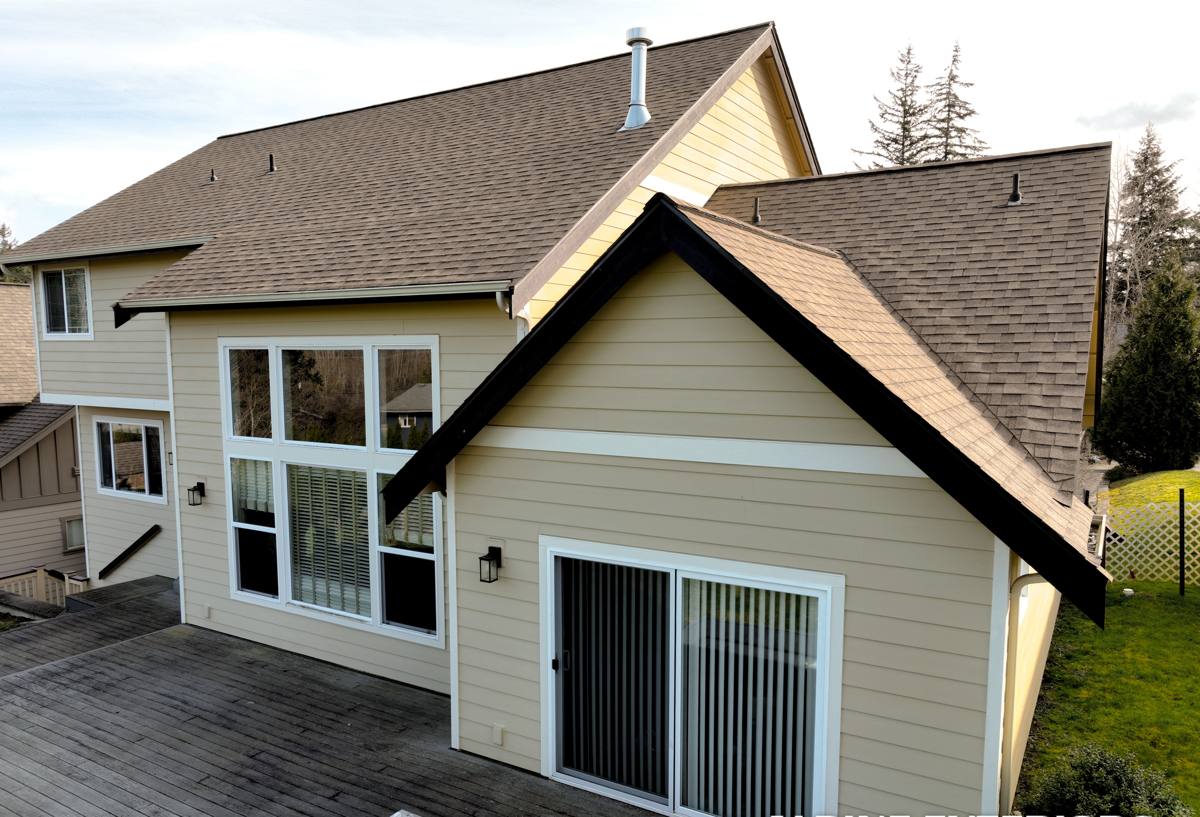
What Salt Air, Driving Rain, and Moss Actually Do to Siding
Salt Air
Airborne salt accelerates corrosion on exposed metal fasteners, flashing, and trim. It also degrades paint and coatings faster than the same materials would wear inland, which is why factory-cured finishes matter more here than in drier parts of the state.
Wind-Driven Rain
Blaine's exposure means rain doesn't just fall — it gets pushed horizontally into wall surfaces, seams, and butt joints. Any siding installed without a proper drainage plane, correct overlaps, and sealed penetrations will eventually let that water find a way behind the cladding.
Moss and Sustained Moisture
Long stretches of damp, low-light weather feed moss and mildew growth on north-facing and shaded walls. Materials that absorb moisture or trap it against the substrate stay wet longer, which gives organic growth more time to establish and gives wood-based products more time to swell, cup, or rot.
None of these are exotic problems — they're the normal cost of living on this coastline. The question is whether the siding system on a house is built to handle them or just tolerate them until it doesn't.
Why We Standardized on James Hardie
We install James Hardie fiber cement exclusively. We don't install vinyl, LP SmartSide, Cemplank, Allura, primed spruce, or cedar, and in a climate like Blaine's, the reasoning is straightforward:
| Material | How it holds up on Blaine's coastline |
|---|---|
| Vinyl | Doesn't rot, but seams and channels can trap moisture behind the panel, and prolonged UV plus salt exposure can fade color and make panels brittle over time. |
| Engineered wood (LP SmartSide) | Wood-based core is more moisture-sensitive than fiber cement; any breach in the edge seal or caulking gives sustained coastal dampness a path into the substrate. |
| Cedar | Handsome material, but it needs ongoing refinishing to resist moisture and moss, and upkeep demands go up fast in a marine, high-moisture climate like this one. |
| Other fiber cement (Cemplank, Allura) | Similar base material to Hardie, but we've standardized on one manufacturer's engineered products, warranty structure, and factory finish so every job we do is consistent and fully backed. |
| James Hardie fiber cement | Non-combustible, dimensionally stable, engineered specifically for Pacific Northwest moisture exposure, with a factory-applied finish built to resist fading and moisture intrusion. |
This isn't a claim that other products can't perform. It's that we'd rather stand fully behind one system we trust in this exact climate than split our expertise, warranty relationships, and installation standards across several.
HardieZone and Why the Product Line Matters
James Hardie engineers its siding by climate zone, not as a one-size-fits-all product. Western Washington — including Blaine and the rest of Whatcom County — falls into the HZ5 zone, which covers regions with sustained moisture exposure and freeze-thaw cycling. HZ5 products are formulated and tested for exactly the conditions a Blaine home deals with all winter: saturated air, repeated wetting and drying, and occasional cold snaps.
The ColorPlus finish James Hardie applies at the factory is part of that same engineering. It's cured under controlled conditions rather than brushed or sprayed on site, which gives it better adhesion and fade resistance against salt air and UV than a field-applied paint job typically achieves. That matters on a coastal property where recoating siding every few years isn't something most homeowners want on their maintenance list.
What a Correct Installation Involves
Fiber cement siding is only as good as the installation behind it. A lot of the problems we get called out to fix on other contractors' work trace back to shortcuts that don't show up until years later. On a Blaine project, we pay particular attention to:
- A continuous water-resistive barrier with correctly lapped and taped seams, installed before any siding goes up
- Proper flashing at every window, door, and roofline intersection, with kick-out flashing where a roof edge meets a wall
- Correct fastener type, spacing, and depth — over- or under-driven nails are one of the most common causes of premature failure
- Manufacturer-specified clearances between siding and grade, decks, roofs, and other horizontal surfaces so water has somewhere to go
- Sealed, back-primed cut edges wherever a board is trimmed on site
- Ventilation behind the cladding so moisture that does get in can dry out rather than sit against the wall
Every one of these details is more consequential in Blaine than it would be in a drier inland climate, because the margin for error shrinks when a wall assembly is wet more often than it's dry.
Our Process for a Blaine Project
1. On-Site Assessment
We walk the property and look specifically at wind exposure, shaded and north-facing walls prone to moss, existing moisture damage, and how the current siding and flashing have held up. This tells us where extra attention is needed before a single board goes up.
2. Tear-Off and Substrate Check
Removing the old siding lets us inspect sheathing and framing for hidden rot or moisture damage — common in coastal homes where problems can develop behind the cladding for years without visible signs.
3. Weather Barrier and Flashing
We install a continuous drainage plane and flashing system built for sustained wind-driven rain, not just code-minimum protection.
4. Hardie Installation to Spec
Boards, fasteners, and clearances are installed to James Hardie's published requirements for the HZ5 zone — the standard that keeps the manufacturer's warranty intact.
5. Final Inspection
We check seams, caulking, trim, and flashing details before calling the job finished, since these are the spots that determine how the siding performs in its first few winters.
Why It Matters That We Already Work Blaine
A crew that's worked this stretch of Whatcom County knows which walls take the worst of the weather off the water, how far moss season actually runs here, and what wind-driven rain does to a poorly flashed corner. That's not something you get from a manufacturer's install manual alone — it comes from having done the work on homes exposed to the same conditions, season after season. It also means we're familiar with local permitting and inspection expectations, so a project moves through those steps without surprises.
What Affects the Cost of a Blaine Siding Project
| Factor | Why it matters |
|---|---|
| Home size and wall complexity | More corners, gables, and dormers mean more cutting, flashing, and labor time |
| Current siding condition | Hidden rot or moisture damage found during tear-off adds repair scope before new siding can go on |
| Product line and profile | Lap, shingle, and panel styles carry different material and labor costs |
| Color and finish | ColorPlus factory finishes vs. field-painted options affect both upfront cost and long-term maintenance |
| Access and site conditions | Waterfront lots, tight setbacks, or difficult staging can affect labor time |
We don't quote a project without seeing it — anyone offering a firm number over the phone for a coastal home hasn't accounted for what's actually behind the existing siding.
Maintenance in a Salt Air, High-Moss Climate
Correctly installed James Hardie siding is low-maintenance, not no-maintenance. In Blaine, that means an annual rinse to clear salt residue and organic buildup, especially on shaded or north-facing walls, and a periodic check of caulking at trim and penetrations, since sealant is usually the first thing to wear in a marine climate. Homeowners should also keep an eye on anything that changes drainage near the house — new plantings, grading changes, or gutter issues — since standing water against siding undermines even the best installation.
If you're planning a siding project in Blaine and want a straight answer about what your home actually needs, we're happy to take a look. Estimates are free, there's no pressure, and you'll get an honest assessment either way — just fill out the form below.