 Ferndale Siding
 Siding in Custer Has to Work Harder Than It Does Inland
Custer sits close enough to the water and open farmland north of Ferndale that homes here take a different kind of weather beating than a house twenty minutes inland. Salt-laden air drifts in off the Strait and Georgia Strait waterways, driving rain comes in sideways during winter storms, and the shaded, moisture-heavy stretches near tree lines and drainage ditches turn into moss factories for six or more months a year. None of that is exotic — it's just the baseline for Whatcom County's north end. But it means siding that would hold up fine in a drier, more sheltered part of the state can fail early out here if it's the wrong material or it's installed without accounting for what this specific ground and air do to a wall system.
We install James Hardie fiber cement siding exclusively. Not vinyl, not LP SmartSide, not primed wood, not the composite plank alternatives you'll see at the box stores. This page is about what that means specifically for a Custer property — what the climate demands, what a correct installation actually looks like, and why hiring a crew that already knows this area beats hiring one that's guessing.
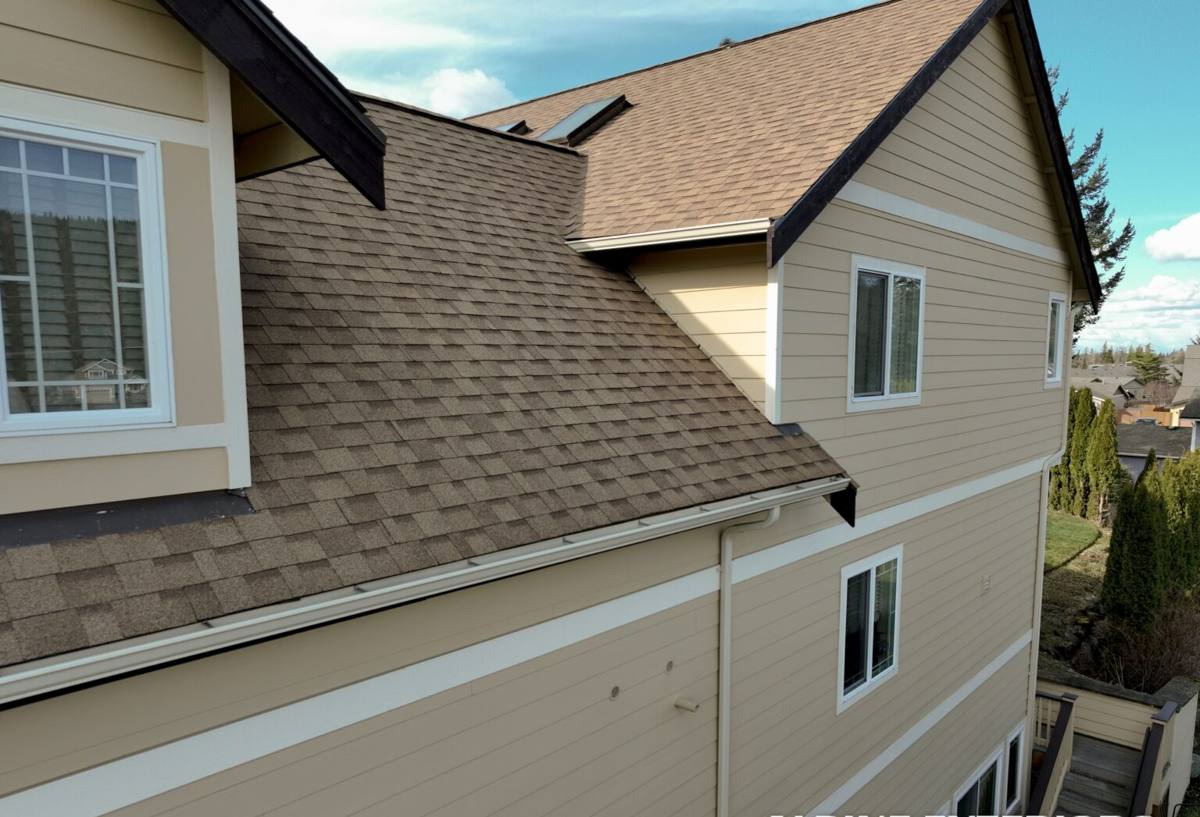
What Salt Air, Rain, and Moss Actually Do to a Wall
Salt Air
Airborne salt is corrosive to metal fasteners, flashing, and trim, and it degrades cheaper paint finishes faster than inland UV exposure alone would. Siding that relies on a field-applied paint job — rather than a factory-baked finish — tends to chalk, fade, and lose adhesion sooner in a salt-air environment because the coating itself wasn't engineered for it.
Driving Rain
Wind-driven rain doesn't just fall on a wall, it gets pushed into every seam, lap, and penetration. A siding system is only as good as its weakest joint. If water finds its way behind the cladding and the wall assembly can't dry out, you get rot in the sheathing and framing long before the siding itself looks like a problem from the curb.
Moss and Sustained Moisture
Shaded elevations, north-facing walls, and anything near mature trees or hedgerows stay damp longer here than most homeowners expect. Organic growth on siding isn't just cosmetic — sustained moisture sitting against a wall accelerates whatever underlying moisture problem already exists, and it's a strong visual signal that a section of siding isn't drying properly between rain events.
Why We Standardized on James Hardie for This Area
James Hardie fiber cement is cement, sand, and cellulose fiber — it doesn't rot, it isn't a food source for moss and mildew the way wood-based products can be, and it holds up to sustained damp exposure far better than materials with organic content in their core. It's also non-combustible, which matters given how dry late summers have trended in this region even with a wet winter climate overall.
The factory-applied ColorPlus finish is the other half of the equation. It's baked on under controlled conditions rather than brushed or sprayed on site, so it resists fading, chalking, and chipping better than field-applied paint — which matters directly in a salt-air environment where field finishes work harder and fail sooner. Hardie backs the finish and the substrate with a strong transferable warranty, but that warranty is only meaningful if the installation itself is done to spec. That's the part most siding failures actually trace back to.
Product Lines We Use
| Hardie Line | What It's For | Why It Fits This Area |
|---|---|---|
| HZ5 (HardieZone 5) | Engineered for cold, wet climates | Matches the Pacific Northwest moisture and freeze-thaw pattern better than a generic warm-climate formulation |
| HardiePlank Lap Siding | Primary wall cladding | Most common profile for the traditional home styles seen throughout Whatcom County |
| HardieTrim & HardieSoffit | Trim, fascia, soffit detailing | Keeps the entire building envelope on one non-combustible, moisture-stable material system rather than mixing in wood trim that will fail on a different timeline |
What a Correct Installation Involves
The material is only half the job. Most premature siding failures we get called out to inspect — regardless of brand — trace back to installation shortcuts, not the product itself. For a Custer home, a correct install means:
- A drainage plane and weather-resistive barrier installed and lapped correctly, so any water that gets behind the cladding has somewhere to go
- Proper flashing at every window, door, and roof-to-wall intersection — the highest-risk spots for driving-rain intrusion
- Correct fastener type, spacing, and penetration depth per Hardie's published installation specs, not generalized "siding nailing" habits carried over from other materials
- Manufacturer-specified clearances at grade, roofline, and deck ledgers so the bottom edge of the siding isn't sitting in standing moisture or splash-back
- Butt joints and laps sealed and shimmed to Hardie spec, not just caulked over gaps
- Painted or factory-finished cut edges sealed before installation, since an exposed cut edge is the single most common point where moisture starts working into fiber cement
Skip any one of those and you can end up with a wall that looks right for a year or two and then starts showing problems at exactly the joints and penetrations that Custer's rain patterns stress the hardest.
Our Process on a Custer Job
- Walk and assess: we look at the existing siding, the wall assembly behind it where accessible, moss and moisture patterns on each elevation, and any trouble spots at windows, decks, and rooflines.
- Honest scope: we tell you what's actually needed — full replacement, or repair where the underlying wall is sound and only sections are compromised. We don't upsell a full tear-off if it isn't warranted.
- Prep and moisture check: old siding comes off, sheathing gets inspected for hidden rot before anything new goes up. This is the step that gets skipped when a crew is rushing, and it's the one that determines whether the new siding lasts.
- Install to Hardie spec: weather barrier, flashing, fastening, clearances, and joint treatment done per manufacturer requirements — not shortcuts.
- Final walk-through: we go over the finished job with you before we consider it done.
Why a Crew That Already Works This Area Matters
A contractor who works Ferndale and the surrounding Whatcom County communities regularly already has a feel for how a given elevation on a given lot type behaves — which walls stay damp longer, where moss shows up first, how driving rain tends to hit a typical north-county property line. That's not a substitute for doing the flashing and fastening correctly, but it does mean fewer surprises and a scope estimate that reflects reality rather than a generic checklist. It also means someone local is easy to reach if a question comes up two years after the job is done, rather than chasing down a crew that was only in the area for one project.
Cost Factors Homeowners Should Understand Upfront
| Factor | Why It Moves the Number |
|---|---|
| Full tear-off vs. sections | Removing and disposing of old siding, and repairing any hidden sheathing damage, adds labor beyond the visible siding cost |
| Home size and wall complexity | More corners, dormers, and roof-to-wall intersections mean more flashing and cutting time |
| Trim scope | Replacing trim, fascia, and soffit alongside the field siding keeps the whole envelope on one material and finish, but adds to the total |
| Color and profile | Factory ColorPlus finishes and certain plank profiles carry different material costs than standard options |
| Site access | Tree cover, fencing, or tight lot lines around a property affect staging and labor time |
We give straightforward, itemized estimates rather than a single lump number, so you can see what's driving the cost and where there's flexibility.
Signs a Custer Home May Need Siding Attention Soon
- Persistent moss or dark streaking on shaded or north-facing walls that keeps coming back after cleaning
- Paint that's chalking, peeling, or fading unevenly, especially on elevations exposed to prevailing wind and rain
- Soft spots, bubbling, or visible warping near window sills, deck ledgers, or where the siding meets the foundation
- Visible gaps at seams, corners, or trim that weren't there when the home was built or last re-sided
- Rising heating costs or drafts that suggest the wall assembly behind the siding isn't sealing the way it should
Any one of these on its own isn't necessarily an emergency, but it's worth having someone who knows what to look for take a look before a small issue turns into sheathing repair.
Ready to Talk Through Your Home
If you're in Custer or elsewhere around Ferndale and want a straight read on what your siding needs — whether that's a full James Hardie replacement or just an honest second opinion — we're glad to come take a look. Use the form below for a free, no-pressure estimate.