 Ferndale Siding
 Windows Built for How Everson Actually Weathers
Everson sits inland from the coastline, but that doesn't mean the coast doesn't reach it. Marine air moves through Whatcom County on a regular basis, and even miles from saltwater, that air carries moisture and a fine mineral residue that finds its way into window hardware, weep holes, and frame seams over time. Combine that with the driving rain that comes off the Pacific through the fall and winter, plus a moss season that can stretch for months in shaded, damp yards, and you have a climate that is genuinely hard on window assemblies — not because any one factor is extreme, but because the combination rarely lets up.
For homeowners in Everson, the practical result is that windows don't just need to look good and keep a draft out. They need frames, seals, and flashing details that hold up to sustained dampness without trapping moisture against wood trim or siding. That's a different design problem than what you'd solve in a dry climate, and it changes how we spec and install every window we put in.
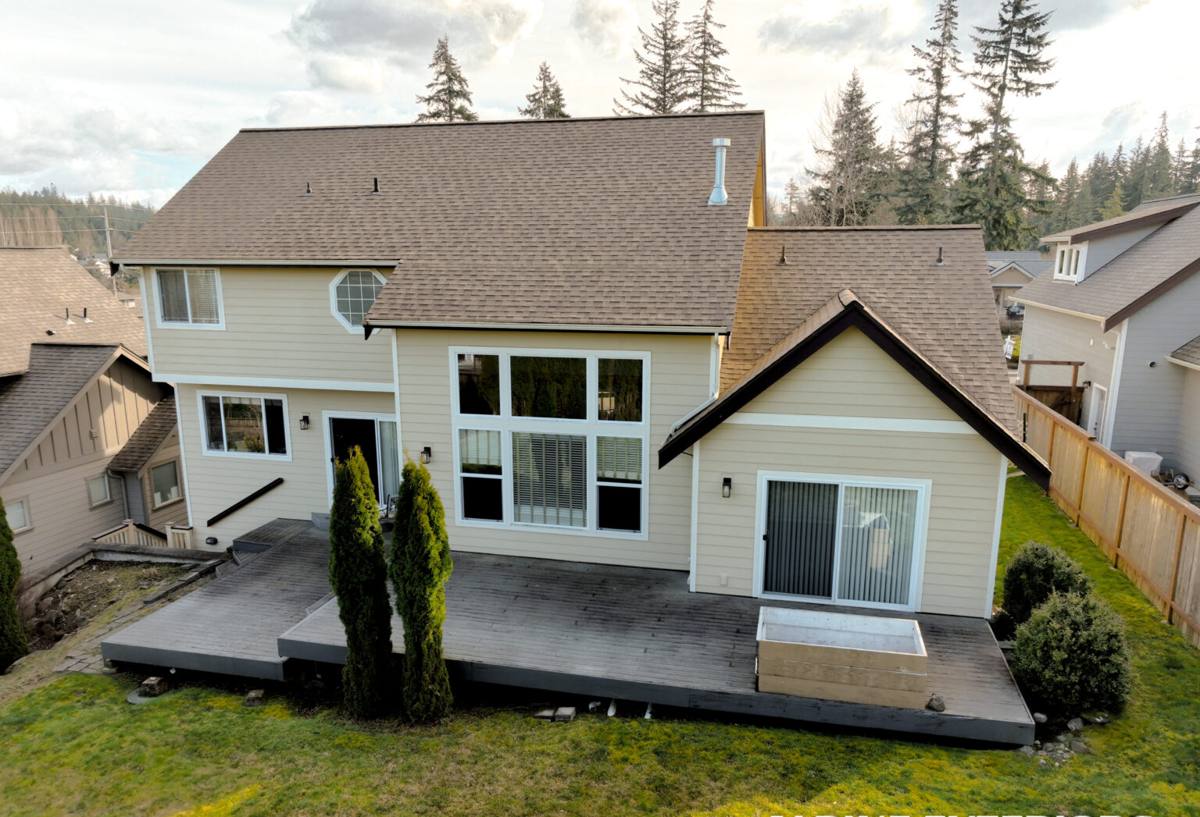
What This Climate Does to an Underperforming Window
Most window failures we see in this part of the county aren't dramatic. They're slow. A few patterns show up again and again in homes around Everson:
- Condensation building up between panes, a sign the seal has failed and the insulating gas has escaped
- Soft or discolored trim below a window, usually from water tracking down the frame instead of shedding away from the wall
- Moss or green film collecting in the frame corners and sill, which holds moisture against the material longer than open air would
- Drafts that show up specifically during wind-driven rain, not on calm days — a sign the weatherstripping or flashing is failing under pressure, not just sitting still
- Noticeably higher heating bills through the cold months, even though the house "feels" fine
None of these show up overnight. They build over several wet seasons, which is why a lot of Everson homeowners don't realize how much an old or poorly installed window is costing them until they compare it to a properly sealed one.
Choosing the Right Window for a Wet, Humid Climate
There isn't one "best" window for every house — it depends on the home's age, exposure, and budget. But in Whatcom County, frame material and glass package matter more than in drier regions, because they determine how the window handles years of sustained moisture rather than just occasional weather.
| Frame Material | How It Handles This Climate | Trade-Offs |
|---|---|---|
| Vinyl | Won't rot; handles moisture well; good value | Can expand/contract with temperature swings if poorly installed; quality varies widely by manufacturer |
| Fiberglass | Very stable in wet, variable weather; strong long-term seal performance | Higher upfront cost than vinyl |
| Wood-clad | Classic look for older Everson farmhouses; clad exterior protects the wood | Requires the cladding and seals to be flawless — any gap invites moisture into the wood core |
| Aluminum | Durable and low-maintenance | Poor insulator on its own; needs a thermal break to perform in this climate |
On glass, we generally recommend double-pane windows with a low-E coating and an argon fill as the baseline for this region, moving to triple-pane on north-facing walls or homes with higher heating costs. The low-E coating matters as much for keeping summer heat gain manageable as it does for retaining winter warmth — Whatcom County gets both extremes, just not for long stretches at a time.
U-Factor and Solar Heat Gain
Two numbers matter more than any marketing label: U-factor (how well the window resists heat transfer — lower is better) and Solar Heat Gain Coefficient (how much solar heat passes through — lower means less heat gain). For our climate, we typically steer homeowners toward a lower U-factor above all else, since keeping heat in during our long damp, gray stretches saves more energy over a year than blocking summer sun does.
What a Correct Installation Actually Involves
The window itself is only part of the job. In a climate like this, the installation details determine whether a good window performs like a good window for the next 20 years or fails early because water got behind it. A correct installation includes:
- Removing the old window and inspecting the rough opening for hidden rot or water damage before anything new goes in
- Installing (or repairing) proper flashing at the head, sides, and sill so water is directed out and away from the wall assembly, not into it
- Applying a continuous weather-resistant barrier that ties into the home's existing house wrap or siding system, with no gaps
- Setting the window level, plumb, and square — even a slight misalignment stresses seals and shortens their life
- Insulating the gap between the window frame and rough opening without over-packing it, which can bow the frame
- Sealing the interior and exterior with the right sealant for the material — not a one-size-fits-all caulk
- Reinstalling or replacing trim so it sheds water instead of holding it against the frame
Skipping any one of these steps is how a quality window ends up with a moisture problem within a few wet seasons — the window gets blamed, but the installation was the actual failure point.
Our Process, Start to Finish
1. On-Site Assessment
We look at your current windows, the condition of the surrounding trim and siding, and how your home is oriented to wind and rain exposure. This tells us where you're losing the most energy and which openings need the most attention to flashing and water management.
2. Product Selection
We walk through frame material, glass package, and style options based on your home's age, your budget, and how the window will actually perform in Everson's conditions — not just how it performs on a spec sheet.
3. Removal and Inspection
Old windows come out carefully so we can check the framing underneath. If we find rot or water damage, we address it before a new window ever goes in — installing over a compromised opening just hides the problem.
4. Flashing, Sealing, and Installation
This is where most of the long-term performance is decided. We flash and seal each opening to manage water properly, set the window correctly, and insulate around the frame.
5. Trim and Siding Integration
We finish the exterior so the window ties cleanly into your siding and trim, both for appearance and for water management — a poorly integrated trim detail is a common source of future leaks.
6. Walkthrough and Cleanup
We check operation on every window, confirm seals and locks work as they should, and clean up the job site before we consider it done.
Why Siding Integration Matters More Than Homeowners Expect
Windows don't function in isolation — they're part of your home's exterior envelope, and the point where a window meets your siding is one of the most common places for water intrusion if it's not handled correctly. Because we work on siding and windows together, we install windows with the surrounding wall assembly in mind, not just the opening itself. That's a real advantage over a window-only crew that treats the rough opening as a standalone problem, then leaves the siding tie-in to whoever comes along afterward.
Why It Helps to Hire a Crew That Already Works in Everson
Everson has a mix of older farmhouses, mid-century homes, and newer construction, and each brings different challenges — original wood-frame openings that have shifted slightly over the decades, older siding materials that need careful tie-in work, or newer homes where the main issue is simply upgrading to better-performing glass. A crew that regularly works this area has already seen the common construction patterns and moisture issues specific to Whatcom County, rather than learning them on your project. We also know the realities of scheduling around this region's weather — timing exterior work for the drier windows in the calendar, and not leaving an opening exposed to a rain system longer than necessary.
Get a Straight Answer on What Your Home Needs
If your windows are drafty, fogging between the panes, or just old enough that you're wondering whether they're costing you more than they're worth, we're happy to take a look. We'll give you a clear, honest read on what's going on and what it would take to fix it — no pressure, no upsell. Reach out using the form below for a free estimate.