 Ferndale Siding
 Lummi Island Decks Face a Different Set of Problems
A deck built for a typical inland yard doesn't automatically hold up on Lummi Island. Between the salt air coming off the water, the driving rain that Whatcom County sees for months at a stretch, and a moss season that can run from fall through spring, an outdoor structure here is under near-constant load from moisture and airborne salt. None of that is dramatic on its own. It's the accumulation, year after year, that separates a deck that still looks and feels solid at year fifteen from one that's soft underfoot and full of loose fasteners by year seven.
This page is about deck building specifically for Lummi Island properties — what the local conditions actually demand, what a correctly built deck looks like, and how we approach the work when a job is on the island rather than on the mainland side of Ferndale.
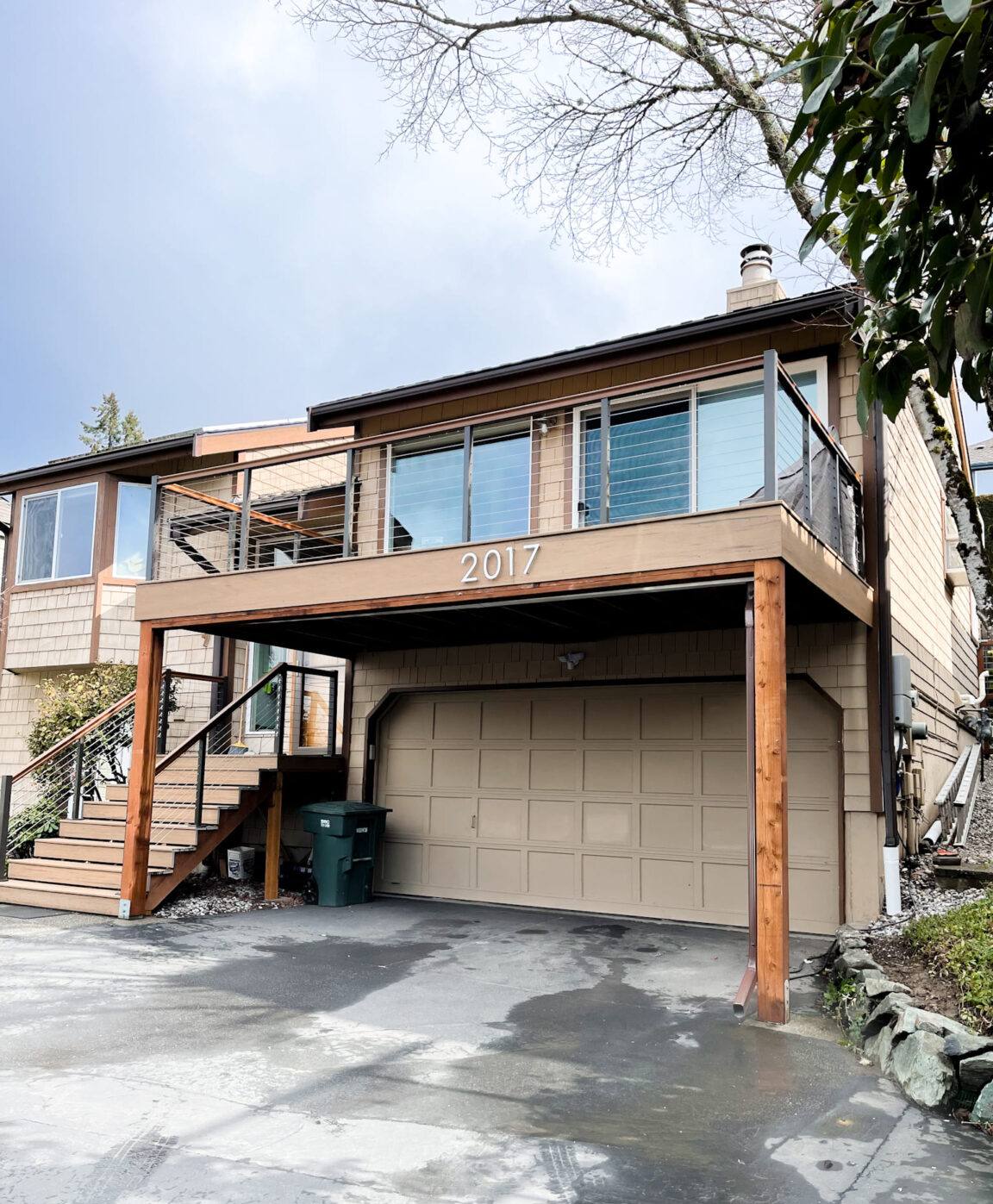
What Salt Air Actually Does to a Deck
Salt air isn't just "humid air." It carries fine salt particles that settle on every exposed surface, including ones that never get rained on directly, like the undersides of railings or the tops of joists in a covered area. Over time that salt accelerates corrosion on anything metal and can dull or degrade some coatings and finishes faster than the manufacturer's stated lifespan would suggest inland.
Fasteners and Hardware
This is the single biggest point of failure we see on decks near the water. Standard hot-dip galvanized fasteners can start showing rust streaks and pitting well before a wood deck's boards are due for replacement. Structural connectors — joist hangers, post bases, ledger bolts — need a corrosion rating that matches a marine or coastal environment, not just a generic exterior rating. We spec stainless steel or high-grade coated fasteners and connectors for anything on Lummi Island, full stop. It costs more up front. It's cheap compared to a deck that needs its structural hardware replaced in year eight.
Framing and Ledger Connections
The ledger board — where the deck attaches to the house — is the most common source of serious deck failures nationwide, and salt air combined with driving rain makes proper flashing and waterproofing even more important here. Water that gets behind a poorly flashed ledger doesn't dry out quickly in this climate. It sits, and it rots the framing from the inside where you can't see it until the deck starts to feel spongy.
Choosing a Decking Material for This Climate
There's no single "best" decking material for every budget, but on Lummi Island the material decision matters more than it does in a drier, inland location. Here's an honest comparison of the common options as they actually perform under salt air, driving rain, and moss exposure:
| Material | Salt Air / Moisture Performance | Moss & Algae Resistance | Maintenance Burden |
|---|---|---|---|
| Pressure-treated wood | Good if fasteners and flashing are correct; wood itself handles moisture cycling reasonably well | Low — moss takes hold quickly on shaded, damp boards | Regular cleaning, periodic sealing or staining |
| Cedar | Naturally moisture- and rot-resistant, but finish weathers faster in salt air | Moderate — still needs cleaning in shaded areas | Refinishing on a cycle to maintain appearance |
| Capped composite | Excellent — doesn't absorb moisture or salt into the core | Better than wood, though surface grime and moss can still build up in shaded spots | Low — occasional washing |
| PVC decking | Excellent — fully synthetic, no wood fibers to hold moisture | Best of the group, but not immune in deep shade | Lowest — occasional washing |
We don't push one material on every homeowner. A well-built, properly fastened pressure-treated deck can serve a Lummi Island home well for decades if it's maintained. But if you want the lowest-maintenance option and the budget allows for it, composite or PVC decking earns its higher upfront cost back in avoided sanding, sealing, and refinishing over the years — especially on a shaded, north-facing, or heavily wooded lot where moss and algae are a constant issue.
Moss Season and Ongoing Surface Care
Whatcom County's moss season is long, and Lummi Island's tree cover and moisture make it worse in shaded areas than you'd see on an open, sun-exposed mainland lot. Moss on a deck surface isn't just cosmetic — it holds moisture against the boards and becomes genuinely slick and dangerous underfoot, particularly on stairs.
A few things reduce how bad this gets:
- Proper board spacing so water and debris drain through rather than pooling
- Keeping overhanging branches trimmed back where practical, since shade and leaf litter both feed moss growth
- Periodic cleaning with a deck-safe cleaner rather than a pressure washer alone, which can damage wood fibers and composite surfaces if used incorrectly
- Choosing a decking material and finish that resists moss growth if the deck sits in heavy shade
None of this eliminates the need for maintenance entirely, but it's the difference between an annual cleaning and a deck that needs boards replaced because moss has been holding moisture against them for years.
Building on an Island: What Changes About the Job
Lummi Island is reached by ferry, and that shapes how a deck project actually runs in ways that don't apply on the mainland side of Ferndale. Material deliveries, equipment, and crew all move on the ferry schedule, not on demand. A crew unfamiliar with that reality can end up with a job stretched out by days waiting on a materials run that missed the last sailing, or a schedule that assumes mainland logistics.
We plan around this rather than discovering it mid-project — ordering materials with enough lead time, batching trips so the crew and equipment aren't making unnecessary round trips, and setting a realistic timeline with the homeowner up front instead of an optimistic one that slips.
Permitting and Shoreline Considerations
Whatcom County requires permits for most new deck construction and significant deck rebuilds, and Lummi Island's shoreline-adjacent lots can bring additional review depending on proximity to the water, setback requirements, and slope. We don't guess on this — we pull the specifics for your parcel before design work goes final, so the deck you plan for is the deck you're actually allowed to build in that location. Skipping this step is how homeowners end up with a finished deck that has to be modified or partially removed after the fact.
Our Process
The steps are the same whether the site is on the mainland or the island, but the details of execution change based on what a Lummi Island site actually requires:
- Site visit and assessment — we look at sun/shade exposure, drainage, wind exposure, and how close the structure will be to salt water, since all of that affects material and hardware choices.
- Design and material selection — sized to your budget and how much maintenance you want to take on long-term, not a one-size-fits-all package.
- Permit check — confirming setback and shoreline requirements before we finalize the plan.
- Structural build — footings, framing, and ledger flashing done to hold up under sustained moisture, with corrosion-rated fasteners and hardware throughout.
- Decking and railing installation — installed with the drainage and spacing details that matter for moss and water management in this climate.
- Final walkthrough — including a plain-language explanation of what maintenance the deck will actually need, and when.
Signs an Existing Deck Needs Attention
If you're not building new but wondering whether your current Lummi Island deck needs work, these are the signs worth taking seriously:
- Soft or spongy spots underfoot, especially near the house connection
- Rust streaks running down from fasteners or metal hardware
- Persistent moss or dark staining that comes back quickly after cleaning
- Railings or posts that feel loose or wobble under pressure
- Gaps or separation where the deck meets the house
- Visible corrosion on joist hangers or other structural connectors, if you can see underneath
Any of these on their own might be minor. Several together usually mean it's time for a real inspection rather than a patch.
Why It Matters Who Builds It
A deck contractor who mostly works inland jobs in Bellingham or Ferndale proper isn't wrong about deck building in general — but they may not default to marine-grade fasteners, they may not have a routine for ferry-dependent material scheduling, and they may not know offhand what Whatcom County expects for a shoreline-adjacent parcel. None of that is a knock on their skill. It's just a different set of defaults than a crew that regularly works Lummi Island builds in.
We treat the salt air, the rain exposure, and the island logistics as standard parts of the job here, not surprises to work around mid-project. That's the difference that shows up years later, not on the day the deck is finished.
If you're planning a new deck or need an honest read on an existing one, we're happy to come out for a free, no-pressure estimate — just fill out the form below.