 Ferndale Siding
 Deck Replacement Built for Lummi Island's Marine Climate
Lummi Island sits out in the Salish Sea, and that changes how a deck ages compared to one built a few miles inland in Ferndale or Bellingham. Salt-laden air off the water accelerates corrosion on fasteners and hardware, driving rain gets pushed sideways into ledger boards and railing joints by wind off the strait, and the shaded, damp conditions common on wooded island lots keep moss and algae established on deck surfaces for a large part of the year. A deck built to a generic spec, without those conditions in mind, tends to show fastener bleed, soft framing, and slick, moss-stained boards years before it should. Replacing a deck out here isn't just swapping old boards for new ones — it's an opportunity to correct whatever the original build didn't account for.
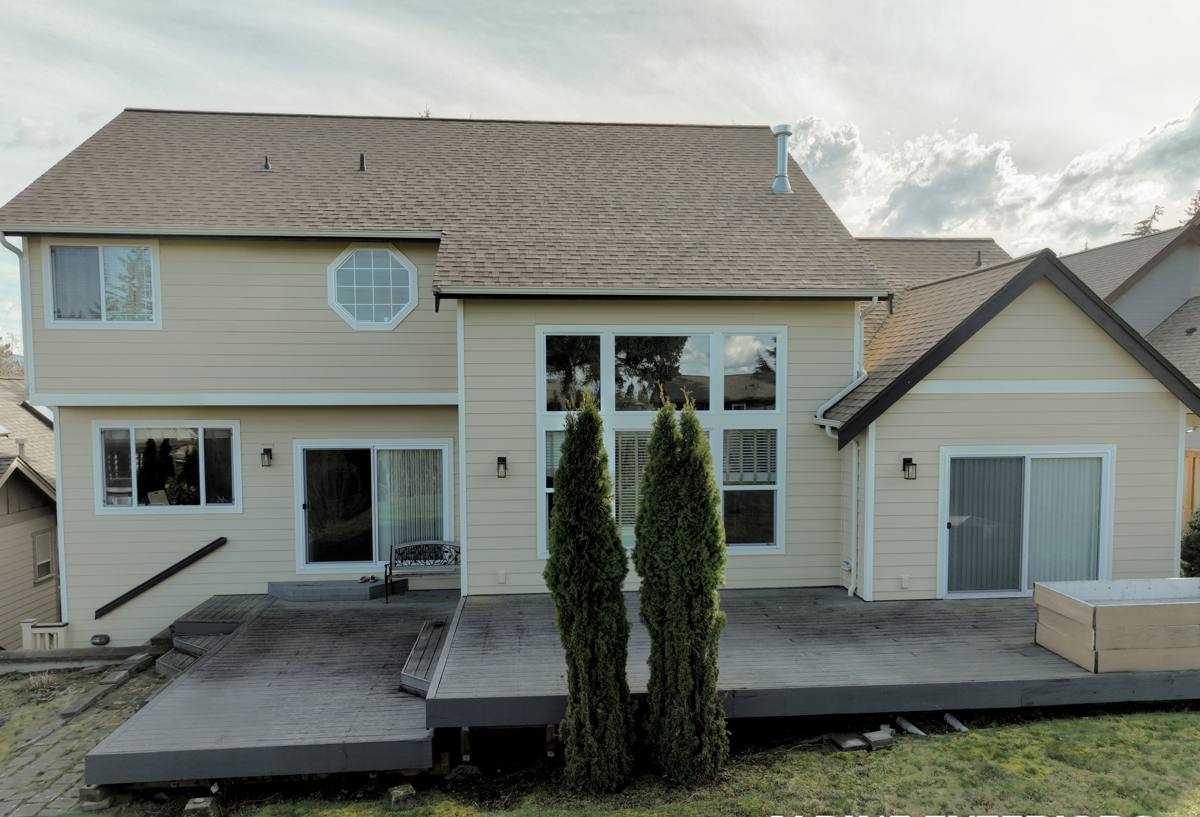
Signs a Lummi Island Deck Needs Replacement, Not Just Repair
Not every tired-looking deck needs to come out entirely. But there's a point where patching stops making sense, and on the island that point usually shows up earlier than homeowners expect because of the exposure. Watch for these:
- Soft or spongy spots in decking boards, especially near the house or in shaded corners where moisture sits longest
- Rust streaking or corroded, loose fasteners — a strong sign in a salt-air environment that hardware is failing faster than the wood around it
- A ledger board connection (where the deck meets the house) that shows staining, gaps, or soft wood — this is the single most safety-critical joint on any deck
- Persistent black or green staining that pressure washing no longer removes, meaning moss and algae have gotten into the wood grain itself
- Railings or posts that flex or wobble under load, which usually points to post-base or footing failure rather than a cosmetic issue
- A structure that's simply reached the end of its practical life — older pressure-treated framing exposed to decades of driving rain and salt air doesn't owe anyone more years of service
If what you're seeing is limited to a handful of boards and the framing underneath tests solid, repair may still be the right call. Replacement becomes the honest recommendation once the framing, ledger, or footings are in question, because layering new boards over compromised structure just hides the problem for another season.
What a Correct Deck Replacement Actually Involves
A full deck replacement is more than a materials swap. Done right, it includes:
- Complete removal of the old decking, railing, and — where needed — framing, with an honest assessment of what's actually reusable versus what's compromised
- Inspection and, where necessary, replacement of the ledger board and its flashing, since this connection carries structural load and is the most common point of water intrusion
- Verification or upgrade of footings and post bases to current structural standards, particularly important on sloped or wooded island lots where soil drainage varies
- Framing built or reinforced with corrosion-resistant fasteners and connectors suited to a marine-influenced environment
- Proper flashing and water management at every point where the deck meets the house, not just cosmetic trim
- Decking and railing installed to manufacturer spacing and fastening specs, which matters more in a climate with heavy seasonal wood movement
Skipping any of these steps is how a deck ends up needing major work again in eight or ten years instead of twenty-five or thirty.
Decking Material Options for Island Exposure
Material choice matters more here than in a drier, more sheltered part of Whatcom County. The table below reflects how common decking materials actually hold up under salt air, driving rain, and a long moss season — not just their price tag.
| Material | Moisture & Salt Air Behavior | Moss/Algae Resistance | Maintenance | Typical Lifespan |
|---|---|---|---|---|
| Pressure-treated lumber | Prone to checking and warping with repeated wet-dry cycling | Low — needs regular cleaning and sealing | Annual cleaning, periodic sealing/staining | 10-15 years in this climate |
| Cedar | Naturally rot-resistant, but softens over time under constant moisture | Moderate — still requires cleaning | Regular cleaning, periodic oil/stain | 15-20 years with upkeep |
| Composite decking | Doesn't absorb moisture or swell like wood | Higher — smooth-cap boards shed moss more easily than wood grain | Periodic washing, no sealing/staining | 25-30+ years, brand-dependent |
| Tropical hardwood | Very dense, handles moisture well | Moderate to high depending on species | Occasional oiling to maintain color | 20-25+ years |
There's no single "correct" answer for every home — a covered, wind-sheltered deck can get more life out of wood than an exposed one facing open water. We'll walk your specific site conditions with you rather than defaulting to one product for every job.
Why We're Selective About Certain Products
Some lower-tier composite and capped-polymer products look fine in a showroom but haven't held up well in our experience under sustained coastal moisture and UV exposure — surface delamination and color fade show up faster than the warranty language suggests. Our standard is to install product lines with a track record we trust in this specific climate, even if that means steering a homeowner away from the cheapest option on the shelf. It's a maintenance and longevity call, not a knock on any brand by name.
Framing and Fasteners: Where Salt Air Does the Real Damage
Homeowners naturally focus on the decking surface, but on Lummi Island the framing and hardware underneath are usually what fail first. Standard electro-galvanized fasteners and connectors corrode noticeably faster in salt-influenced air than they do a few miles inland. We spec hot-dip galvanized or stainless-steel fasteners, joist hangers, and structural screws for island work, along with corrosion-resistant flashing tape at the ledger and any framing penetrations. It costs more up front than standard hardware, but replacing rusted-through joist hangers in year twelve is a far bigger expense — and a bigger risk — than paying for the right hardware in year one.
Our Deck Replacement Process
Every project starts with an on-site look at the existing deck, not a phone estimate, because framing condition and site exposure vary a lot from lot to lot on the island. From there:
- Assessment — we inspect decking, framing, ledger, and footings, and give you a straight read on what's salvageable and what isn't
- Design and material selection — we go over decking, railing, and layout options based on your home, your budget, and how exposed the site is
- Permitting — most deck replacements in unincorporated Whatcom County require a permit, especially when framing, footings, or elevated structure is involved; we handle that process
- Demolition and framing — old material comes out, structure gets rebuilt or reinforced to current code with marine-grade hardware
- Decking, railing, and finish work — installed to spec, with attention to fastening patterns and expansion gaps appropriate to the material
- Final walkthrough — we go over care and maintenance for whatever material you chose before we consider the job done
Logistics on the Island
Working on Lummi Island means factoring in ferry scheduling for material deliveries and crew access, which we build into project timelines up front rather than treating as a surprise mid-project. It's part of why working with a crew that already does regular work out here, instead of one quoting the job without accounting for it, tends to keep a project on schedule.
Permits and Local Considerations
Deck replacement projects on the island generally fall under Whatcom County's permitting jurisdiction rather than the City of Ferndale, since Lummi Island is unincorporated county land. Requirements can depend on the deck's size, height off grade, and whether structural framing or footings are being altered versus a like-for-like resurface. We pull and manage the necessary permits as part of the job so you're not left navigating that process solo.
Maintenance That Actually Matters Here
Whatever material you choose, a few habits go a long way toward getting the full expected lifespan out of a Lummi Island deck:
- Rinse salt residue and organic debris off the surface a few times a year, not just once in the spring
- Keep gutters and downspouts near the deck clear so runoff isn't dumping directly onto framing or ledger connections
- Sweep leaves and needles out of corners and against the house before they trap moisture and feed moss growth
- Check railing posts and stair stringers annually for movement or soft wood, especially after a wet winter
- For wood decks, don't let sealing or staining lapse — it's cheaper than replacing sun- and rain-damaged boards early
- Have framing and the ledger connection looked at every few years, since that's the area most likely to fail quietly, out of sight under the decking
Why Hire a Crew That Already Works on Lummi Island
A deck built to a standard spec, without accounting for salt air, wind-driven rain, and a long moss season, is a deck that will need real work again sooner than it should. We build Ferndale and Whatcom County exterior projects with those conditions as the baseline, not an afterthought, and we've priced in the realities of island logistics — ferry scheduling, material staging, access — so a Lummi Island job runs on the timeline we quote. That's the difference between a deck that looks good for a season and one that actually holds up out here.
If your deck is showing its age or you're planning a replacement, we're happy to come out, take an honest look, and put together a free, no-pressure estimate. Use the form below to get started.