 Ferndale Siding
 Siding Repair in Blaine Isn't Just Patch-and-Paint
We're based just down the road in Ferndale, and Blaine is regular territory for our crew — enough of it that siding repair calls there follow patterns we recognize before we even get out of the truck. A cracked panel near grade, rust bleeding from a fastener line, a soft spot below a window: on most Blaine homes, those aren't random. They trace back to the same three things every house on this stretch of coast deals with — salt air off the water, rain that arrives sideways instead of straight down, and a moss season that runs most of the year on anything that stays damp. Repair work that doesn't account for why the damage happened in the first place tends to come back, sometimes within a single wet season.
This page is specifically about repair — fixing damaged sections of existing siding — not a full re-side. We install James Hardie fiber cement exclusively on new work and full replacements, for reasons we're upfront about on other pages of this site. Repair calls are different: they come to us on homes sided in whatever was on the house when the damage started, Hardie included, and sometimes something else. We'll always give an honest read on whether a section repair is the right move or whether the smarter long-term call is a broader conversation about replacement, rather than quietly patching a system that's already past the point where patching makes sense.
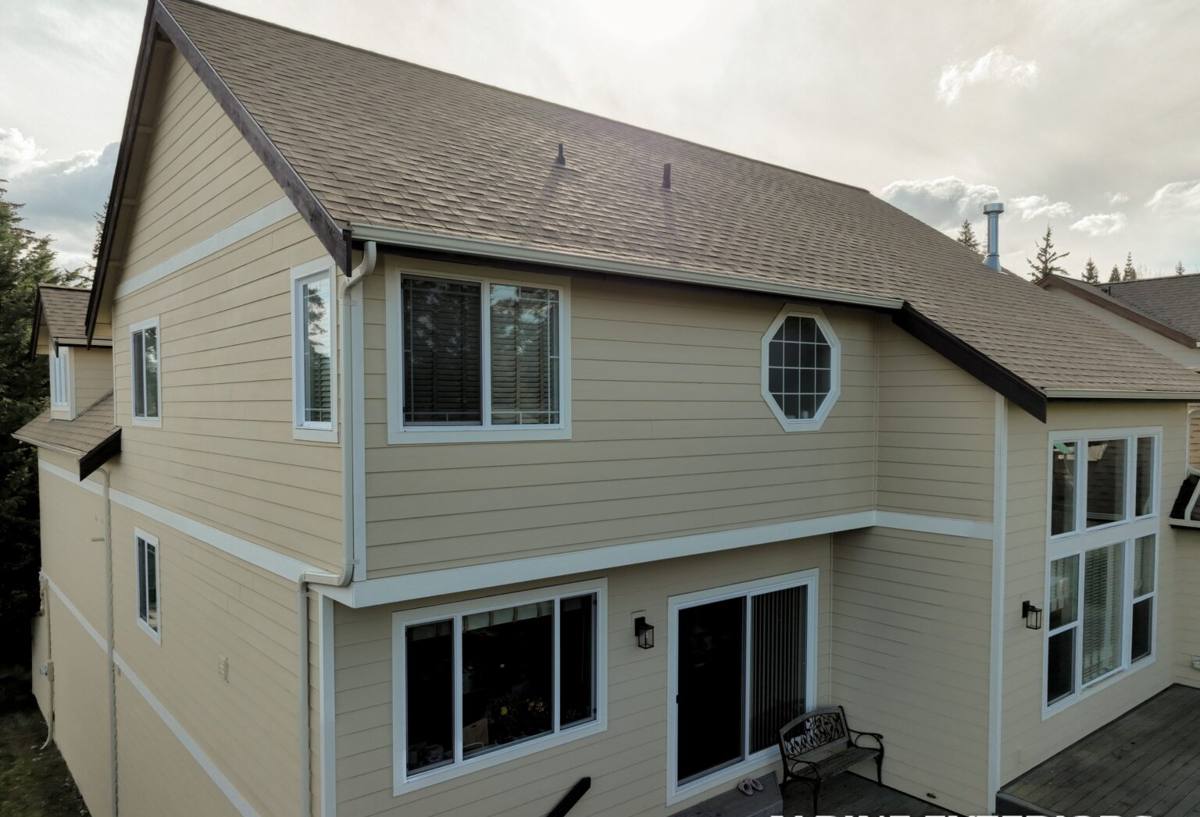
What Blaine's Climate Does to Siding That's Already Damaged
Salt Air Attacks the Weak Point First
Intact siding sheds salt-laden air reasonably well; damaged siding doesn't. Once a panel is cracked, a fastener has backed out, or a seam has opened up, that break becomes the point where corrosion and material breakdown concentrate fastest. Homes close to the water in Blaine see this compress a small, cosmetic issue into a real problem in a shorter window than the same damage would take inland.
Wind-Driven Rain Exploits Existing Gaps
Storms off the water don't just add rainfall — they add wind that forces water sideways into whatever opening it can find. A crack or gap that would stay mostly dry in a calmer climate becomes an active moisture pathway in Blaine, because the rain arrives with enough force behind it to get pushed through rather than just running past. That's a big part of why minor damage here often needs attention sooner than a homeowner might expect.
Moss and Trapped Moisture Behind a Compromised Panel
A damaged panel usually means the drainage gap and water-resistive barrier behind it are compromised too, even if that's not visible from the ground. Once moisture gets trapped there, mild temperatures and near-constant dampness give moss and mildew a foothold behind the siding, not just on top of it. Left alone, that's the kind of damage that keeps expanding quietly until a much bigger section needs attention than the original crack ever suggested.
Repair or Replace: How We Make the Call
When a Section Repair Makes Sense
Isolated damage — a handful of panels, a single wall section, damage tied to one clear cause like an impact or a failed piece of flashing — is usually a good repair candidate, provided the sheathing behind it is still sound and the surrounding siding is in reasonable shape. Most of the repair calls we get in Blaine fall into this category, and there's no reason to push a homeowner toward a bigger job than the house actually needs.
When the Damage Signals a Bigger Problem
Repair stops being the right answer when damage shows up in multiple, unrelated spots; when we open one section and find the sheathing or barrier compromised well beyond the visible break; or when the existing siding is an older material — cedar, older vinyl, an aging fiber cement product — that's simply reaching the end of what it can be expected to do in this climate. In those cases we'll say so plainly and talk through what a full re-side with James Hardie would look like, rather than billing for repair after repair on a system that's past the point of good returns.
What a Correct Repair Actually Involves
Finding the Real Extent of the Damage
The visible crack or stain is rarely the whole story. A correct repair starts by opening up the area — pulling the affected panel or panels — to see what's actually happening behind them before quoting a scope of work. Guessing at scope from the outside is how a homeowner ends up paying for a second repair a year later.
Matching the Existing Siding
Matching a repair to what's already on the wall is harder than it sounds. James Hardie's ColorPlus finishes and panel profiles change over a product's run, and older siding — Hardie or otherwise — may not have an exact match available anymore. We source the closest reasonable match, tell homeowners honestly when a perfect match isn't realistic, and if the mismatch would be too visible to live with, we'll say so and talk through whether a wider section, or eventually a full wall, makes more sense than a patch that stands out every time the light hits it.
Sealing, Flashing, and Fastening the Repair Correctly
A repair only holds up if it follows the same standards a full installation would: corrosion-resistant fasteners at the correct spacing, proper clearance at grade and trim, and every field-cut edge sealed before it goes back on the wall. A repair that skips these details to save time tends to fail again faster than the original damage did, because the same climate that caused the first problem is still working on the house.
Confirming the Sheathing and Barrier Behind It
With the panel off, we check the sheathing and water-resistive barrier underneath for rot, staining, or gaps in the barrier's lap. Fixing that layer while the wall is already open costs far less than dealing with it later as its own separate problem, and skipping that check is one of the more common ways a "finished" repair turns out not to be finished at all.
Common Blaine Repair Scenarios
| What a Homeowner Sees | Likely Cause | Typical Repair Scope |
|---|---|---|
| Cracked or chipped panel low on the wall | Impact damage, or long-term moisture wicking at an inadequate grade clearance | Replace affected boards; correct clearance if that's the underlying cause |
| Rust streaking around fastener heads | Standard-grade hardware corroding faster in salt air | Remove and refasten with corrosion-resistant hardware to spec |
| Soft or bulging siding near a window | Failed or missing flashing letting wind-driven rain behind the panel | Open the wall, correct the flashing, replace affected siding |
| Persistent moss or dark staining in one section | Poor drainage gap or siding installed tight against trim | Correct the clearance/drainage detail, clean and reseal the section |
| A prior patch that's already failing again | Earlier repair skipped sealed cut edges or correct fasteners | Redo the repair to spec rather than patch over the old patch |
Our Repair Process, Step by Step
- On-site assessment: we look at the damage and everything around it, not just the spot the homeowner called about, since related issues often show up nearby on the same wall.
- Exploratory opening: before quoting a final scope, we pull the affected panel or panels to see what's really going on behind them.
- Scope confirmation: we explain what we found in plain terms, price only what's actually needed, and flag it honestly if we think replacement is the better long-term call.
- Repair execution: matching material goes in following the same fastening, clearance, and sealing standards as a full installation.
- Final check: we confirm the flashing and drainage detail behind the repair is correct, then walk the homeowner through what was found and what was done.
Cost Factors for a Blaine Repair
| Factor | Why It Matters |
|---|---|
| Number and location of affected panels | More panels, or damage on a hard-to-reach upper wall, add labor and staging time |
| What's found once a panel comes off | Hidden sheathing rot or a failed barrier adds scope beyond what was visible at the estimate |
| Age and availability of matching siding | Older or discontinued colors and profiles may require a wider repair to keep an even look |
| Access and weather windows | Wind off the water can limit safe staging and ladder days more than it would further inland |
| Whether the root cause gets fixed | Correcting the flashing or drainage issue behind the damage, not just replacing the panel, prevents a repeat call |
These are general drivers, not a quote — every Blaine home carries a slightly different mix of exposure, prior repairs, and existing material, so we walk the property and open up the damage before putting a real number on the work.
A Checklist for a Correctly Done Repair
Whether it's our work or a second opinion on someone else's, these are reasonable things to confirm before a siding repair is considered finished:
- Damage opened up and inspected beyond just the visible crack or stain
- Sheathing and water-resistive barrier checked, and repaired if compromised
- Replacement material matched as closely as reasonably possible in profile and finish
- Corrosion-resistant fasteners used, at the manufacturer's specified spacing
- All new cut edges sealed or primed before the panel went back on the wall
- The root cause — flashing, clearance, or drainage — addressed, not just the symptom
- A plain explanation of what was found and fixed, not just a bill
Why a Ferndale Crew That Already Works Blaine Matters
Repair work rewards local judgment more than installation does, because every repair starts with a diagnosis, not a spec sheet. A crew that regularly handles siding damage on Blaine's coastal homes has a working sense of how salt air, wind-driven rain, and a long moss season actually behave on real houses here — which cracks are cosmetic and which ones are already letting water in, when a color match is close enough to live with and when it isn't, and when a patch is honestly the wrong answer for a wall that's telling you something bigger is going on. That judgment comes from doing this work repeatedly in this specific place, not from a general repair checklist applied the same way on every job.
If you've got siding damage on a Blaine home and aren't sure whether it needs a patch, a section replacement, or a bigger conversation, we're glad to take a look. Reach out using the form below for a free, no-pressure estimate.