 Ferndale Siding
 Sudden Valley's Deck Problem Isn't Like Everywone Else's
Sudden Valley sits in a wooded, low-traffic pocket of Whatcom County, and that setting is exactly what makes decks here behave differently than decks in an open subdivision. Mature tree cover keeps yards shaded for long stretches of the day, which sounds pleasant until you realize shade means a deck surface that never fully dries out between rain events. Add in the marine air that moves through this part of Washington off Bellingham Bay and the Puget Sound system, and you get a near-constant low-grade dampness that settles into wood grain, hides under railings, and feeds moss and algae growth for most of the year.
None of this is unique to any one house. It's a function of geography: tree canopy, lake-influenced humidity, and a marine climate that delivers driving rain more often than it delivers dry wind. A deck built to a generic spec sheet — the kind sold at a big box store with installation instructions written for Arizona or Ohio — will often look fine for a year or two before the real issues show up: green film on the boards, soft spots at fastener points, and a substructure that never gets a chance to breathe.
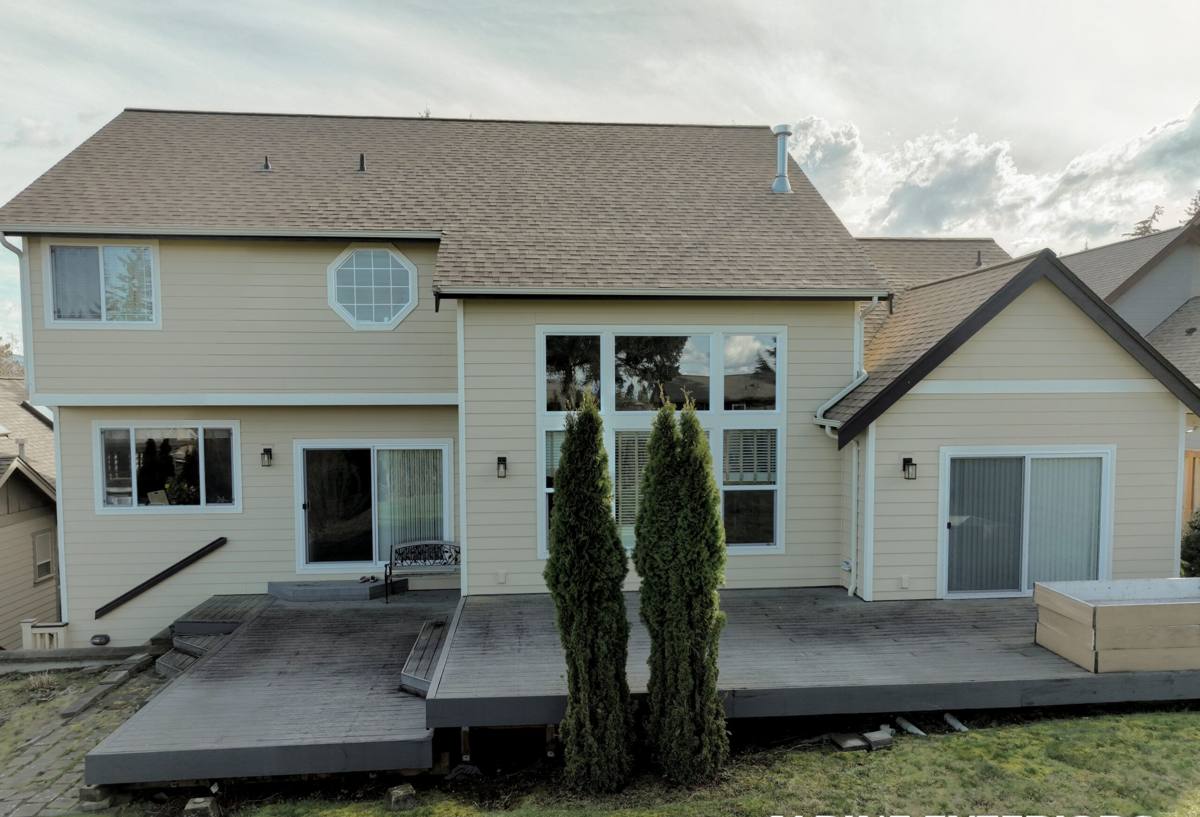
Why Composite Makes Sense Here — With Caveats
Composite decking is a strong fit for Sudden Valley precisely because it doesn't rot the way real wood does. That's the headline benefit, and it's a legitimate one. But composite is not a "install it and forget it" product in a climate like this. The boards themselves resist moisture absorption, but moss and algae don't care what the surface is made of — they'll grow on composite just as readily as on wood if the deck stays damp and shaded and airflow underneath is poor. The material solves the rot problem. It does not solve the moss problem on its own. That only gets solved with correct design: spacing, ventilation, drainage, and board selection that accounts for how much sun (or lack of it) a given deck actually gets.
We also see composite decks fail early for reasons that have nothing to do with the boards themselves — undersized joists, missing joist tape, fasteners that weren't rated for treated lumber contact, or a substructure built tight to grade with no airflow. In a drier climate those shortcuts might not show up for a decade. Here, they show up in two or three wet seasons.
Where Failures Actually Start
- Joists without protective tape, absorbing moisture from the top down where the decking traps it
- Ledger board connections without proper flashing, letting water track back into the house rim joist
- Low clearance underneath the deck, so ground moisture and moss spores have nowhere to go
- Fastener systems mismatched to the board manufacturer's spec, voiding warranty coverage without the homeowner knowing
- Board layout that ignores drainage slope, creating standing water pockets that never dry
Board Selection: Capped vs. Uncapped Composite
Not all composite is built the same, and in a shaded, damp environment like Sudden Valley the difference matters more than it would in a sunnier neighborhood. Capped composite boards have a plastic polymer shell wrapped around a wood-plastic composite core, which blocks moisture absorption into the core and gives algae and moss less to grip onto. Uncapped composite (older-generation or budget-tier product) exposes the wood-fiber core directly, and that core can absorb moisture at the surface — exactly the condition moss needs to establish.
| Factor | Capped Composite | Uncapped Composite |
|---|---|---|
| Moisture absorption at surface | Low — sealed polymer shell | Higher — exposed composite core |
| Moss/algae resistance in shade | Better, especially with textured caps | Weaker; grows faster in low-sun areas |
| Typical warranty length | 25–50 years, stain/fade coverage included | Often shorter, limited stain coverage |
| Upfront material cost | Higher | Lower |
| Long-term cleaning burden | Lower | Higher — more frequent washing needed |
For a fully shaded lot, we generally steer homeowners toward capped boards even though the upfront cost is higher. The maintenance savings over ten or fifteen years in a climate that stays damp this much of the year usually make up the difference, and it's a more honest recommendation than selling a cheaper board that will need aggressive cleaning twice a year to look decent.
Substructure: The Part Nobody Sees, and the Part That Matters Most
A composite deck is only as good as what's underneath it. In Whatcom County's wet-winter, damp-shoulder-season climate, we treat the substructure as the primary defense against long-term problems, not an afterthought hidden by the boards on top.
What a correct substructure includes
- Joist tape or equivalent protective barrier on every joist top, not just the ledger
- Proper ledger flashing where the deck attaches to the house, sloped to shed water away from the wall
- Adequate clearance between the deck framing and grade to allow airflow and drying
- Hidden fastener systems or fasteners rated specifically for the board manufacturer's requirements
- A slight, consistent slope away from the house for drainage — subtle enough you won't notice it, but enough that water doesn't pool
This is also where warranty coverage gets decided. Most composite manufacturers require specific fastener types, spacing, and substructure practices as a condition of the warranty. Skip one of those and the board warranty can be voided even though the boards themselves were never the problem.
Design Choices That Actually Fight Moss
Because so much of Sudden Valley sits under tree canopy, we build moss resistance into the design rather than treating it as a maintenance problem to solve later. That means picture-frame board orientation that encourages runoff rather than pooling, gap spacing sized correctly for drainage (not just appearance), and railing and post placement that doesn't create dead-air pockets where moisture sits. Where a deck is going into a particularly shaded corner of a lot, we'll sometimes recommend a lighter board color, since darker composite surfaces hold more surface moisture and show algae growth faster than lighter tones in low-light conditions.
We also pay attention to what's planted or growing near the deck. Overhanging branches that drop needles or leaves onto the surface accelerate moss growth by trapping organic debris against damp boards. That's not something we can redesign away, but it's worth flagging to homeowners so they know trimming back growth near the deck is part of keeping it clean, not an optional chore.
Our Process for a Sudden Valley Composite Deck
- On-site assessment — we look at sun exposure, tree cover, existing structure condition (if replacing an old deck), and drainage patterns specific to the lot.
- Board and structure recommendation — matched to how shaded and damp that particular spot actually is, not a one-size answer.
- Substructure build or repair — framing, joist protection, ledger flashing, and clearance corrected before a single composite board goes down.
- Installation — manufacturer-spec fasteners, correct gap spacing, and drainage slope built in.
- Walkthrough — we go over manufacturer warranty terms and a simple maintenance routine so there are no surprises later.
Maintenance: What Actually Keeps a Sudden Valley Deck Clean
Composite is low-maintenance compared to wood, but "low-maintenance" is not "no-maintenance" in a climate that stays damp and shaded this much of the year. A short, regular routine prevents the buildup that turns into a bigger cleaning job later.
- Sweep off leaves, needles, and debris regularly, especially through fall and into winter
- Rinse the deck surface every few weeks during the wet season to keep spores from establishing
- Clean visible moss or algae promptly with a mild soap and soft-bristle brush — avoid pressure washers on composite unless the manufacturer specifically approves it
- Keep gutters and downspouts near the deck clear so overflow isn't adding extra water onto the surface
- Trim back overhanging branches to reduce shade and debris where practical
- Check underneath the deck once or twice a year for standing moisture or blocked airflow
What Drives Cost on a Job Like This
| Cost Factor | Why It Matters in Sudden Valley |
|---|---|
| Board tier (capped vs. uncapped) | Capped boards cost more upfront but resist moss and hold warranty coverage better in shaded lots |
| Substructure condition | Older decks often need framing repair or joist protection added before new boards go on |
| Site access and slope | Wooded, sloped lots common in this area can add framing and staging time |
| Railing and fastener system | Hidden fastener systems and code-compliant railings add cost but improve long-term appearance and safety |
| Drainage and flashing work | Correcting poor drainage or missing flashing on a replacement job adds labor but prevents repeat failure |
We give homeowners a broad range early on and a firm number after the on-site assessment, because guessing at cost before seeing the actual lot and existing structure does nobody any favors.
Why It Matters That We Already Work This Area
A crew that mostly builds decks in open, sunny yards will size a Sudden Valley job the same way they'd size any other — and that's how homeowners end up with a deck that looks great the first summer and grows moss by the second winter. Working this specific pocket of Whatcom County repeatedly means we've already seen which corners of a shaded lot need lighter board colors, which substructure shortcuts cause problems here specifically, and how much drainage slope actually matters when a deck sits under tree cover for most of the year. That's the difference between a deck that's built to a spec sheet and one that's built for the lot it's actually going on.
If you're planning a composite deck in Sudden Valley or anywhere else in the Ferndale area, we're happy to walk the site, look at your sun exposure and drainage, and put together a straightforward, no-pressure estimate. There's a form below — reach out and we'll take it from there.