 Ferndale Siding
 Custer's Weather Is Harder on a Deck Than People Expect
Custer sits close enough to the water that salt-laden air is a daily fact of life, not an occasional coastal breeze. Add Whatcom County's long wet season — months of driving rain followed by a slow, shaded drying period under fir and cedar canopy — and you get conditions that punish a deck in ways that don't show up right away. Fasteners corrode from the inside out. Moss and algae take hold in the joints between boards. Wood decking cups, splinters, and needs re-staining on a schedule most homeowners can't keep up with. A deck built without this climate in mind will look fine for a year or two and then start failing in ways that are expensive to fix.
We build composite decks for homeowners in Custer with that reality built into the plan from day one — not as an afterthought once boards start showing problems.
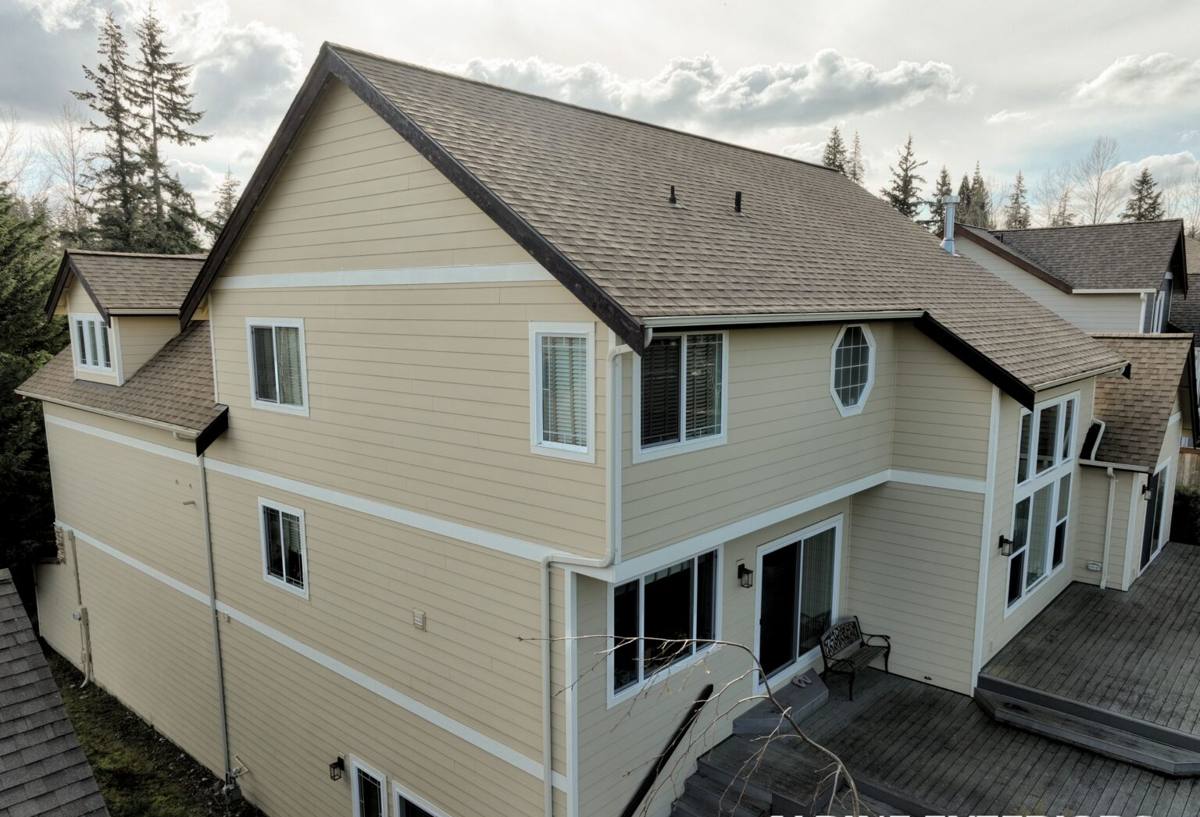
Why Composite Decking Makes Sense for This Area
Composite decking isn't automatically the right call everywhere, but for a property exposed to salt air and heavy seasonal moisture, it solves problems that wood decking in this region runs into repeatedly.
Salt Air and Hardware
Salt accelerates corrosion on any exposed metal — screws, joist hangers, flashing. On a wood deck, the boards themselves also absorb and release moisture constantly, which loosens fastener connections over time and speeds up corrosion at every screw hole. Composite boards don't swell and shrink with humidity the way wood does, so fasteners stay seated properly and hold their grip longer. It's still critical to use stainless steel or coated fasteners and hardware rated for coastal exposure — we don't cut corners here just because the decking itself is composite.
Moss, Algae, and Shade
A lot of Custer properties have partial tree cover or sit close enough to the water that boards stay damp longer than they would further inland. That's exactly the environment moss and algae need. Composite decking resists moisture absorption into the board itself, which means it doesn't provide the same organic surface for growth that untreated or under-maintained wood does. It still needs periodic cleaning — composite is moss-resistant, not moss-proof — but the maintenance burden is a fraction of what a wood deck demands in this climate.
What a Correct Composite Deck Build Actually Involves
The decking material is only part of the job. Most of the problems we get called out to fix on other people's decks trace back to the substructure, drainage, or fastening — not the boards themselves.
Substructure and Ledger Attachment
Where the deck attaches to the house, the ledger board connection has to be flashed correctly to keep water from working its way behind the siding. In a high-rainfall area like this, a poorly flashed ledger is one of the most common sources of hidden rot — and it's happening behind the deck, not on it, so homeowners often don't notice until siding or framing damage shows up.
Drainage and Airflow Beneath the Deck
Composite boards don't rot, but the joists, beams, and posts underneath usually are still wood (unless you've upgraded to a fully composite or steel substructure), and they need airflow and drainage to last. We grade and plan under-deck drainage so water sheds away from the structure instead of pooling under the deck where it stays damp all winter.
Fastening and Board Selection
Hidden fastener systems give a cleaner surface and reduce the number of exposed screw heads where corrosion and water intrusion can start. Board spacing also matters more here than in a dry climate — gaps that are too tight trap moisture and debris between boards, which is exactly where algae and grime take hold first.
Composite vs. Wood vs. PVC: What Actually Differs
| Factor | Wood | Composite | PVC / Cellular |
|---|---|---|---|
| Moisture behavior | Absorbs and releases; cups and splinters over time | Minimal absorption; dimensionally stable | Essentially non-absorptive |
| Maintenance | Annual staining/sealing, regular moss treatment | Periodic washing; no staining or sealing | Periodic washing; no staining or sealing |
| Upfront cost | Lowest | Mid-range | Highest |
| Salt air / coastal durability | Fair to poor without diligent upkeep | Good | Very good |
| Appearance over time | Fades, grays, requires refinishing to hold color | Holds color well, some fading possible | Holds color and finish longest |
| Warranty structure | Typically none beyond installer's workmanship | Manufacturer material warranty, often 25–50 yr | Manufacturer material warranty, often comparable or longer |
PVC decking is worth discussing for the wettest, most shaded parts of a property, but it comes at a real cost premium and has its own installation sensitivities around thermal expansion. For most Custer homes, mid-to-premium composite hits the right balance of upfront cost, low maintenance, and durability against the salt-and-rain cycle this area sees every year.
Our Process for a Custer Deck Project
The steps don't change much from house to house, but the details we pay attention to are shaped by this specific area:
- Site assessment — we look at sun/shade exposure, proximity to water, existing drainage patterns, and the condition of any existing structure we're replacing.
- Structural plan — ledger flashing, joist spacing rated for the board and any planned furniture or hot tub loads, and post footings sized for our soil conditions.
- Material selection — walking through composite lines and finishes with the homeowner based on budget, color preference, and how much sun/shade the deck will actually get.
- Build — framing, flashing, decking, fascia, and railing, with fasteners and hardware specified for coastal exposure throughout.
- Final walkthrough — we cover what maintenance the specific product line does and doesn't need, so there are no surprises a year in.
Why It Matters That We Already Work in Custer
A crew that's built decks elsewhere in the state and treats every job the same way will spec the same fasteners, the same flashing details, and the same drainage plan whether the house is in a dry inland valley or a few miles from the Custer shoreline. That's how decks end up with corroded hardware or hidden rot within a handful of years in this specific environment. Working regularly in and around Ferndale and Custer means we already know which fastener grades hold up here, which finishes handle the moss season without constant scrubbing, and how local building requirements apply to deck permitting and railing height in Whatcom County. That's knowledge that only comes from doing the work here repeatedly, not from a spec sheet.
Maintenance a Composite Deck Still Needs in This Climate
Composite decking cuts maintenance dramatically compared to wood, but "low-maintenance" isn't "no-maintenance," especially this close to the coast. A simple seasonal routine keeps a deck looking and performing the way it should:
- Rinse and sweep debris off the deck surface regularly through fall, when leaves and needles trap moisture against the boards
- Wash with a soft-bristle brush and mild soap a couple of times a year to keep salt residue and early moss growth from building up in board grooves
- Keep gutters and downspouts near the deck clear so runoff isn't dumping extra water onto or under the structure
- Check railing posts and stair connections annually for movement — hardware can loosen even when the boards themselves are holding up fine
- Trim back overhanging branches that keep sections of the deck shaded and slow to dry after rain
- Inspect under-deck drainage and ventilation before the wet season each year to make sure water is still shedding away from the structure
Problems We Commonly Find on Older Custer Decks
When we're called out to repair or replace an existing deck in this area, a handful of issues show up again and again: ledger boards flashed incorrectly (or not flashed at all) when the deck was originally built, standard carbon-steel fasteners that have rusted and stained the decking around them, joists set too close to grade with no airflow underneath, and board spacing tight enough that moss has taken root between every board. None of these are unusual mistakes — they're what happens when a deck is built to a generic spec instead of one that accounts for this specific climate. It's also why a deck that "looks fine" from a distance can still need serious framing repair underneath.
If you're weighing a new composite deck or wondering whether an existing one in Custer is holding up the way it should, we're happy to take a look. Fill out the form below for a free, no-pressure estimate — we'll walk the site, answer questions honestly, and give you a straight assessment of what your deck actually needs.