 Ferndale Siding
 Roof Repair Built for the Nooksack Area's Climate
Homes in and around Nooksack sit under the same wet, marine-influenced weather pattern that defines Whatcom County — long stretches of steady rain, wind that drives moisture sideways under roof edges, and a moss season that can run most of the year in shaded spots. A roof out here doesn't fail because of one bad storm. It fails slowly, from cumulative exposure: a lifted shingle tab that lets water track under the next course, a clogged valley that backs up during a heavy rain event, moss roots working into the granule surface until the mat underneath starts to soften. Roof repair in this area has to account for that pattern, not just patch the symptom you can see from the ground.
We work on homes throughout the Ferndale and greater Nooksack area regularly, which means we're not guessing at how local roofs age. We know which sections of a roof take the worst of the wind-driven rain, which orientations hold moss longest, and which older repair habits — caulk-and-hope patches, for example — tend to fail within a season or two out here. This page is about what an honest, correctly done roof repair looks like for a Nooksack-area home, not a generic list of services.
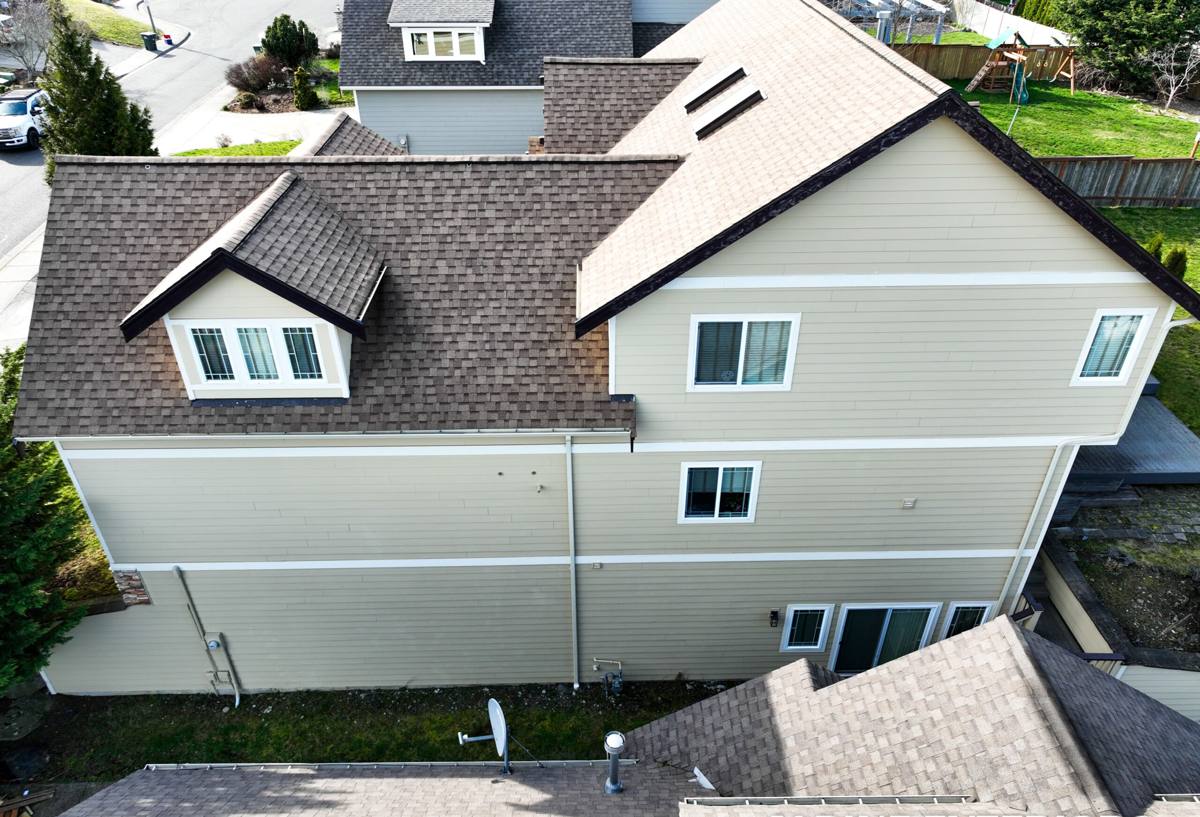
Common Roof Problems We See Near Nooksack
Most of the repair calls we get in this area fall into a handful of categories. None of them are exotic — they're just what happens when Pacific Northwest weather works on a roof year after year.
Moss and Organic Growth
Moss doesn't just sit on a roof looking bad. It holds moisture against the shingle surface far longer than open air would, and as it spreads it works small root structures under shingle tabs and into seams. Over a few seasons, that constant damp contact softens the shingle mat and breaks the granule bond, which is when a roof that "looks okay from the driveway" turns out to have soft, failing sections once you get up close.
Wind-Driven Rain and Flashing Failures
Rain that falls straight down is easy for a roof to shed. Rain that's being pushed sideways by wind — which is common here — finds every gap in flashing around chimneys, skylights, vents, and roof-to-wall transitions. Flashing failure is one of the most common sources of interior leaks we find, and it's often mistaken for a "roof leak" when the shingles themselves are actually fine.
Valley and Gutter Backups
Roof valleys concentrate a huge volume of water during heavy rain. When they're clogged with needles, moss debris, or granule buildup, water backs up under the shingle edges instead of running off. Combined with gutters that aren't keeping pace with volume, this is a slow, quiet way for a roof to develop rot at the eaves.
Aging and UV-Cycled Shingles
Even with less direct sun than drier climates see, shingles here still go through repeated wet-dry cycling that eventually causes granule loss, curling, and cracking — especially on south- and west-facing slopes. Once a shingle has lost its flexibility, it can crack from something as simple as foot traffic or a falling branch.
What a Proper Roof Repair Actually Involves
A repair that holds up under repeated Whatcom County storms is more than swapping out a shingle or squeezing in a bead of sealant. Done correctly, it involves:
- Diagnosis beyond the visible damage — tracing a leak or damaged area back to its actual source, which is often several feet from where the water shows up inside
- Removing and replacing compromised layers — not just the shingle, but underlayment or decking underneath if it's saturated or soft
- Correct flashing detail — reforming or replacing flashing so water sheds over it, not just caulking a gap shut
- Matching materials appropriately — using a shingle profile and, where possible, color that blends reasonably with the existing roof rather than leaving an obvious patch
- Re-establishing proper water path — making sure valleys, laps, and drainage are restored to shed water the way the roof was designed to
Skipping any of these steps is how you end up with a "repair" that looks fine for one dry season and fails again the next wet one. We'd rather explain why a repair needs an extra step than do a fast version that doesn't actually solve the problem.
Our Nooksack Roof Repair Process
1. On-Site Inspection
We start by getting on the roof, not just looking at it from the ground. That includes checking the attic side where accessible, since interior signs — dark staining, damp insulation, daylight at a seam — often tell us more about a leak's real path than the exterior does.
2. Honest Scope and Estimate
We tell you what we actually find: whether this is a contained repair, a larger section that needs replacing, or a sign that the roof is nearing the end of its useful life. You get a written estimate with the scope explained in plain terms — no pressure to upsell a full replacement if a repair genuinely is the right call.
3. The Repair Itself
We remove damaged material back to sound decking, address the underlying cause (not just the surface symptom), rebuild flashing and underlayment as needed, and install matching roofing material with proper fastening and lap patterns.
4. Cleanup and Debris Removal
Old shingles, moss debris, and any replaced decking are cleared from the site and gutters are checked to make sure nothing from the repair itself is left to clog them.
5. Walkthrough and Follow-Up
We walk you through what was done and what to expect going forward, including any maintenance — like periodic moss treatment — that will extend the life of the surrounding roof.
Repair Approach and Cost Factors
Not every roof problem calls for the same fix, and the right approach depends on how contained the damage is and how the rest of the roof is holding up. Here's how we think through it:
| Repair Type | Best For | Typical Range |
|---|---|---|
| Spot repair (shingle/flashing swap) | Isolated leak, storm damage, single failed flashing point | $300–$900 |
| Section repair (with decking check) | Moss/moisture damage covering a defined area, valley or eave rot | $800–$2,500 |
| Multi-area repair | Older roof with several separate problem spots but sound overall structure | $2,000–$5,000+ |
| Repair vs. replace consultation | Roof nearing 18–25+ years old with recurring issues | Estimate provided at inspection |
These are broad ranges meant to help you plan, not a quote — actual cost depends on roof pitch, access, material type, and what we find once the damaged area is opened up. We'll always give you a firm number in writing before any work starts.
Moss, Algae, and Moisture Management
Given how much of the repair work we see traces back to long-term moisture and moss exposure, prevention is worth as much attention as the repair itself. A few things that make a real difference on homes in this area:
- Keeping overhanging branches trimmed back so roof sections get more airflow and light, which slows moss regrowth
- Clearing valleys and gutters at least twice a year, more often under heavy tree cover
- Addressing moss while it's still surface-level, before it has time to root into the shingle mat
- Checking attic ventilation — poor airflow traps interior moisture against the roof deck from underneath, which accelerates the same kind of damage from the other direction
None of this eliminates the need for repairs over a roof's lifespan, but it stretches the time between them and keeps small issues from becoming decking-level problems.
Signs Your Nooksack-Area Roof Needs Attention
Most roof damage doesn't announce itself with a dramatic leak. It shows up as smaller signals first — worth a look before the next heavy rain event.
- Granules collecting in gutters or at downspout outlets
- Dark streaking or thick moss patches, especially on north-facing or shaded slopes
- Shingles that look curled, cracked, or lifted at the edges
- Staining or a musty smell in the attic or along interior ceiling lines
- Daylight visible through the roof deck from inside the attic
- Sagging in any section of the roofline, however slight
- Flashing that looks separated, rusted, or loosely caulked around chimneys and vents
If you're seeing more than one of these, it's worth having someone look before it turns into an interior repair too.
Why Hiring a Crew That Already Works in Nooksack Matters
Roof repair isn't one-size-fits-all, and a crew unfamiliar with this specific corner of Whatcom County is working with less information than one that's already up on roofs here regularly. Local experience means knowing which manufacturers' products hold up well under sustained wet exposure, understanding how wind patterns off the surrounding valley and farmland affect which slopes take the worst weathering, and having a realistic sense of how quickly moss returns in shaded spots so we can recommend a maintenance interval that actually fits the property — not a generic schedule pulled from a manual written for a drier climate.
It also means accountability. A local crew has a reputation in the community to stand behind, and we're not disappearing after the invoice clears. If something about a repair doesn't hold up the way it should, we're easy to reach and close by.
Get a Straightforward Roof Repair Estimate
If you're dealing with a leak, storm damage, or a roof that's showing its age, we're happy to take a look and tell you honestly what it needs — whether that's a contained repair or something bigger. Use the form below to request a free, no-pressure estimate for your Nooksack-area home.