 Ferndale Siding
 Building Decks for Birch Bay's Marine Climate
Birch Bay sits right on the water, and that changes what a deck needs to survive here compared to a deck built twenty miles inland. Salt-laden air moves off the bay and settles on everything — railings, fasteners, the underside of joists — and it doesn't stop working just because the sun is out. Add Whatcom County's long wet season and the shade many Birch Bay lots get from mature trees and neighboring homes, and you have a recipe for moss, slow-drying wood, and corrosion that a generic deck build isn't designed to handle.
We're a Ferndale-based crew, and Birch Bay is part of our regular service area, not a one-off trip. That matters because deck failures out here rarely come from bad design — they come from material choices and detail work that were fine for a drier, less salty part of the state but weren't right for a shoreline neighborhood. This page covers what we actually do differently for a Birch Bay deck build, from the framing up.
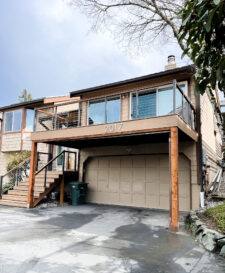
What Salt Air and Driving Rain Actually Do to a Deck
It helps to understand the specific damage mechanisms before talking about how we build around them.
Salt Air and Metal Fasteners
Ordinary galvanized fasteners hold up fine in most of Whatcom County. Close to the bay, airborne salt accelerates corrosion on nails, screws, and structural hardware — brackets, joist hangers, bolts. Once a fastener starts rusting, it loses holding strength quietly, often years before any visible sign shows up on the deck surface above it.
Driving Rain and Wind-Driven Moisture
Rain in Birch Bay doesn't just fall straight down — wind off the water pushes it sideways, into places a deck built for a sheltered inland yard was never detailed to handle: under railing base plates, behind ledger boards, into end-grain cuts that weren't sealed. Wood that stays wet longer stays soft longer, and that's where rot starts.
Moss and Algae Growth
Whatcom County's wet season runs long, and shaded, north-facing, or tree-covered Birch Bay lots stay damp for extended stretches. Moss and algae aren't just cosmetic — they hold moisture against the decking surface and make boards slippery, which is a real safety issue on stairs and landings.
Decking Material Options for a Birch Bay Build
There's no single "best" decking material — the right choice depends on budget, how much upkeep you're willing to do, and how exposed the deck is to salt air and shade. Here's how the common options actually perform in this specific climate.
| Material | Salt Air Behavior | Moss/Algae Resistance | Maintenance |
|---|---|---|---|
| Pressure-treated pine | Framing-grade only near the water; fasteners need to be stainless or heavy-coated | Low — needs regular cleaning and sealing | Annual cleaning, re-sealing every 1-2 years |
| Cedar | Naturally rot-resistant, tolerates salt air reasonably well | Moderate — still needs periodic cleaning in shaded spots | Sealing every 1-2 years to hold color and resist checking |
| Composite decking | Very good — doesn't absorb moisture the way wood does | Better than wood, but still grows algae film in shade without cleaning | Periodic washing; no sealing or staining |
| PVC decking | Excellent — fully synthetic, unaffected by salt | Good, though smooth-surface product buildup still needs washing | Lowest — occasional washing only |
We'll walk through these trade-offs honestly during your estimate. Composite and PVC cost more up front but reduce the maintenance burden significantly in a shoreline environment. Cedar and treated wood cost less initially but need a real maintenance commitment to hold up in Birch Bay's conditions — that's not a knock on wood, it's just the honest trade-off.
What's Underneath Matters More Than the Surface
Homeowners naturally focus on decking boards and railings because that's what you see. But the framing, footings, and connections underneath are what actually determine whether a deck lasts 10 years or 30 in a salt-air environment.
Footings and Frost Depth
Whatcom County code requires footings set below the local frost depth, sized appropriately for the deck's load and soil conditions. We don't shortcut footing depth or size to save time — it's the single most consequential structural decision on the whole project, and it's invisible once the deck is finished.
Ledger Board Flashing
Where a deck attaches to the house, the ledger board connection is the single most common source of hidden rot on any deck, anywhere — and driving rain off the bay makes it worse here. Proper flashing that sheds water away from the house rim joist, installed in the correct order relative to the house's existing weather barrier, is non-negotiable on every attached deck we build.
Joist Protection
We use joist tape or an equivalent capping product on top of framing lumber before decking goes down. It's a small material cost that prevents water from sitting in fastener holes and wicking into the top of the joist — one of the slower, quieter ways decks rot from the inside.
Fasteners and Hardware: Where We Don't Cut Corners
Given what salt air does to standard hardware, we spec stainless steel or high-grade coated fasteners and structural connectors for Birch Bay decks, not the minimum-code galvanized hardware that's fine further inland. This applies to:
- Joist hangers and structural brackets
- Ledger board lag bolts or structural screws
- Decking fasteners (screws or hidden-fastener clips)
- Railing post connections and guardrail hardware
- Stair stringer connectors
The cost difference between standard and corrosion-resistant hardware is small relative to the total project. The difference in how the deck performs after ten years near the water is not.
Our Build Process
Every deck we build in Birch Bay follows the same sequence, adjusted for your lot's specific exposure, shade, and slope:
- On-site assessment — we look at sun exposure, tree cover, drainage, and how close the build site sits to salt air exposure from the bay
- Design and material conversation — honest trade-offs between wood and composite/PVC based on your budget and maintenance appetite
- Permit submission — Whatcom County and applicable local requirements, including setbacks, guardrail height, and stair code
- Footings and framing — sized and set to code, with corrosion-resistant hardware throughout
- Ledger flashing and joist protection — the parts you won't see once the deck is done, done right
- Decking, railing, and stair installation
- Final walkthrough — we go over maintenance expectations specific to your material choice and site conditions
Permits and Code Considerations in Whatcom County
Most new decks and significant deck rebuilds in unincorporated Whatcom County — which covers Birch Bay — require a building permit, particularly once the deck exceeds a certain height above grade or is structurally attached to the house. Guardrail height, baluster spacing, and stair rise/run are all governed by code, and inspectors do check these details. We handle the permit submission and coordinate inspections as part of the project, so you're not the one chasing down paperwork.
Maintenance: What Actually Keeps a Birch Bay Deck Going
The maintenance a deck needs here is a direct response to the two things this page keeps coming back to — salt air and prolonged moisture. A short, honest checklist:
- Rinse salt residue and debris off decking and railings a few times a year, more often on sides facing the water
- Keep gutters and downspouts clear so roof runoff isn't dumping extra water onto or near the deck
- Trim back overhanging branches and vegetation touching the deck to reduce shade and moss growth
- Clean moss and algae off decking surfaces before it builds up, especially on stairs and shaded sections
- Reseal wood decking and railings on the schedule appropriate to the product — don't wait until it looks gray and dry
- Check railing posts and stair connections annually for movement, which can signal fastener corrosion underneath
Why a Crew That Already Works Birch Bay Matters
A deck built by a crew that mainly works dry, sheltered, inland lots can still be a technically fine deck — for that setting. Applied to a Birch Bay shoreline lot without adjustment, standard-spec hardware and default detailing show their limits faster than they would elsewhere in Whatcom County. Working this neighborhood regularly means we're not guessing at how exposed a given lot is to salt air or how much shade and moisture a north-facing yard holds through the wet season — we've seen it, on other decks, in this same stretch of coastline.
As a Ferndale-based crew, Birch Bay is a short drive for us, not a special trip, which also means warranty work, follow-up questions, or a maintenance check-in a few years down the line is easy to schedule rather than a logistics problem.
Cost Factors to Expect
Every deck project is different, but the main variables that move the price are consistent. We'll give you specific numbers during your on-site estimate — no project gets quoted sight unseen.
| Factor | Why It Matters in Birch Bay |
|---|---|
| Decking material | Composite and PVC cost more upfront but reduce long-term maintenance against salt air and moss |
| Deck size and height | Taller decks need more substantial railings, stairs, and footing work per code |
| Site access and slope | Waterfront and hillside lots can complicate footing placement and material staging |
| Attached vs. freestanding | Attached decks require ledger flashing work tied into the existing house structure |
| Hardware grade | Stainless or heavy-coated fasteners cost more than standard galvanized but last longer near the water |
If you're planning a new deck or replacing one that's showing its age in Birch Bay's salt air and wet winters, we're happy to take a look and walk you through your options. Reach out for a free, no-pressure estimate — the form below gets you started.