 Ferndale Siding
 Building a Deck That Can Handle Blaine's Waterfront Climate
Blaine sits right up against the Salish Sea, and that location shapes everything about how a deck should be built there. Homes closer to the water deal with salt-laden air, wind-driven rain that finds its way into places a calmer climate never would, and a long stretch of the year where shade and moisture combine to grow moss on almost any horizontal surface. A deck in Blaine isn't just outdoor furniture — it's a structure that has to shed water, resist corrosion, and stay safe underfoot through a wet Whatcom County fall, winter, and spring.
We work throughout the Ferndale area, and Blaine jobs come with their own set of considerations compared to decks we build further inland. This page covers what we've learned building and repairing decks in this specific environment, and what we think a correct composite deck installation looks like here.
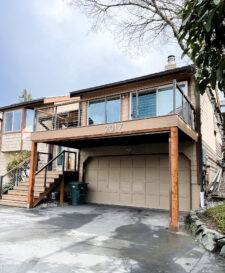
What Salt Air and Driving Rain Actually Do to a Deck
Two forces do most of the damage to decks in Blaine, and they work differently than what you'd see in a dry climate.
Salt Air and Corrosion
Airborne salt accelerates corrosion on anything metal — fasteners, joist hangers, railing hardware, even the screws holding boards down. A fastener that would last decades in a low-salinity area can start rusting and staining within a few seasons this close to the water. Once a fastener corrodes, it weakens, and the rust it sheds streaks the decking around it — a problem that shows up as much on wood as it does on lower-grade composite.
Wind-Driven Rain and Trapped Moisture
Blaine's rain doesn't just fall straight down — coastal wind pushes it sideways, under railings, into ledger connections, and along the underside of boards. Decks fail less often from rain hitting the surface and more often from moisture that gets trapped underneath: in framing that can't dry out, in fastener holes that were never sealed, or in board gaps that were cut too tight to let water and debris pass through.
The Long Moss Season
Whatcom County's mild, wet stretch from fall through spring gives moss and algae months to establish themselves on any deck surface that stays damp and shaded. Moss isn't just cosmetic — it holds moisture against the board surface and turns a deck slick and genuinely dangerous on wet mornings. Surface texture, drainage, and how much airflow a deck gets underneath all affect how fast moss takes hold.
Why Composite Decking Suits This Environment
Composite decking — a blend of wood fiber and recycled plastic, typically capped with a protective polymer shell — is a strong match for Blaine's climate for a few specific reasons, not because it's maintenance-free in an absolute sense.
- It doesn't absorb water the way wood does. Capped composite boards resist the swelling, cupping, and splintering that wood decking develops when it's repeatedly soaked and dried in a marine climate.
- It won't rot. Wood decking exposed to constant coastal moisture is prone to fungal decay, especially at fastener holes and board ends. Composite doesn't feed rot the way wood fiber can.
- It holds its finish without repeated staining. Wood needs re-staining or sealing on a schedule to keep protecting the material underneath; skip a cycle in this climate and you're often re-doing more work than if you'd kept up with it. Composite's cap layer handles UV and moisture exposure without that maintenance cycle.
- Better boards resist moss better. Textured composite surfaces shed water faster than smooth wood grain, which slows how quickly algae and moss can establish — though nothing fully stops moss growth in shaded, low-airflow spots.
None of this means composite decking is maintenance-free. It means the maintenance burden shifts from sealing and staining to periodic cleaning, and the material itself isn't structurally degrading the way untreated wood can in this climate.
What a Correct Composite Deck Installation Involves Here
The composite boards themselves get most of the attention, but in a coastal climate the framing, fasteners, and drainage details underneath the boards matter just as much — arguably more, since that's where most Blaine deck failures actually start.
Substructure and Framing
We build to the composite manufacturer's span ratings, not generic wood-deck spacing, since composite boards flex differently than wood under load. Joists and beams get corrosion-resistant or coated hardware throughout, and we pay close attention to ledger board flashing where the deck meets the house — that connection is one of the most common places moisture gets trapped and starts rotting the rim joist behind the siding.
Fasteners and Hardware
Given the corrosion risk from salt air, we use fasteners and structural hardware rated for coastal or marine-grade exposure, not standard exterior-rated hardware. It costs a little more up front and saves you rust streaks and failing connections years down the road.
Drainage and Airflow
Board gapping, ventilation underneath the deck, and grading around the support posts all affect how quickly the structure dries out after a storm. A deck built tight to the ground with poor airflow underneath stays damp longer and develops moss and mildew faster — we plan for airflow from the start rather than treating it as an afterthought.
Railings and Fasteners at the Surface
Railing posts and hardware are constant points of water intrusion if they're not properly flashed and sealed where they penetrate the deck surface. We treat every post connection as a place water will try to get in, because near the water, it will.
Composite Board Tiers and What Drives the Cost
Composite decking comes in a range of quality tiers, and the differences matter more in a marine climate than they would somewhere drier. Here's a general comparison to help frame the conversation — exact pricing depends on your deck's size, structure, and site conditions, so treat these as broad ranges, not a quote.
| Factor | Entry-Level Composite | Mid-Tier Capped Composite | Premium Capped Composite |
|---|---|---|---|
| Moisture resistance | Basic; some water absorption at cut edges | Good; fully capped on most profiles | Best; capped on all sides including grooves |
| Fade/stain resistance | Fades and stains faster in sun and salt air | Solid UV and stain resistance | Strongest fade and stain warranties |
| Moss/algae resistance | Smoother, holds moisture longer in shade | Textured surfaces shed water better | Best surface texture and drainage design |
| Typical warranty | Shorter, more limited | 25 years, more comprehensive | 25+ years, often includes fade/stain |
| Relative material cost | Lowest | Mid-range | Highest |
Beyond the board tier, the biggest cost factors on a Blaine deck are typically: deck size and shape, height off grade (railings and stairs add cost), substructure condition if you're replacing an existing deck, and site access for equipment and material delivery.
Our Process, Start to Finish
- On-site assessment. We look at your existing deck or the build site, check drainage and sun/shade exposure, and talk through how you actually use the space.
- Product and layout selection. We walk through composite board options at different price points and help you land on a layout, color, and railing system that fits your home and budget.
- Written estimate. You get a clear scope and price before any work starts — no surprise change orders for things we should have caught up front.
- Demo and framing. If we're replacing an existing deck, we inspect the framing underneath before covering it back up; rotted or undersized framing gets addressed, not built over.
- Installation. Boards, railings, and hardware go in to manufacturer spec, with the coastal-specific details — flashing, fastener grade, gapping — built in throughout, not added as an afterthought.
- Final walkthrough. We go over the finished deck with you, including basic care guidance specific to your board choice and site conditions.
Maintaining a Composite Deck in a Marine Climate
Composite decking cuts down on maintenance, but "low-maintenance" isn't "no-maintenance," especially this close to the water.
- Sweep off debris and standing organic matter (leaves, needles) regularly, since decomposing debris feeds moss and holds moisture against the board.
- Wash the deck surface a couple of times a year with mild soap and water, more often in shaded areas prone to moss.
- Check railing posts, stair connections, and fasteners annually for early rust staining — catching a corroding fastener early is a five-minute fix, not a repair.
- Keep gutters and downspouts near the deck clear so runoff isn't dumping extra water onto the structure.
- Trim back vegetation that's shading the deck and keeping it damp longer than it needs to be.
Why It Matters to Hire a Crew That Already Works in Blaine
A contractor who mostly builds decks inland, away from salt air, can do a perfectly good job on a standard framing plan and still underspec the hardware or skip drainage details that matter here. We build in Whatcom County, including waterfront and near-waterfront properties in Blaine, and we spec fasteners, flashing, and drainage for the conditions your deck will actually face — not a generic build sheet. That's the difference between a deck that looks right on installation day and one that still looks right in five years of salt air, driving rain, and moss season.
Get a Free, No-Pressure Estimate
If you're planning a new composite deck or replacing one that's showing its age, we're happy to take a look and walk you through your options — no pressure, no obligation. Use the form below to request a free estimate for your Blaine property.