 Ferndale Siding
 Why Board & Batten Fits Fairhaven's Homes
Board and batten siding has a clean, vertical-line look that suits a lot of the architecture around Fairhaven — from older farmhouse-style homes to newer builds going for a modern coastal look. It's not just a style choice, though. The vertical panel-and-strip system sheds water differently than horizontal lap siding, and in a community that sits close to Bellingham Bay and takes the full brunt of Whatcom County's marine weather, how a siding system handles water matters as much as how it looks.
We install board and batten as part of our regular Ferndale-area work, and Fairhaven is a neighborhood we're in often enough to know what its homes are up against: salt-laden air off the water, wind-driven rain that doesn't just fall straight down, and a moss season that can stretch most of the year on shaded, north-facing walls. A board and batten system that isn't detailed correctly for those conditions will look fine for a year or two and then start showing problems — moss creeping up battens, panel edges swelling, fastener corrosion bleeding through paint. A system that is detailed correctly will still look sharp a decade later.
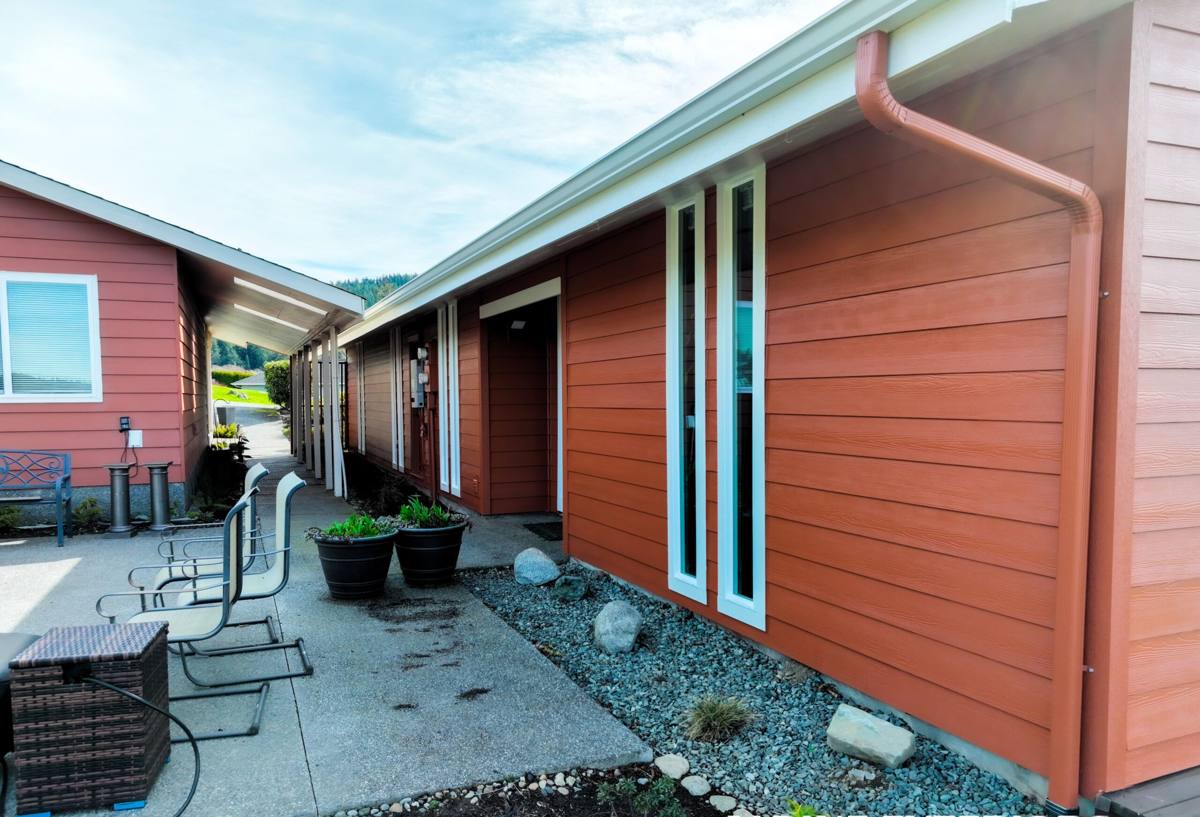
What Coastal Whatcom County Weather Does to Siding
Three things define the exposure for a Fairhaven home: salt air, driving rain, and moss season. Each one attacks siding in a different way, and a good installation has to answer all three at once, not just one.
Salt Air
Proximity to saltwater accelerates corrosion on anything metal — fasteners, flashing, trim connectors. Cheap or under-spec'd fasteners can start rusting within a few years near the water, and once a fastener corrodes, the seal around it fails and water gets behind the siding.
Driving Rain
Storms coming off the Strait of Georgia and Bellingham Bay don't fall straight down — wind pushes rain sideways and up under joints, seams, and horizontal trim. Board and batten's vertical seams are actually an advantage here if they're flashed and caulked correctly, because there's less horizontal surface for wind-driven water to catch on. But if the battens aren't sealed properly at the top or the panel joints aren't backed correctly, wind-driven rain will find the gap.
Moss Season
Shaded walls, tree cover, and the region's long wet stretch from fall through spring create ideal conditions for moss and algae growth. Moss holds moisture against the siding surface far longer than open air would, which is a problem for any material that isn't dimensionally stable when damp, and it's simply unattractive on a wall that's supposed to look clean and vertical.
James Hardie Vertical Siding: Built for This Exposure
We install James Hardie fiber cement exclusively, and for a board and batten project that's not a marketing preference — it's because fiber cement behaves in a way that matches what Fairhaven's climate demands. Hardie's vertical siding panels are engineered to resist moisture absorption and won't swell, rot, or delaminate the way some wood-based or engineered-wood panel products can when they take on repeated wetting from driving rain or trapped moisture under moss growth.
The factory-applied ColorPlus finish is baked on under controlled conditions, which gives it better adhesion and UV resistance than field-applied paint, and it holds its color and finish integrity longer in a marine environment where salt air and UV exposure both work against paint film over time. Hardie's HZ5 product line, developed for climates with more moisture exposure, is a better match for a bay-adjacent property than a generic siding product not engineered with regional moisture in mind. It's also non-combustible, which matters as much for insurance conversations as it does for wildfire smoke season, which the Pacific Northwest now sees most summers.
None of that means Hardie board and batten is maintenance-free. It still needs correct installation, periodic cleaning, and attention to caulk lines over time. What it means is that the material itself isn't the weak point — the installation is where a board and batten job succeeds or fails.
What a Correct Board & Batten Installation Involves
This is the part most homeowners never see, and it's the part that determines whether the siding lasts 30 years or needs rework in five. On a Fairhaven property, we pay particular attention to a few details that generic installation guides gloss over.
Rainscreen & Drainage Plane
A drainage gap behind the siding — created with vertical furring strips or a purpose-built rainscreen product — lets any moisture that does get past the outer surface drain and dry out instead of sitting against the wall sheathing. In a region with this much annual rainfall, skipping the rainscreen is one of the most common corner-cuts we see on older installations, and it's usually the root cause when we get called out to look at moss-stained, soft-feeling walls.
Fastening & Batten Spacing
Panels and battens need to be fastened into solid framing with corrosion-resistant fasteners rated for the exposure — not just galvanized, but a grade that holds up near saltwater. Batten spacing has to follow Hardie's engineering specs so panel joints are backed and load is distributed correctly; battens set too far apart or fastened only into sheathing (not studs) will work loose over time as the building moves seasonally.
Flashing & Trim Details
Every horizontal transition — window heads, water tables, roof-to-wall intersections — needs flashing that directs water out and away, not just caulk over a gap. Caulk fails eventually; flashing is the permanent line of defense. We flash first and treat sealant as the backup, not the primary barrier.
Board & Batten Material Comparison
Homeowners in Fairhaven sometimes ask us to bid board and batten in vinyl or engineered wood alongside Hardie. We don't install those products, but it's worth understanding why, in plain terms.
| Material | Moisture Behavior | Salt Air / Coastal Fit | Long-Term Upkeep |
|---|---|---|---|
| James Hardie Fiber Cement | Dimensionally stable, engineered moisture resistance (HZ5) | Strong — non-combustible, corrosion-resistant fastening compatible | Periodic cleaning, caulk checks; factory finish holds up well |
| Vinyl Board & Batten | Doesn't rot, but can warp or distort in heat and doesn't hold rigid panel lines the same way | Fasteners and trim hardware still need to be corrosion-resistant | Low upkeep but limited repair options if a panel cracks or fades |
| Engineered Wood / Primed Panel | More moisture-sensitive at cut edges and joints; needs diligent sealing | Higher risk near salt air and prolonged damp/moss exposure | Regular repainting and edge-sealing to prevent swelling |
This is why we standardized on Hardie: for a coastal, high-moisture, moss-prone environment like Fairhaven's, it's the material that requires the least fighting against the climate to perform well over decades.
Our Fairhaven Installation Process
- On-site assessment. We look at wall orientation, shade and moss patterns, existing moisture damage, and exposure to prevailing wind and rain direction before recommending a batten layout and product spec.
- Prep and moisture barrier. Any damaged sheathing is addressed first — siding installed over compromised sheathing just hides a bigger problem. A weather-resistive barrier and rainscreen gap go in before any panel touches the wall.
- Flashing installation. Windows, doors, and horizontal transitions get flashed before panels go up, not patched afterward.
- Panel and batten installation. Hardie panels and battens are installed to manufacturer spacing and fastening specs, with corrosion-resistant fasteners appropriate for a bay-adjacent property.
- Trim, caulking, and final inspection. We walk the full installation checking seams, fastener lines, and trim details before calling the job complete.
Cost Factors for Board & Batten Siding in Fairhaven
Every project is different, but the same handful of factors drive most of the cost variation we see on Fairhaven homes:
| Factor | Why It Matters |
|---|---|
| Existing wall condition | Rot, moisture damage, or missing rainscreen from a prior install adds prep work before new siding goes on |
| Wall height and complexity | Multi-story walls, dormers, and cut-ins around windows increase labor and trim detailing |
| Batten spacing and panel size chosen | Layout affects material quantities and installation time |
| Accessibility | Tight lot lines, slopes, or limited staging area near the water can add setup time |
| Color and finish selection | ColorPlus factory finishes vary slightly in cost by color line |
We give straightforward, itemized estimates so homeowners can see exactly what's driving the number, rather than a single lump figure.
Maintenance in a Moss-Prone, Salt-Air Environment
Hardie board and batten holds up well in this climate, but a little seasonal attention keeps it looking and performing its best over the years:
- Rinse siding annually (garden hose pressure, not a pressure washer) to clear salt residue and organic buildup before it takes hold
- Trim back tree branches and shrubs that keep walls shaded and damp, especially on north- and west-facing sides
- Check and refresh caulk at trim joints and penetrations every few years — sealant is a wear item even on the best installations
- Address moss or algae growth early with a gentle cleaning solution rather than letting it establish and hold moisture against the surface
- Walk the exterior after major storms to check for loose battens, damaged trim, or flashing displaced by wind
Why a Local Ferndale Crew Matters for Fairhaven Homes
Board and batten siding is detail-sensitive work, and the details that matter change with the site. A crew that already works Fairhaven and the greater Ferndale area knows which walls take the worst of the wind off the bay, which neighborhoods hold onto moss longest into summer, and which local permitting steps to expect before a crew ever shows up with material. That's not something a traveling crew or a company that treats Whatcom County as a one-off job site picks up on the first pass.
It also means accountability doesn't end when the crew packs up. We're local, we're going to be back in Fairhaven on other projects, and if a caulk line needs a look in year three, we're not far away. That proximity shapes how carefully a job gets done in the first place.
If you're weighing board and batten siding for a Fairhaven home, we're glad to walk the property, talk through what your specific walls are dealing with, and put together a straightforward, no-pressure estimate. There's a form below to get that conversation started.