 Ferndale Siding
 Siding That Has to Work Harder in Custer
Custer sits in an exposed stretch of Whatcom County, close enough to the water that salt-laden air is a fact of life, and far enough from any wind break that driving rain hits siding at an angle, not just straight down. Add in a moss season that stretches from fall through spring in this part of Washington, and you have a set of conditions that punishes the wrong siding choice fast. Paint fails early, seams open up, and moisture finds its way behind panels that were never really sealed correctly in the first place.
We install fiber cement siding in Custer because it's one of the few claddings that holds up to all three of those stressors at once — salt air, wind-driven rain, and sustained damp — without the maintenance spiral that comes with wood or the brittleness that comes with vinyl in a cold snap. But the material only performs as well as the installation behind it. A correct job in Custer looks different from a correct job in a sheltered inland neighborhood, and that difference is where most of the problems we get called out to fix actually start.
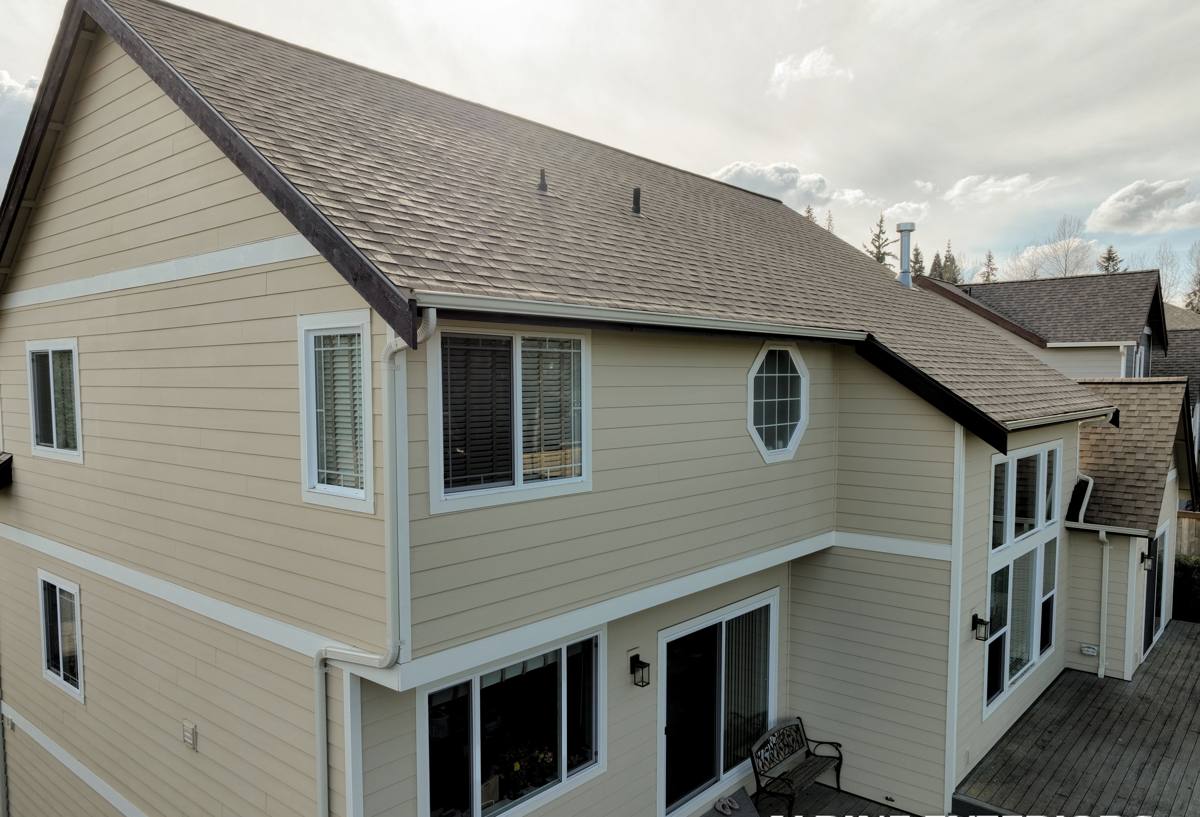
What Custer's Climate Actually Does to Siding
Salt Air and Coastal Exposure
Homes on this side of Whatcom County deal with airborne salt in a way that inland properties simply don't. Salt accelerates corrosion on exposed fasteners, trim flashing, and any metal component that isn't rated for the exposure. It also breaks down cheap paint finishes faster than a lab spec sheet would suggest, which is why factory-applied, baked-on finishes matter more here than in a lot of other markets.
Driving Rain
Open exposure means rain rarely falls straight down in Custer — it comes in sideways during winter storms, which puts real pressure on every seam, joint, and penetration in the siding system. A house wrap and flashing detail that would pass fine in a calm microclimate can fail here within a few winters if it wasn't built for wind-driven water in the first place.
Extended Moss and Damp Season
Northwest Washington's moss season isn't limited to shaded roofs. On siding, prolonged damp conditions on north-facing walls and anywhere airflow is restricted create the same conditions moss and mildew need to take hold on organic or poorly sealed materials. Siding that can't shed water quickly, or that absorbs moisture into its substrate, stays damp longer and gives moss and mildew more time to establish.
Why We Standardized on James Hardie
We only install James Hardie fiber cement siding — not LP SmartSide, not vinyl, not other fiber cement brands, not primed wood. That's a deliberate standard, not a lack of options. Hardie's HZ5 product line is engineered specifically for climates with freeze-thaw cycles and sustained moisture exposure, which describes Whatcom County well. It's non-combustible, it doesn't rot or delaminate the way engineered wood products can when a seal fails, and the ColorPlus factory finish is baked on under controlled conditions rather than field-applied, which matters a lot in a climate that's hard on paint.
We've seen what happens when other products are installed in exposed, wet climates like this one — not through unverified claims, but through the maintenance calls we get on homes that weren't originally sided with Hardie. Engineered wood siding can swell or degrade at cut edges and seams if the factory seal is compromised and moisture gets in repeatedly. Vinyl can crack in a hard freeze and never seals seams the way fiber cement does. Standardizing on one product means we know exactly how it behaves over 20-plus years in this specific climate, and we can back the installation with a consistent process every time.
What a Correct Installation Involves
Fiber cement siding is only as good as the water management system behind it. In an exposure like Custer's, we treat every layer of that system as load-bearing for the home's long-term health, not just the visible finish.
- A continuous, correctly lapped weather-resistive barrier behind the siding, with no gaps at seams or penetrations
- Proper flashing at every window, door, and roof intersection, integrated with the house wrap rather than caulked over it as an afterthought
- Correct fastener spacing and type — stainless or coated fasteners rated for coastal exposure, driven to Hardie's specified depth so panels aren't over- or under-driven
- Manufacturer-specified clearances at the foundation, roofline, and any horizontal trim, so water has somewhere to go instead of wicking into the bottom edge of a panel
- Rain screen or drainage gap detailing where the wall assembly calls for it, so any moisture that does get behind the cladding can drain and dry
- Factory-cut and factory-primed edges wherever possible, with field cuts sealed per Hardie's application instructions
Skipping any one of these doesn't show up on day one. It shows up in year three or four, as a soft spot at a butt joint, a paint failure at a window head, or moss creeping up from a bottom edge that's been sitting damp all winter. In an exposure like Custer's, the margin for error is smaller than it is in a calmer inland setting.
Our Process, Start to Finish
Assessment and Scope
We start with a walk-around of the home to look at current siding condition, existing water damage, trim and flashing detail, and any areas where the house's specific exposure — wind direction, tree cover, proximity to the water — should change how we approach the job.
Tear-Off and Substrate Check
Old siding comes off down to the sheathing so we can actually see what's underneath. This is where hidden rot, failed old flashing, or compromised wrap usually turns up, and it's far cheaper to address before new siding goes up than after.
Weather Barrier and Flashing
New house wrap goes on correctly lapped, and flashing is installed at every penetration before a single piece of Hardie siding is hung. This step is invisible once the job is done, which is exactly why it's the step that gets shortcut on lower-quality installations.
Siding Installation
Panels or planks are installed to Hardie's fastening and clearance specifications, with attention to butt joint placement and caulking at transitions — not just for appearance, but because those are the points most exposed to wind-driven rain.
Trim, Color, and Cleanup
Trim details are finished to match the home, ColorPlus finishes are inspected for factory consistency, and the site is cleaned up — old material hauled off, yard restored to how we found it.
Comparing Siding Options for a Custer Exposure
| Factor | Fiber Cement (James Hardie) | Engineered Wood | Vinyl |
|---|---|---|---|
| Salt air resistance | Strong — non-combustible, factory finish holds up | Moderate — vulnerable at compromised seals | Moderate — can chalk and fade faster |
| Wind-driven rain performance | Strong when flashed and fastened to spec | Sensitive to moisture at cut edges | Seams can allow water intrusion over time |
| Cold-weather flexibility | Stable, doesn't become brittle | Stable if sealed properly | Can crack in hard freeze impacts |
| Moss/mildew resistance on damp walls | Sheds water, resists organic growth on the surface | Can hold moisture if coating degrades | Doesn't absorb moisture but traps it behind panels |
| Finish longevity | Factory-baked ColorPlus finish, long repaint intervals | Factory or field finish, variable | Color molded in, but fades and chalks over time |
| Fire resistance | Non-combustible | Combustible | Combustible, can melt/deform near heat sources |
None of this means other products are unusable everywhere — it means that in an exposure like Custer's, the trade-offs stack up against them more than they would in a sheltered, drier climate.
Living With Fiber Cement Siding in This Climate
Fiber cement is low-maintenance, not no-maintenance. In Custer's conditions, a periodic rinse-down to clear salt residue and organic buildup off north-facing and shaded walls goes a long way toward keeping moss from getting a foothold. Caulking at trim joints should be checked every few years, since caulk is the one component in the system that wears out on a schedule regardless of siding material. Because ColorPlus finishes are factory-applied, repainting intervals are long, but if a repaint is ever needed, it should go to Hardie's finish specifications to keep the warranty intact.
What to Check Before Hiring Anyone for This Work
- Do they carry current Washington contractor licensing and adequate liability insurance?
- Can they explain their flashing and house wrap detailing in specific terms, not just "we seal everything"?
- Do they have documented experience installing in coastal or high-exposure sites, not just calmer inland neighborhoods?
- Will they put fastener type, clearances, and warranty terms in writing before work starts?
- Do they install one consistent, climate-appropriate product line, or whatever's cheapest that week?
A crew that already works in Custer and the surrounding Whatcom County coastline has usually already made the mistakes that come with treating this exposure like any other job — and corrected for them. That experience shows up in the details: where the flashing goes, how the bottom clearance is set, which fasteners get used. It's not something you can fully verify from a bid sheet, which is why asking direct questions about process matters as much as comparing prices.
Get an Estimate for Your Custer Home
If your current siding is showing early paint failure, soft spots, or persistent moss and mildew, it's worth having someone look at what's actually happening behind it before deciding on a fix. We're happy to walk the property, look at the existing siding and flashing condition, and give you a straightforward, no-pressure estimate for a James Hardie fiber cement install built for Custer's exposure. Use the form below to get started.