 Ferndale Siding
 Building Decks for Marietta's Coastal Conditions
Marietta sits close to the water on the edge of Ferndale, in Whatcom County, and that location shapes everything about how a deck should be built here. Homes in this area deal with a marine environment that inland Whatcom County neighborhoods simply don't see to the same degree: salt-laden air off the water, driving rain that comes in sideways during winter storms, and a moss season that can stretch from October through April. A deck built with generic materials and generic detailing will show its age fast in Marietta. A deck built for this specific environment will still look and perform well a decade later.
This page covers what we've learned building and repairing decks for homes in and around Marietta — what the climate demands, what a correct build actually involves, and why the details matter more here than they would in a drier, more sheltered part of the county.
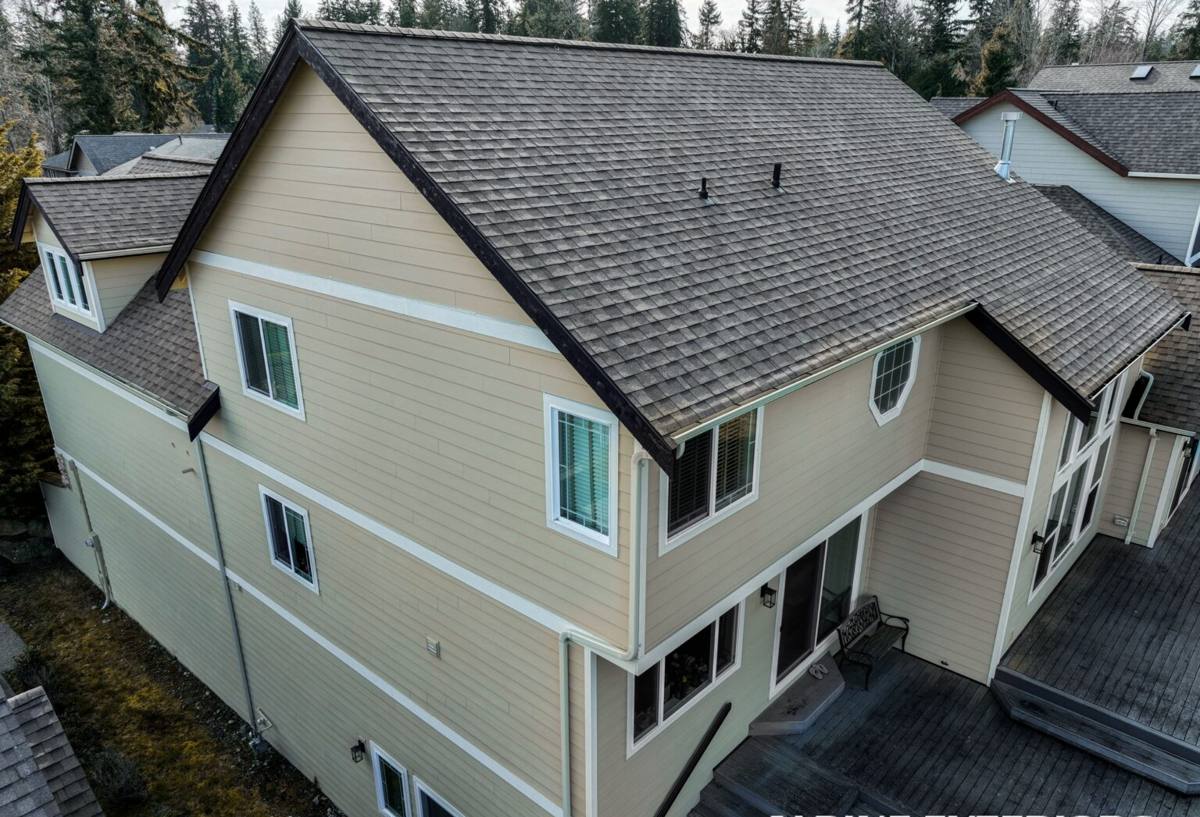
What Salt Air and Driving Rain Do to a Deck Over Time
Salt air is corrosive, and it doesn't need to be a stiff ocean breeze to do damage — a steady low-level marine air, day after day, is enough to accelerate rust on fasteners, hinges, and any exposed metal hardware. On a deck, that means screws, joist hangers, post bases, and railing brackets are all under more stress than they would be on a deck twenty miles inland. When the wrong-grade fastener is used, you get rust streaking down the decking within a few years and, eventually, a structural connection that's weaker than it looks.
Driving rain is the second half of the equation. Ferndale gets plenty of rain in a normal year, but wind-driven rain off the water finds its way into places a gentle vertical rain never would — behind ledger boards, under poorly lapped flashing, into end grain that isn't sealed. Water that gets behind a ledger board and can't escape is one of the most common causes of hidden rot we find on older decks in this area, and it's almost always a detailing problem, not a wood-quality problem.
Why This Matters for Ledger Attachment
The ledger board — where the deck attaches to the house — is the single most important connection on most decks, and it's also the most common failure point in a wet coastal climate. Proper flashing, a continuous water-resistive barrier behind the ledger, and a small gap or drainage path between the ledger and the siding are non-negotiable in Marietta. Skipping any of these steps might not show a problem for a year or two, but it eventually leads to rot that's expensive to fix because it's hidden behind the deck itself.
Moss Season and Deck Safety
Anyone who's lived through a Whatcom County winter knows moss season isn't subtle. On a deck, moss doesn't just look bad — it holds moisture against the decking surface and turns a normal walking surface into a genuine slip hazard, especially on stairs. The boards most at risk are the ones that don't get much sun or wind: under overhangs, on the north side of the house, and in corners where airflow is limited.
Two things control how bad moss season gets on a given deck: drainage and surface texture. A deck built with tight board spacing, poor under-deck ventilation, or a smooth, low-traction decking surface will grow moss faster and hold it longer than one built with proper gapping, airflow underneath, and a surface designed with some grip. This is a design decision made at build time, not something you can fully fix with a pressure washer every spring.
Choosing the Right Decking Material for This Climate
There's no single "best" decking material — there's a best material for a given budget, look, and maintenance appetite, and in a salt-air, high-moisture climate like Marietta's, some trade-offs matter more than they would elsewhere.
| Material | How It Handles Salt Air & Rain | Moss Resistance | Maintenance |
|---|---|---|---|
| Cedar | Naturally rot-resistant, but fasteners and end grain need attention | Moderate — needs regular cleaning | Periodic sealing/staining to maintain performance |
| Pressure-Treated Fir/Pine | Good structural performance if properly sealed; cut ends need re-treating | Moderate — porous surface holds moisture | Regular sealing; watch for surface checking |
| Composite Decking | Very stable in wet, salty conditions; won't rot | Low-to-moderate — surface texture matters | Occasional cleaning, no sealing needed |
| PVC/Capped Composite | Excellent moisture resistance, fully sealed surface | Low — sheds moisture quickly | Lowest — cleaning only |
We install all of these, and the right call depends on your budget and how much upkeep you want to do. What we won't do is install any of them with mismatched fasteners or skipped flashing details just to save time — that's where coastal decks actually fail, regardless of which decking material sits on top.
What a Correctly Built Deck Requires
A deck that's going to hold up in Marietta's climate needs a few things done right, every time, not just when it's convenient:
- Stainless steel or coated fasteners rated for coastal/high-moisture exposure — not standard interior-grade hardware
- Continuous, properly lapped flashing at the ledger board with a drainage gap behind it
- Footings set to the depth and bearing Whatcom County code requires for the soil conditions on your lot
- Joist spacing and beam sizing matched to your actual span and load, not just "what's always been done"
- Board gapping and under-deck airflow sized for drainage, not just appearance
- Guardrails, stair rise/run, and baluster spacing built to current code — this is a safety item, not a style choice
- Sealed or capped cut ends on any wood component exposed to weather
Miss any one of these and the deck might look fine on installation day. The problems show up two, five, or ten years later — usually as soft spots near the ledger, rust streaks, or a railing post that's gone spongy at the base.
Permits and Local Code
Most new decks and many significant deck rebuilds in Ferndale and unincorporated Whatcom County require a building permit, particularly once you're above a certain height off grade or attaching structurally to the house. Permitting isn't a formality to skip — it's an inspection checkpoint that catches footing depth, ledger attachment, and railing code issues before they're buried under decking. We handle the permit process as part of the job, so you're not the one tracking down inspections or trying to interpret code language on your own.
Our Process for a Custom Deck Build
1. On-Site Assessment
We look at your home's exposure — how much direct wind and rain it gets off the water, how much sun the deck area gets (a big factor in moss growth), and what the existing structure or ledger attachment looks like if there's a deck to replace.
2. Design and Material Selection
We talk through layout, size, and material options honestly, including the maintenance trade-offs of each, so you're picking based on what you actually want to deal with five years from now, not just what looks best on day one.
3. Permitting
We prepare and submit what's needed for your jurisdiction and schedule inspections at the right points in the build.
4. Construction
Footings, framing, ledger flashing, decking, and railings — built with the fastener grade, flashing details, and spacing appropriate for a Marietta-area home, not a generic inland spec.
5. Final Walkthrough
We walk the finished deck with you, cover basic care for whatever material you chose, and make sure you know what to watch for as the seasons change.
Keeping a Marietta Deck in Good Shape
A well-built deck in this climate still needs some seasonal attention. This is a reasonable maintenance rhythm for most homes in the area:
- Clear leaves and debris from between boards before the fall rains set in
- Sweep or rinse moss off the surface as it appears through winter — don't let it establish
- Check fastener heads and railing connections once a year for rust or movement
- Re-seal or re-stain wood decking on the manufacturer's recommended schedule, not just when it looks faded
- Keep gutters and downspouts near the deck clear so runoff isn't draining directly onto or under it
- Confirm under-deck vents or gaps haven't been blocked by landscaping or storage
Why Hiring a Crew That Knows Marietta Matters
A lot of deck problems we get called to fix started with a crew that builds decks fine — just not decks in this specific environment. Fastener grade, flashing detail, and drainage design all need to be adjusted for a marine climate, and that adjustment isn't automatic unless the crew has actually worked this coastline before. We've built and repaired decks throughout the Ferndale area, including Marietta, and we size the materials and details to the exposure your specific lot actually gets, not a generic Pacific Northwest average.
If you're planning a new deck or replacing one that's showing its age, we're glad to come take a look and talk through honest options for your home. Reach out through the form below for a free, no-pressure estimate.