 Ferndale Siding
 A Waterfront Deck Takes a Different Kind of Beating
Sandy Point sits right on the water, and that changes what a deck has to survive year after year. A deck in a sheltered inland yard mostly deals with rain and sun. A deck at Sandy Point deals with all of that plus salt-laden air coming off the water, near-constant wind exposure, and driving rain that hits at an angle instead of falling straight down. Add in the long stretch of gray, damp months that Whatcom County sees every year, and you've got a structure that ages faster than most homeowners expect.
None of that means a deck at Sandy Point is doomed to fail early. It means the repair work has to account for those conditions specifically — the fasteners, the flashing details, the wood treatment, even the order of operations — rather than treating it like a generic repair job. That's the difference between a fix that lasts one season and one that holds up for the long haul.
Warning Signs It's Time for Repair, Not Just Cleaning
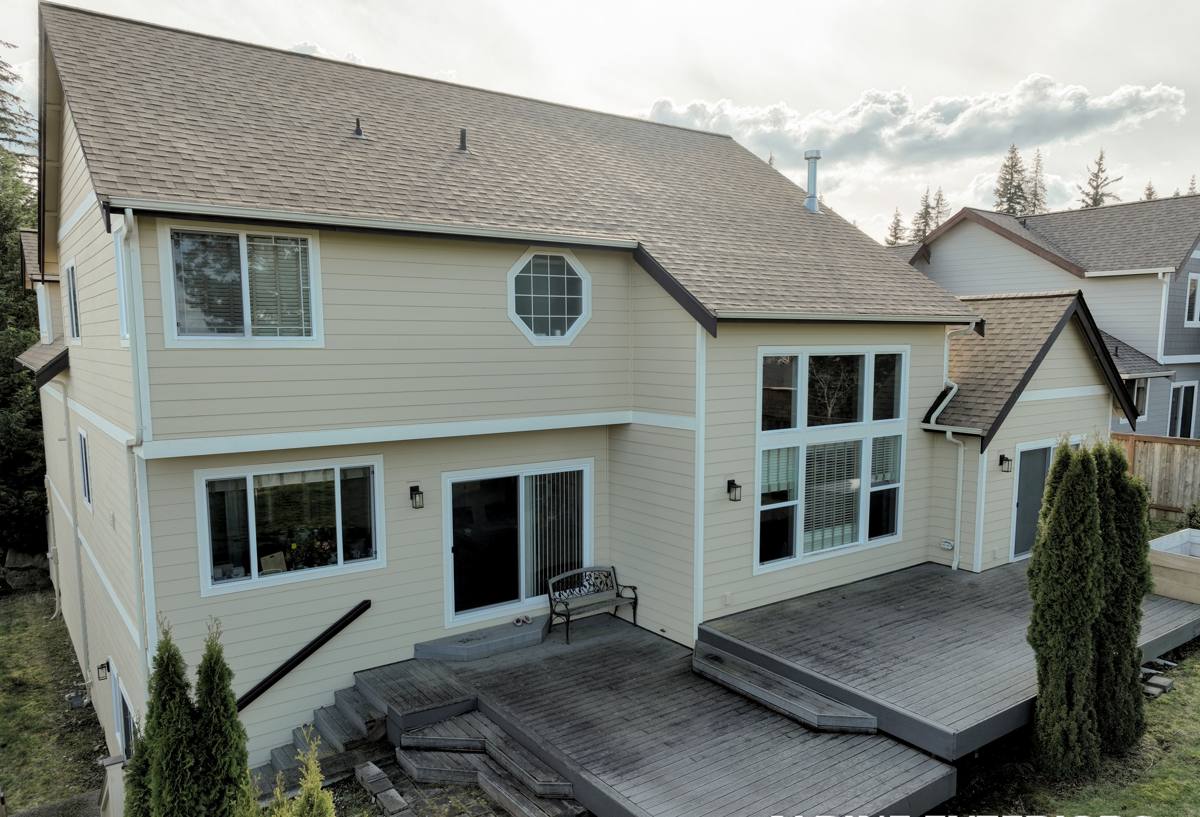
A lot of deck problems get mistaken for cosmetic issues — a little discoloration, a squeak here and there — when they're actually early signs of structural trouble. Salt air speeds up corrosion on metal fasteners and connectors in ways that aren't always visible from the top of the deck. Here's what we look for, and what you should too:
- Rust streaking around screw heads or bolt connections, even if the wood around them looks fine
- Soft or spongy spots when you press on the decking boards, especially near the house or along the edges
- Gaps or movement where the deck ledger board meets the house — this is a structural connection, not a cosmetic one
- Railings or posts that flex more than they used to, or that feel loose when you lean on them
- Persistent green or black staining that comes right back within weeks of cleaning
- Visible cracking or splitting in structural framing members, not just the decking surface
- Standing water that doesn't drain within an hour or two of rain stopping
If you're seeing more than one or two of these, it's worth having someone look underneath the deck, not just at the walking surface. A lot of the real damage in salt-air environments happens out of sight, in the framing and fastener connections.
What a Correct Deck Repair Actually Involves
Structural Framing and the Ledger Connection
The ledger board — where the deck attaches to the house — is the single most important structural connection on most decks, and it's also one of the most common places we find hidden rot or corrosion in waterfront homes. A proper repair means pulling back decking as needed to inspect the ledger, the joist hangers, and the flashing behind them, not just patching what's visible from above. If the flashing was installed poorly or has failed, water has likely been getting behind it for a while, and that has to be addressed before anything else matters.
Decking Surface and Fasteners
Once the framing is confirmed sound, the decking boards and their fasteners come next. In a salt-air setting, the fastener choice matters as much as the board choice. We'll get into that in more detail below, but the short version is: whatever held the deck together originally may not be adequate for another 15-20 years of this environment, even if the wood itself is fine.
Railings, Stairs, and Guards
Railings and stair stringers take a lot of abuse from wind and moisture and are also a safety issue, not just an appearance one. Loose railing posts usually mean the framing they're anchored to has softened, which circles back to the structural check above. We don't reattach a railing to compromised wood and call it fixed — we address what it's anchored into.
Repair or Replace? Weighing the Real Factors
Not every deck problem calls for full replacement, and not every deck is worth patching indefinitely either. Here's how we typically walk homeowners through that decision:
| Factor | Leans Toward Repair | Leans Toward Replacement |
|---|---|---|
| Framing condition | Solid, dry, no rot at connections | Soft or rotted joists, ledger, or posts |
| Age of structure | Under 15 years, built to a reasonable standard | Older, or built with undersized/outdated framing |
| Extent of damage | Isolated boards, localized fastener corrosion | Widespread staining, movement, or rot across the deck |
| Fastener type used originally | Stainless or quality coated hardware still intact | Standard galvanized hardware badly corroded |
| Owner's plans | Staying long-term, wants to preserve current layout | Wants a different size, layout, or material upgrade |
A short, honest inspection is really the only way to know which column your deck falls into. We'd rather tell a homeowner their deck needs full replacement than sell them a repair that won't hold — and just as often, we find that a targeted repair is genuinely all that's needed.
Materials That Actually Hold Up in Salt Air
This is where a lot of decks in coastal Whatcom County get shortchanged, not because of bad workmanship but because standard hardware wasn't designed for this environment. Standard galvanized fasteners are fine in most inland settings, but salt air accelerates corrosion on galvanized coatings much faster than it does further from the water. For Sandy Point repairs, we favor stainless steel fasteners and connectors at any point where the hardware is exposed to weather or in direct contact with treated lumber, since certain wood treatments can also accelerate corrosion on lower-grade metals.
For decking material itself, both quality wood and composite decking can perform well here — it's less about which product is inherently "better" and more about matching the material to how the homeowner wants to maintain it. Wood decking needs regular refinishing to keep moisture out, which some owners are glad to do because it's straightforward and affordable to touch up. Composite decking costs more up front and needs far less finishing maintenance, but it still needs the same attention to framing, fasteners, and drainage underneath — composite doesn't fix a bad structural foundation, it just changes what the top surface requires from you.
We don't push one product over another as a blanket rule. We'll walk through the honest maintenance trade-offs for your specific deck and let you decide what fits your budget and how much upkeep you want to take on.
Fighting Whatcom County's Long Moss Season
Moss and algae growth is less about the deck itself and more about how much of the year it stays damp and shaded — and in this part of Washington, that's a big chunk of the calendar. Moss doesn't just look bad; it holds moisture against the wood surface and makes boards slicker and more slippery underfoot, which is a real safety concern on stairs and ramps.
Part of a good repair addresses the conditions that let moss take hold in the first place: making sure boards have proper gaps for airflow and drainage, correcting any low spots where water pools, and trimming back overhanging vegetation where that's within the homeowner's control. Cleaning alone doesn't solve a drainage or airflow problem — it just buys you a few months before the moss comes back.
How We Handle a Sandy Point Deck Repair, Start to Finish
- Inspection: We check the deck from above and below — decking surface, framing, ledger connection, fasteners, and drainage — and tell you plainly what we find.
- Written plan: You get a clear scope of what needs repair versus replacement, in plain language, before any work starts.
- Material selection: We talk through fastener grade and decking material options suited to your specific exposure and budget.
- The repair itself: Structural issues get addressed first — framing, ledger, flashing — before cosmetic surface work.
- Final check: We walk the deck with you when it's done so you know exactly what was fixed and what to keep an eye on going forward.
Why Local Experience in Sandy Point Matters
Waterfront neighborhoods like Sandy Point have their own quirks — narrow beach-access streets, homes sitting closer to salt spray than most of Ferndale proper, and weather that comes off the water differently than it does a few miles inland. A crew that's already worked decks in this specific setting isn't guessing at what fastener grade to use or how much flashing detail a ledger connection needs here — they've already seen how the standard approach holds up, and where it doesn't.
There's also a practical side to it: knowing the area means knowing how to get materials and equipment in and out efficiently on tighter waterfront lots, and understanding that a repair schedule may need to work around weather windows that are narrower here than inland. That local familiarity translates into fewer surprises and a repair that's built for the actual conditions your deck faces, not a generic set of assumptions.
Keeping Your Deck in Good Shape After the Repair
A well-done repair buys you a lot of time, but a little regular attention stretches that even further in this climate:
- Rinse off salt residue and debris a few times a year, especially after storms
- Keep an eye on fastener heads for early rust staining and address it before it spreads
- Clear leaves and debris from between boards so water and airflow aren't blocked
- Recoat or reseal wood decking on the schedule the product calls for — don't stretch it out
- Do a quick check under the deck once a year, looking at the ledger board and framing connections
If you're seeing signs of wear on a deck in Sandy Point or anywhere else around Ferndale, we're happy to take a look and give you a straightforward assessment — no pressure, no upselling, just an honest read on what your deck actually needs. Use the form below to request a free estimate.