 Ferndale Siding
 Building a Deck That Actually Belongs on the Sandy Point Coastline
Sandy Point sits close enough to the water that every deck built there is fighting a low-grade battle against the same three things year after year: salt-laden air, driving rain that comes in sideways more often than straight down, and a moss season that seems to start earlier and last longer each year in Whatcom County. A deck built with the same specs you'd use for a dry inland yard will show its age fast out here — soft spots in the decking, rust bleeding through fasteners, and a green film that never fully goes away no matter how often it's scrubbed. Building correctly for Sandy Point isn't about upgrading everything to the most expensive option available. It's about knowing which parts of a deck take the real abuse in this environment and putting the money and attention where it counts.
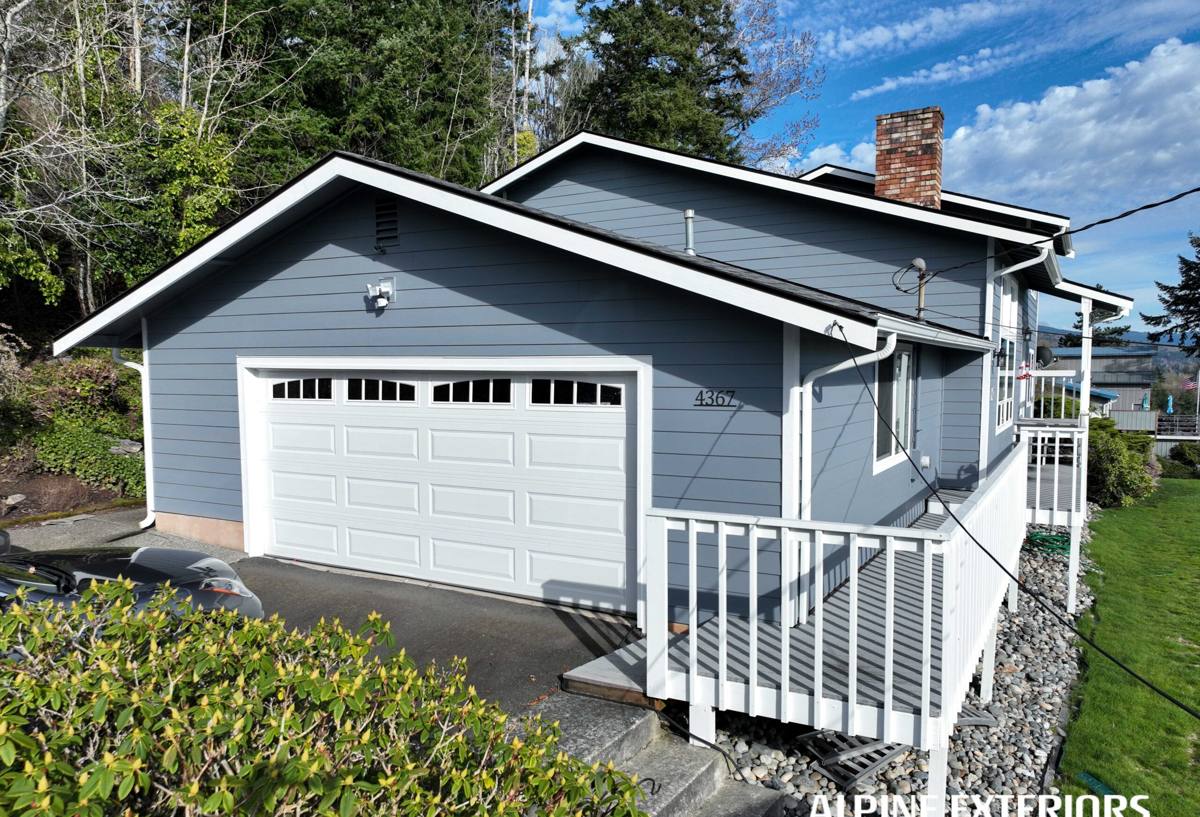
What Salt Air, Rain, and Moss Actually Do to a Deck Out Here
Salt air doesn't just sit on the surface of a deck — it works its way into every joint, fastener head, and seam over the course of a winter. Combined with near-constant moisture, it accelerates corrosion in metal hardware and speeds up wood decay in ways that are hard to see until a board or bracket has already failed underneath. Homeowners a few miles inland in Ferndale proper deal with a milder version of this same problem; out at Sandy Point, the exposure is more direct and more constant.
Moss is the other piece of it. A deck that stays shaded, doesn't get much direct sun, and sits low to grade will hold moisture in its surface longer after every rain. That moisture is exactly what moss and algae need to establish themselves, and once they're growing on a deck surface, they hold even more water against the wood and turn the boards slippery and dangerous underfoot. None of this is exotic — it's just what happens to an ordinary deck in this specific coastal setting when it wasn't designed with that setting in mind.
The Parts of a Deck That Fail First Here
In our experience working this stretch of the county, deck problems in a salt-air, high-moisture environment show up in a predictable order:
- Fastener heads and structural hardware corroding before the wood around them shows any visible damage
- Ledger board connections at the house, where trapped moisture has nowhere to escape
- Joist tops and the undersides of decking boards, which stay wet long after the surface looks dry
- Post bases at or near grade, where splash-back and standing water do the most damage
- Railing connections exposed to direct wind-driven rain from the water side of the property
Choosing Decking Material for a Sandy Point Property
There's no single "best" decking material for every home — it depends on budget, how much maintenance a homeowner actually wants to do, and how exposed the deck is to wind and salt spray. What we won't do is recommend a material and then let a homeowner find out five years later that it wasn't a good fit for this climate. Here's how the common options actually compare once salt air and moss are part of the equation:
| Material | Upfront Cost | Salt Air / Moisture Behavior | Moss & Algae Resistance | Typical Maintenance |
|---|---|---|---|---|
| Pressure-treated lumber | Lowest | Good if properly sealed and re-sealed; treatment protects against rot but not corrosion of surface fasteners | Needs regular cleaning and periodic sealing to resist buildup | Annual cleaning, re-sealing every 2–3 years |
| Cedar | Moderate | Naturally rot-resistant but softer surface can wear faster under constant damp/dry cycling | Better than pressure-treated but still needs upkeep | Regular cleaning, periodic oil or sealant application |
| Composite decking | Higher | Doesn't absorb moisture into the board itself; performs well in salt air | Surface texture matters — some composites hold algae film more than others | Periodic washing, no sealing or staining needed |
| PVC / capped composite | Highest | Fully sealed surface, best resistance to moisture intrusion | Easiest to keep clean, least prone to holding moss | Occasional washing only |
For a deck that gets regular salt spray or sits close to the water side of a Sandy Point lot, we generally steer homeowners toward composite or capped composite decking for the walking surface — not because wood "fails," but because the maintenance burden of keeping a wood surface sealed against this much moisture is a real, ongoing cost that a lot of homeowners underestimate when they're comparing sticker prices. If budget points toward wood, that's a legitimate choice too — it just means being honest up front about the sealing schedule it needs to hold up out here.
Framing and Substructure: Where the Real Work Happens
The decking surface is what everyone sees, but the framing underneath is what determines whether a deck is still solid in ten years. In a high-moisture, salt-air environment, we treat the substructure differently than we would on a dry inland lot:
Ledger and House Connection
The ledger board — where the deck attaches to the house — is the single most common point of hidden rot on any deck, anywhere, and salt air makes it worse by accelerating corrosion in the flashing and fasteners at that joint. Correct flashing detail here, done once and done right, is worth more than almost any other single decision on the project.
Joists and Beams
We use fasteners and connectors rated for the moisture and corrosion exposure this location actually sees, not just whatever meets minimum code for an inland build. Joist tape or equivalent protection over the tops of joists keeps water from sitting directly against cut lumber where it does the most damage.
Posts and Footings
Post bases that hold wood up off the concrete, rather than embedding it, keep the most vulnerable part of the structure out of standing water and splash-back — which matters more here than in a drier part of the county where ground moisture isn't a year-round condition.
Fasteners and Hardware: The Detail Homeowners Never See Until It Fails
This is the part of a deck build that's easiest to cut corners on because nobody inspects it after the boards go down. In a salt-air environment, standard galvanized fasteners can corrode faster than the wood around them, leading to staining, weakened connections, and eventually loose boards or railings. We spec stainless steel or high-grade coated fasteners and structural hardware rated for coastal exposure on every Sandy Point project — it costs more per box of screws, but it's a small fraction of the total project cost and it's the difference between hardware that's still tight in fifteen years and hardware that's rusting through in five.
Our Deck Building Process for Sandy Point Homes
- On-site assessment — we look at sun exposure, wind direction relative to the water, existing drainage, and how the site has handled moisture historically before we ever talk materials.
- Design and material selection — decking, railing, and hardware chosen for the specific exposure of that lot, not a one-size-fits-all spec.
- Permitting — we handle the permit process through the applicable county or local building department before any work starts.
- Demolition and site prep — removal of any existing structure and grading adjustments where drainage needs help.
- Footings and framing — built to handle the moisture and corrosion exposure specific to this location, not just minimum code.
- Decking, railing, and finish work — installed with attention to fastener placement and drainage gaps between boards so water sheds instead of pooling.
- Final walkthrough — we go over maintenance expectations honestly, including what this specific deck will need and when.
Permits and Practical Site Considerations
Deck construction in and around Ferndale and unincorporated Whatcom County generally requires a building permit once a deck exceeds a certain height or size, and setback rules can matter more on some Sandy Point lots depending on proximity to the water and existing property lines. We handle this process as part of the job rather than leaving a homeowner to sort it out — but every lot is different, and we won't guess at specifics that depend on a given property's zoning or shoreline designation until we've actually looked at it.
A Realistic Maintenance Checklist for This Environment
Even a well-built deck needs some upkeep in this climate — the goal is to make that upkeep manageable rather than a constant fight. A reasonable annual routine looks like:
- Clear debris from between boards and off the surface before fall rains set in
- Wash the deck surface at least once a year to knock back algae and moss before it establishes
- Check railing and stair connections for looseness, which often shows up before visible corrosion does
- Inspect the ledger board area at the house for any staining or soft spots
- Re-seal wood decking on the schedule appropriate to the product — don't wait until it's visibly gray and weathered
- Confirm gaps between boards are clear so water keeps draining instead of pooling on the surface
Why It Matters to Hire a Crew That Already Works This Coastline
A lot of deck problems we get called out to repair weren't built badly in a general sense — they were built to a standard that would have held up fine a few miles inland but wasn't matched to what Sandy Point's salt air and rain actually do over time. Fastener grade, flashing detail, and material choice all need to be adjusted for this specific exposure, and that's the kind of judgment that comes from having already built and repaired decks in this exact area, not from a generic spec sheet. We've done work throughout Ferndale and the surrounding Whatcom County coastline, and we bring that same standard to every deck we build out at Sandy Point.
If you're planning a new deck or replacing one that hasn't held up, we're happy to take a look and give you a straightforward, no-pressure estimate — just fill out the form below.