 Ferndale Siding
 Everson's Climate Puts Extra Stress on Siding
Everson sits inland along the Nooksack River valley, a few miles east of Ferndale, in a part of Whatcom County that gets its own particular mix of weather problems. It doesn't take the direct salt spray that homes right on Bellingham Bay or the Strait of Georgia deal with, but salt-tinged marine air still moves through the county on prevailing westerly winds, and it settles on fasteners, trim, and any exposed metal over time. Combine that with the driving rain events that roll through in fall and winter, open farmland that lets wind push moisture into every seam and lap, and the shade and humidity that river-valley lots hold onto longer than open ground — and you get a climate that is genuinely hard on exterior materials.
The result is a long moss season. Moss and algae don't just need moisture, they need moisture that sticks around, and Everson-area homes with tree cover, north-facing walls, or low ground clearance get exactly that for much of the year. None of this means siding is doomed here. It means repairs have to account for where water actually goes, not just what's visible from the driveway.
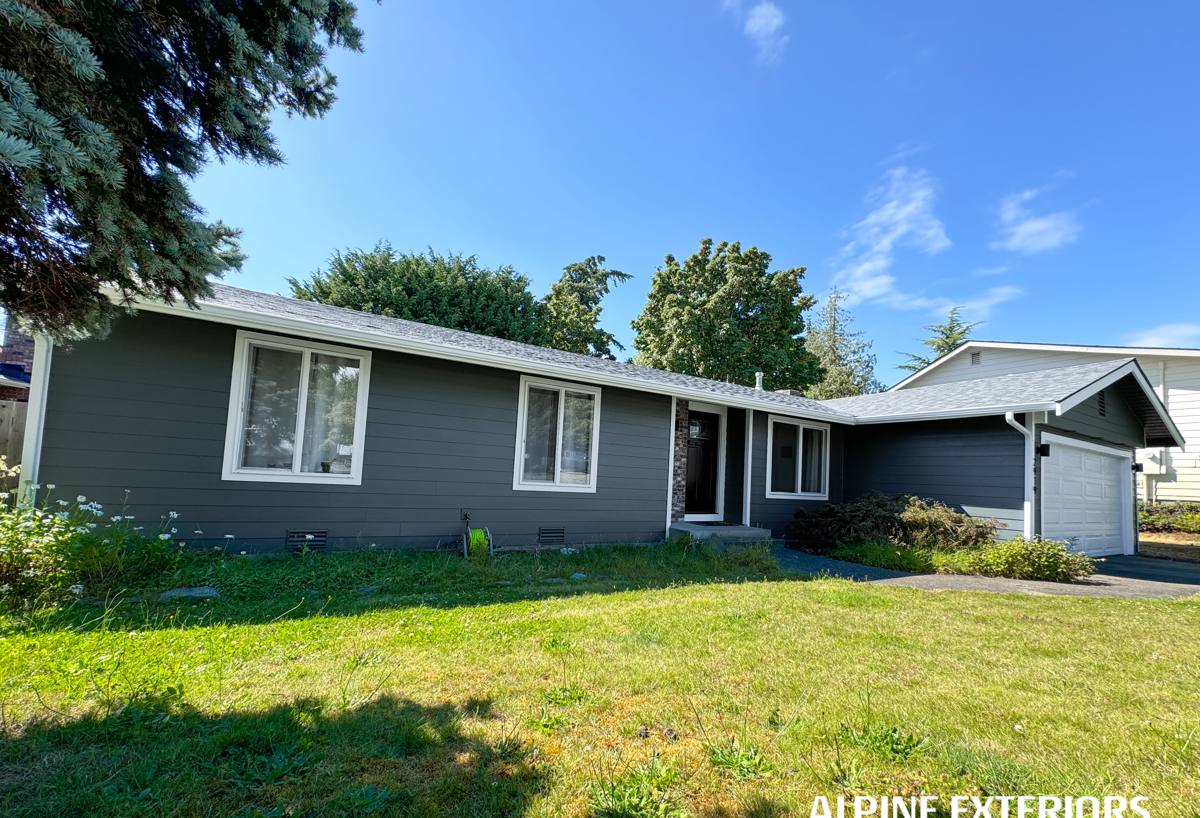
Signs Your Siding Needs Repair, Not Just a Wash
A lot of siding problems in this area get treated as cosmetic — a power wash, a coat of paint, some caulk from a tube — when the underlying issue is moisture that's already working its way behind the surface. Knowing the difference saves homeowners from spending money twice.
Moss, Algae, and Dark Staining
Surface growth on its own is usually cosmetic. But moss that's thick enough to hold water against the siding, or staining that keeps coming back within weeks of cleaning, is a sign the wall isn't drying out between rain events. That's a repair issue, not a cleaning issue.
Soft, Swollen, or Delaminating Panels
Press on suspect areas, especially near the bottom courses, around window sills, and at deck ledgers. If a panel gives, feels spongy, or the layers are separating, water has already gotten past the surface. This is common on older wood-based or composite siding that's reached the end of its service life.
Cracked, Warped, or Missing Boards
Freeze-thaw cycles, wind-driven debris, and simple age crack and warp boards, especially at butt joints and corners. Once a board is cracked, it's no longer shedding water the way it was designed to, and the damage underneath accelerates fast.
Gaps, Caulk Failure, and Trim Separation
Caulk is a maintenance item, not a permanent fix. When it shrinks, cracks, or pulls away from trim and window casings, it opens a direct path for wind-driven rain — exactly the kind Everson gets during winter storm systems moving in off the coast.
What a Correct Siding Repair Actually Involves
A repair that only addresses what's visible from the ground tends to fail again within a season or two. A correct repair starts with figuring out how water got in, not just patching where it came out.
Finding the Water Path, Not Just the Symptom
Staining or soft siding on a wall often points to a problem several feet away — a failed kick-out flashing at a roof-to-wall intersection, a gap behind a light fixture, or a missing drip cap over a window. We pull back siding to trace the actual entry point before deciding what needs to be replaced versus what can be sealed and reinstalled.
Matching Material, Profile, and Finish
Patched-in siding that doesn't match plank width, reveal, or color reads as a repair from the street forever. On Hardie siding this means matching the correct HZ5 product line, profile, and ColorPlus finish so the repaired section blends in rather than standing out.
Flashing, House Wrap, and Water Management Details
The siding itself is the least important part of keeping water out of a wall — the flashing, house wrap, and drainage plane behind it do the real work. Any repair we do reinstates proper weather-resistive barrier overlaps, flashes penetrations correctly, and leaves a drainage gap where the siding calls for one, so the wall dries the way it's supposed to.
Repair Scenarios We See Around Everson and Ferndale
Every home is different, but a few patterns show up repeatedly in this part of Whatcom County:
- Older homes with original wood or early composite siding reaching the end of its practical service life, with moisture damage concentrated at the lowest courses and around ground-level trim.
- Homes on more open, ag-adjacent lots that take direct wind-driven rain with less windbreak, showing wear concentrated on west- and south-facing walls.
- Tree-shaded lots with persistent moss and algae on north-facing walls that stay damp longer between dry spells.
- River-valley humidity contributing to slower drying times overall, which extends the effective moss season compared to more open, breezier sites.
None of these are unusual or alarming — they're just the specific conditions a repair plan needs to account for instead of ignoring.
Repair or Replace? How We Help You Decide
Not every damaged section means a full re-side. But damage that's spread across multiple walls, or siding that's already near the end of its expected life, often makes a targeted repair a short-term fix rather than a real solution. Here's how we typically walk homeowners through that decision:
| Factor | Favors Repair | Favors Full Replacement |
|---|---|---|
| Extent of damage | Isolated to one wall or a few sections | Spread across multiple elevations |
| Age of existing siding | Under 15-20 years, otherwise sound | Original siding nearing or past expected service life |
| Underlying water damage | Localized, sheathing intact | Rot or sheathing damage found in multiple areas |
| Material match | Product still available or close match achievable | Discontinued profile or faded color that won't blend |
| Long-term plan | Homeowner plans to sell or hold short-term | Homeowner wants a 30+ year exterior with minimal upkeep |
We'll always tell you honestly which side of that table your home falls on rather than defaulting to the bigger job.
Why We Repair and Rebuild Only With James Hardie Fiber Cement
We install and repair exclusively with James Hardie fiber cement siding. We don't install vinyl, LP SmartSide, Cemplank, Allura, or bare cedar and primed spruce, and it's a deliberate standard, not a lack of options.
Vinyl moves with temperature and can crack or warp in cold snaps; it also can't be repainted to match a home's evolving look. Engineered wood products like LP SmartSide perform well when the factory finish and edge sealing stay intact, but any breach — a nail pop, a saw cut left unsealed, a corner that takes repeated moisture — puts wood fiber at risk of swelling in exactly the wet-then-dry cycle this region produces. Bare cedar and primed spruce require ongoing painting and caulking to hold up here, and skipping even one maintenance cycle in a moss-prone climate shows up fast. Other fiber cement brands compete reasonably on the base material, but James Hardie's HZ5 line is specifically engineered for wet, high-humidity climates like ours, backed by a ColorPlus factory finish that resists fading and doesn't rely on field-applied paint to perform, and a strong transferable warranty.
When we repair a home, patching in anything other than Hardie means introducing a material with different moisture behavior, different expansion characteristics, and a different warranty status into a wall system. That's a maintenance headache waiting to happen. Keeping repairs Hardie-to-Hardie keeps the whole wall performing as one system.
Our Siding Repair Process
- On-site inspection: We look at the visible damage and probe surrounding areas for soft spots, staining patterns, and likely entry points.
- Diagnosis: We identify the actual water path — flashing, trim, penetrations, or grade issues — not just the board that's failing.
- Written scope and estimate: You get a clear explanation of what's being replaced, what's being resealed, and why, with cost broken out honestly.
- Removal and inspection of sheathing: Damaged siding comes off and we check the wall behind it before closing anything back up.
- Correct reassembly: House wrap, flashing, and drainage details get reinstated to spec, then matching Hardie siding goes back on with proper fastening and clearances.
- Final walkthrough: We show you what was found and what was done, so there are no surprises later.
Choosing a Repair Crew That Already Works in Everson
Siding repair is easy to do badly and hard to do well, because a sloppy repair can look fine for a year before the water problem it papered over resurfaces. A crew that already works this specific stretch of Whatcom County has seen how this valley's rain, wind exposure, and moss season actually behave on real homes — not just in a training manual.
Before hiring anyone for a siding repair, it's worth asking:
- Will you diagnose the cause of the damage before quoting a fix, not just patch what's visible?
- Are you licensed and insured to work in Washington, and can you provide proof?
- Will the repaired section match the existing siding's profile, reveal, and color?
- What's actually happening behind the siding — will flashing and house wrap be inspected and corrected, or just covered back up?
- Is the replacement material warrantied, and does that warranty stay intact when it's a repair rather than a full install?
A contractor who can answer those clearly, without dodging, is one worth trusting with the job.
If you're seeing moss buildup, soft spots, or storm damage on your Everson or Ferndale home, we're happy to take a look and give you a straight answer about what's going on and what it'll take to fix it right. Reach out for a free, no-pressure estimate using the form below.