 Ferndale Siding
 Siding Repair in Fairhaven: A Different Set of Conditions
Fairhaven sits close to the water, and that changes what siding repair actually needs to accomplish. A cracked panel or soft spot on a home a few miles inland is often a cosmetic problem. The same damage on a home exposed to Bellingham Bay's salt air, wind-driven rain, and a long, damp moss season is usually a sign that moisture has already found a way behind the cladding. Our crew works this coastal stretch of Whatcom County regularly out of Ferndale, and the repair calls we get from Fairhaven look different from the ones we get ten minutes inland — more corner and butt-joint failures, more paint and caulk breakdown on the weather-facing walls, more moss creeping into seams that never fully dry out between storms.
That context matters because a repair that just replaces what's visibly broken, without addressing why it broke, tends to fail again in a season or two. Good siding repair in this area starts with figuring out what the damage is actually telling you about moisture, airflow, and the condition of the material underneath.
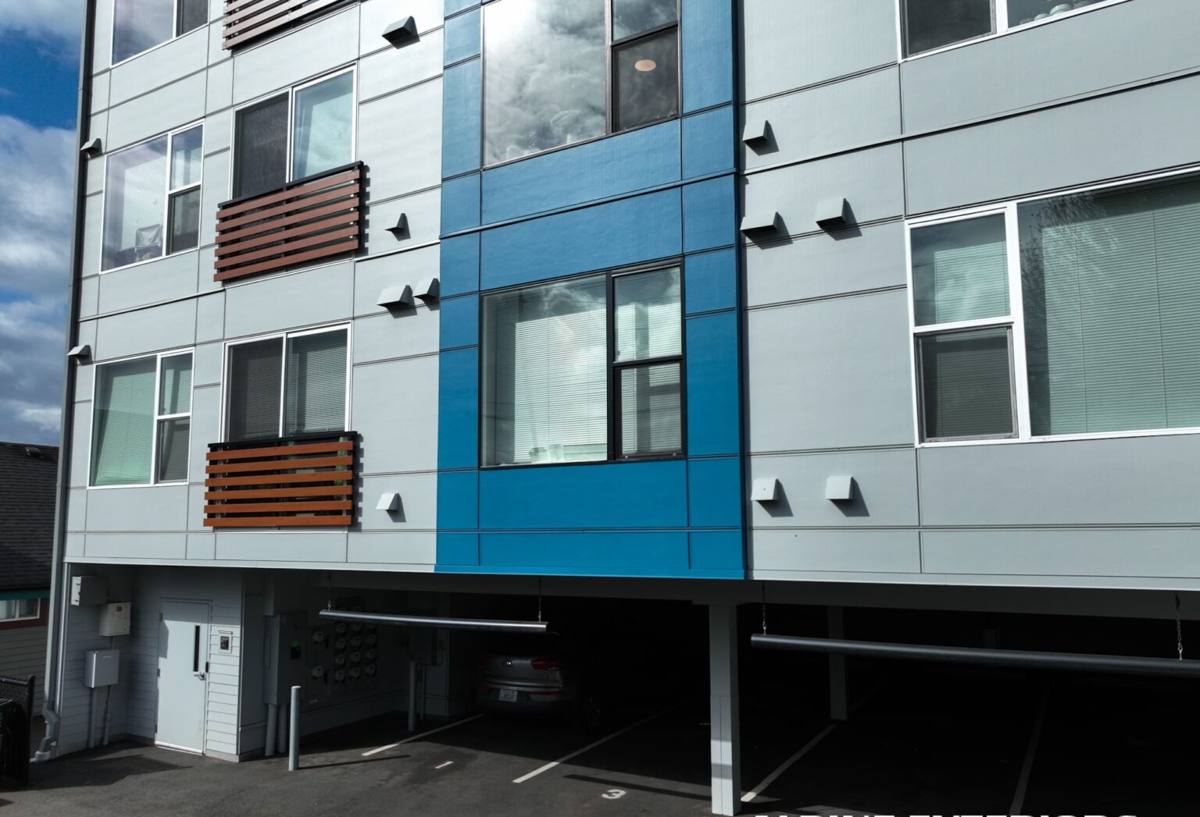
What Salt Air, Rain, and Moss Actually Do to Siding
Salt Air
Coastal air carries fine salt particles that settle on exterior surfaces and accelerate the breakdown of paint films, caulk, and unprotected fasteners. Over years, this shows up as chalking, faster fade on painted trim, and corrosion on any nail heads, flashing, or hardware that wasn't rated for exposure. It doesn't destroy siding on its own, but it shortens the life of every finish and fastener on the wall.
Driving Rain
Wind off the water doesn't just wet a wall — it drives rain sideways and up under laps, trim, and butt joints that were only designed to shed water running straight down. That's where poor original installation shows up first: gapped joints, missing or wrong flashing, caulk used in place of proper detailing. Water gets in, and because it got in sideways, it often doesn't drain back out the way it came.
Moss and Prolonged Moisture
Whatcom County's wet season is long, and shaded or north-facing walls near mature trees can stay damp for weeks at a time. Moss and algae take hold in that environment, holding moisture against the siding surface far longer than open, sunny walls experience. On wood-based or improperly sealed products, that sustained dampness is where rot gets started.
Signs Your Fairhaven Home May Need Siding Repair
- Soft, spongy, or crumbling siding when pressed — especially near the bottom courses or around window and door trim
- Visible cracking, especially at butt joints or corners where panels meet
- Paint that's peeling, bubbling, or failing in one specific area rather than evenly across the wall
- Dark streaking, moss, or persistent green growth that doesn't dry out between rain events
- Gaps opening up at trim, corner boards, or window casings
- A musty smell or visible staining on interior walls that back up to exterior siding
- Fasteners backing out, rust streaks below nail heads, or panels that have visibly shifted
Any one of these can be minor. Several showing up in the same area of the house, especially a wall that takes the brunt of the weather, usually means water has been getting behind the siding for a while.
What a Correct Repair Actually Involves
A repair that's done right is not just swapping a damaged piece for a matching one. It starts with removing enough surrounding material to actually see the wall behind it — the house wrap or weather-resistive barrier, the sheathing, the flashing details around windows, doors, and penetrations. That inspection tells us whether we're dealing with a surface problem or a structural one.
A proper repair sequence looks like this:
- Remove the damaged section and enough adjacent material to expose the underlying wall assembly
- Inspect sheathing and framing for rot or soft spots and address any found before closing the wall back up
- Repair or replace the weather-resistive barrier and flashing at that section — this is the layer that actually keeps water out, not the siding itself
- Install new siding matched to the existing product, profile, and reveal
- Detail joints, corners, and penetrations correctly rather than relying on caulk to bridge a gap that should have been flashed
- Match paint or factory finish as closely as the existing material allows
Skipping the second and third steps is the most common shortcut in siding repair, and it's exactly the shortcut that lets Fairhaven's rain and salt air cause the same failure again.
Patch, Repair, or Full Re-Side: How We Decide
Not every damaged wall needs to be fully re-sided, but not every problem can be spot-patched either. We look at three things: how much of the wall is affected, whether the damage is isolated or spread across multiple elevations, and what condition the material is in overall. A single impact-damaged panel on an otherwise sound wall is a straightforward repair. Widespread soft siding, repeated moisture staining on more than one wall, or a home where the original installation shows the same detailing mistakes throughout is usually telling you the whole system needs attention, not just the spot you noticed.
We'll always tell you honestly which category your situation falls into, including when a repair is the right, cost-effective call and a full re-side isn't necessary.
Why We Repair With — and Onto — James Hardie Fiber Cement
We install exclusively James Hardie fiber cement siding, and that standard carries into our repair work too. When we're patching into an existing Hardie wall, we're working with a material that's engineered for exactly the conditions Fairhaven deals with: non-combustible, dimensionally stable in wet climates, and available in HZ product lines built for moisture-heavy regions like the Pacific Northwest. ColorPlus factory-finished panels also give us a much better shot at a clean color match on a repair than field-painted materials do, since the finish was baked on at the factory rather than applied on site years apart.
When a repair call comes in on a home with vinyl, LP SmartSide, primed wood, or another fiber cement brand, we'll still assess and repair what's there honestly. But if a homeowner is facing a repair extensive enough to reconsider the material altogether, we'll walk through why we standardized on Hardie: it doesn't absorb water and swell the way engineered wood products can if a seam fails, it doesn't have the expansion and contraction behavior that causes vinyl to gap and rattle in temperature swings, and its warranty structure and track record in coastal, wet climates is why we're willing to put our name behind it.
Repair Compatibility by Existing Siding Type
| Existing Siding | Repair Approach | Long-Term Consideration |
|---|---|---|
| James Hardie fiber cement | Direct patch or panel replacement, ColorPlus match where possible | Best long-term match; product engineered for this climate |
| Vinyl | Panel replacement using compatible profile | Discontinued colors/profiles can be hard to match years later |
| LP SmartSide / engineered wood | Section replacement, careful check for moisture wicking at repair edges | Repeat repairs common if original seams weren't sealed correctly |
| Primed wood or cedar | Repair, prime, and repaint to match | Ongoing maintenance cycle continues regardless of this repair |
Our Process for a Fairhaven Repair Call
- Assessment — We look at the damaged area and the wall assembly behind it, not just the visible siding, and check for the same issues on other exposed elevations.
- Honest scope and estimate — You get a clear explanation of what's damaged, why, and whether it's a patch, a repair, or something bigger — in plain language, no pressure.
- Repair execution — Removal, sheathing and barrier inspection, correct flashing and detailing, then new siding installed to match.
- Finish and cleanup — Paint or finish matched as closely as the existing material allows, site cleaned up, work area left as we found it.
Repair Cost Factors
| Factor | Why It Matters | Typical Impact on Cost |
|---|---|---|
| Extent of hidden damage | Rot or moisture behind the wall must be addressed before new siding goes up | Can significantly increase scope once the wall is opened |
| Wall exposure | Weather-facing and water-facing elevations see more driving rain and salt exposure | Higher-exposure walls may need more thorough flashing repair |
| Color and profile match | Older or discontinued products are harder to match seamlessly | May require repainting a broader area for a consistent look |
| Access and site conditions | Height, landscaping, and tight lot lines affect labor time | Modest impact, varies by property |
| Number of affected areas | Multiple isolated repairs vs. one concentrated area | More trips and setup can add cost vs. a single consolidated repair |
Before You Call: A Quick Homeowner Checklist
- Note which side(s) of the house the damage is on — this tells us a lot about weather exposure
- Check nearby interior walls for staining, soft drywall, or musty smells
- Look for moss or dark streaking on shaded or tree-covered walls
- Press gently on any soft-looking siding to gauge how far the damage extends
- Take note of when you first noticed the issue and whether it's gotten worse after storms
- Have your siding type handy if you know it (vinyl, fiber cement, wood, engineered wood)
Why It Matters to Hire a Crew That Already Works Fairhaven
Siding repair in a coastal Whatcom County community isn't the same trade as siding repair in a dry inland climate. A crew that regularly works Fairhaven and the surrounding Bellingham Bay area already knows which walls take the worst of the weather, how fast moss reestablishes itself in the wet months, and what correct flashing and detailing needs to look like to actually hold up here — not just pass inspection somewhere drier. That local pattern recognition is what separates a repair that lasts from one you're calling us back about next winter.
If you're seeing damage, staining, or moss on your Fairhaven home's siding, we're happy to take a look and give you an honest read on what it needs — whether that's a small patch or something more. Reach out for a free, no-pressure estimate and we'll walk the property with you.