 Ferndale Siding
 Siding Repair Built for Nooksack's Weather, Not Just Its Zip Code
Homes in and around the Nooksack area near Ferndale take a different kind of beating than siding fifty miles inland. You've got salt-laden air drifting in off the bay, driving rain that comes in sideways during the fall and winter storm cycle, and a moss season that can stretch from October clear into May. Siding repair out here isn't a cosmetic errand — it's about catching the small stuff before it becomes a rot problem behind the wall.
We repair siding on Nooksack-area homes regularly enough to know the pattern: damage shows up first on north-facing walls, under overhangs that don't quite clear the wall plane, and anywhere moisture can sit instead of shed. A repair done right addresses why the damage happened, not just what it looks like from the driveway.
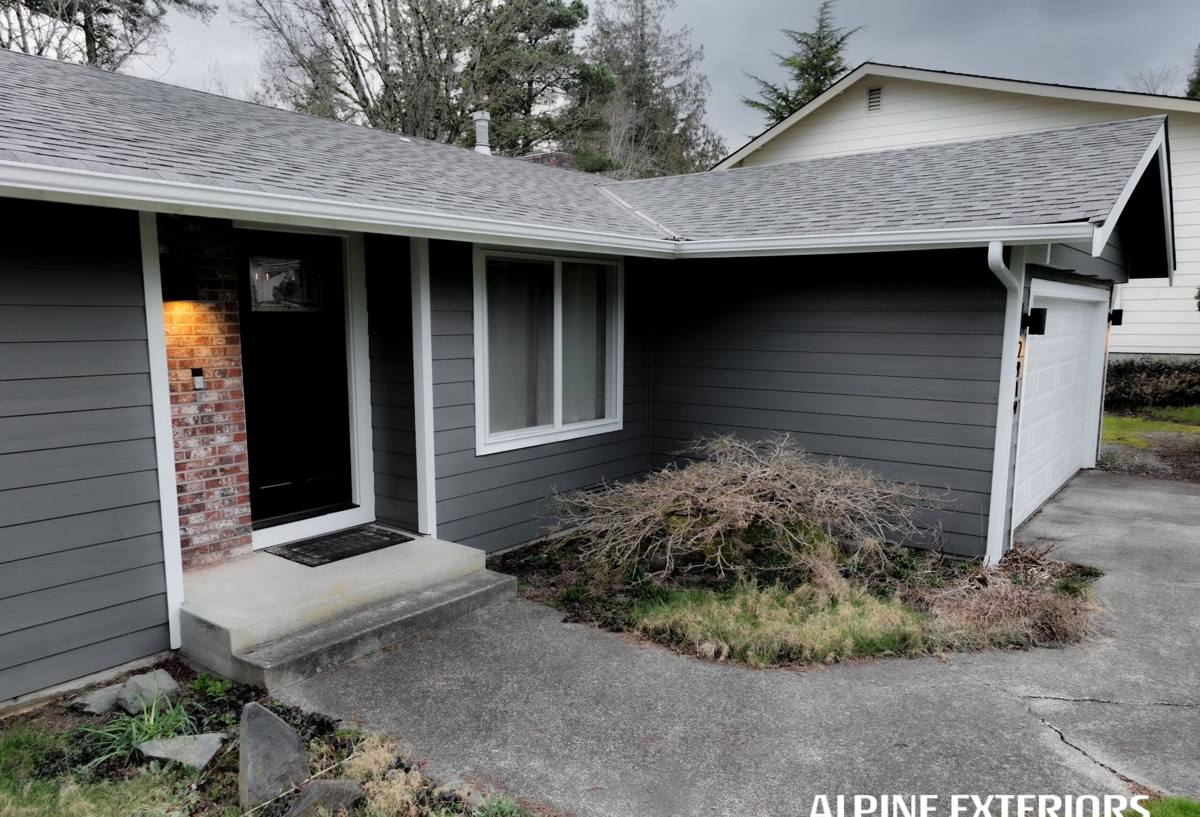
Why This Climate Is Harder on Siding Than It Looks
Salt Air
Whatcom County's proximity to Bellingham Bay and the Salish Sea means airborne salt works its way onto exterior surfaces year-round. Salt is hygroscopic — it pulls moisture out of the air and holds it against whatever it's sitting on. On wood-based siding, that means paint and caulk joints fail faster than the manufacturer's warranty assumes. On metal fasteners and trim, it accelerates corrosion, which shows up as rust streaking below nail heads.
Driving Rain
Storms off the water don't fall straight down — they come in at an angle, which pushes water into laps, seams, and butt joints that were only ever designed to shed vertical rainfall. Over years, that wind-driven rain finds every gap in the caulking and flashing.
A Long Moss Season
Shaded and north-facing walls in this part of Whatcom County stay damp long enough that moss and algae get a genuine foothold, not just a light green tinge. Moss holds moisture directly against the siding surface for months at a stretch, which is exactly the condition that lets rot start in wood substrates and lets coatings fail early on fiber cement and other materials.
Signs a Nooksack-Area Home Needs Siding Repair
- Soft or spongy spots when you press on the siding, especially near the bottom courses and around window trim
- Visible cracking, splitting, or buckling in individual boards or panels
- Persistent moss or dark streaking that comes back within weeks of cleaning
- Paint that's peeling or bubbling rather than just fading
- Gaps opening up at butt joints, corners, or where siding meets trim
- Rust staining below fastener heads or at metal flashing
- Any soft drywall, musty smell, or staining on interior walls that back up to exterior siding
- Siding that flexes or feels loose when tapped
Any one of these on its own might be minor. Several together, especially on the same wall, usually means moisture has been getting behind the siding for a while.
Common Damage by Siding Material
| Siding Material | Typical Failure Mode Here | Repairable? |
|---|---|---|
| Cedar / wood lap | Rot at butt joints and bottom courses, paint failure from moisture cycling | Often, if rot is localized and framing underneath is sound |
| Vinyl | Cracking in cold snaps, warping near heat sources, panels popping loose in wind | Section replacement possible, but color-matching aged vinyl is difficult |
| LP SmartSide / OSB-based products | Edge swelling and delamination where moisture penetrates the strand board core | Limited — swelling usually signals the panel itself is compromised |
| Fiber cement (James Hardie) | Caulk joint failure, coating wear at cut edges, occasional impact damage | Yes — individual planks or panels replace cleanly without disturbing the rest |
What a Correct Siding Repair Actually Involves
A repair that just patches the visible damage without checking what's behind it is a repair you'll pay for twice. Here's what we actually do:
1. Remove and Inspect
We pull the damaged siding back far enough to see the house wrap, flashing, and sheathing underneath — not just the section that looks bad. Water damage almost always travels further than the visible symptom.
2. Address the Water Path, Not Just the Symptom
If the damage traces back to a flashing gap, a caulk joint that failed, or a grading issue pushing splashback onto the wall, we fix that first. Replacing siding over an unresolved moisture path just buys a few more years before the same spot fails again.
3. Replace Sheathing or Framing If Needed
If the water intrusion has been going on long enough to soften the sheathing or framing, that gets replaced before any new siding goes back on. This is the step that gets skipped by crews trying to keep a repair cheap, and it's the one that matters most.
4. Match and Reinstall
For fiber cement repairs, matching factory-finished color and profile is straightforward. For older wood or vinyl siding, we'll be upfront if an exact match isn't realistic — sometimes the honest answer is that a repair will be visible, and you should decide if that's acceptable or if it's time to talk about replacement.
5. Reseal Properly
Correct caulk joints at penetrations, trim, and butt joints, with the right sealant for the substrate — not a tube of whatever was on the truck.
Repair vs. Replacement: How to Decide
| Factor | Favors Repair | Favors Replacement |
|---|---|---|
| Extent of damage | Isolated to one or two wall sections | Present on multiple elevations |
| Age of siding | Under 15 years, still within useful life | Original siding is 20+ years old |
| Underlying material | Fiber cement, sound cedar | OSB-based product with edge swelling, failing vinyl with no matching stock |
| Moisture source | Identifiable and fixable (flashing, caulk, grading) | Chronic, whole-house moisture management issue |
| Color/profile match | Available and close | Discontinued or badly weathered, mismatch will be obvious |
We'll tell you honestly which side of that table your home falls on. If a repair will genuinely hold, we don't push a full replacement just because it's the bigger job.
When Repair Isn't Enough: Why We Rebuild in James Hardie
When damage is widespread enough that replacement is the right call, this company installs James Hardie fiber cement siding — that's the only product we put on a home. We stopped installing vinyl, LP SmartSide, and other engineered wood products because, in this climate specifically, they carry maintenance and moisture trade-offs that show up as exactly the kind of repair calls detailed above: swelling edges, cracked panels, and caulk joints that don't hold in driving rain.
James Hardie's fiber cement is non-combustible, holds ColorPlus factory finish far longer than field-applied paint, and their HZ product lines are engineered around real regional exposure — including damp, salt-influenced coastal conditions like Whatcom County's. It costs more upfront than vinyl or engineered wood, and it's less forgiving of poor installation technique, which is exactly why installation quality matters as much as the product choice. Correctly installed, with proper clearances, fastening, and joint treatment, it's the product we're willing to warranty and stand behind.
Why a Crew That Already Works Nooksack Matters
Siding repair is a trade where local experience actually changes the outcome, not just the sales pitch. A crew that already works in this part of Whatcom County knows which wall orientations take the worst of the wind-driven rain, how long moss actually takes to become a moisture problem here versus a purely cosmetic one, and what correct flashing detail looks like for our rain load — not a generic national spec sheet. That translates into fewer surprises once we open up a wall, and a repair that's sized to what your home actually needs.
It also means a straight answer about scope. We're not incentivized to turn every repair call into a full re-side, and we're not going to patch over a rot problem to make a bid look cheaper. We tell you what we find, what it'll take to fix it right, and let you make the call.
What to Expect From Your Estimate
- An on-site inspection of the damaged area and anywhere else moisture is likely to be tracking
- A clear explanation of what's causing the damage, not just what it looks like
- An honest repair-vs-replacement recommendation, with the trade-offs laid out
- A written scope so you know exactly what's included before work starts
If your siding in the Nooksack area is showing soft spots, persistent moss, cracking, or gaps that keep opening back up, it's worth getting a professional look before another wet season passes. Reach out for a free, no-pressure estimate — we'll tell you straight what we find and what it'll take to fix it.