 Ferndale Siding
 Siding for a Peninsula That Takes a Beating
Point Roberts sits on its own peninsula, surrounded on three sides by the waters of the Salish Sea and connected to the rest of Whatcom County only by a drive through Canada. That geography is part of what makes it a beautiful place to own a home — and part of what makes siding on that home work harder than siding fifteen miles inland in Ferndale. Homes here take a steady diet of salt-laden air, wind-driven rain off the water, and long stretches of damp, low-light weather that keep north- and west-facing walls wet for days at a time. Siding that would hold up fine in a more sheltered spot can fail early out here if it isn't built and installed for this specific exposure.
This page is about one product, in one place: James Hardie fiber cement siding, installed on Point Roberts homes. We don't install vinyl, LP SmartSide, or other fiber cement brands, and we'll explain why as it becomes relevant — but the short version is that we've standardized on the one siding system we're confident will actually hold up to what this peninsula throws at a house.
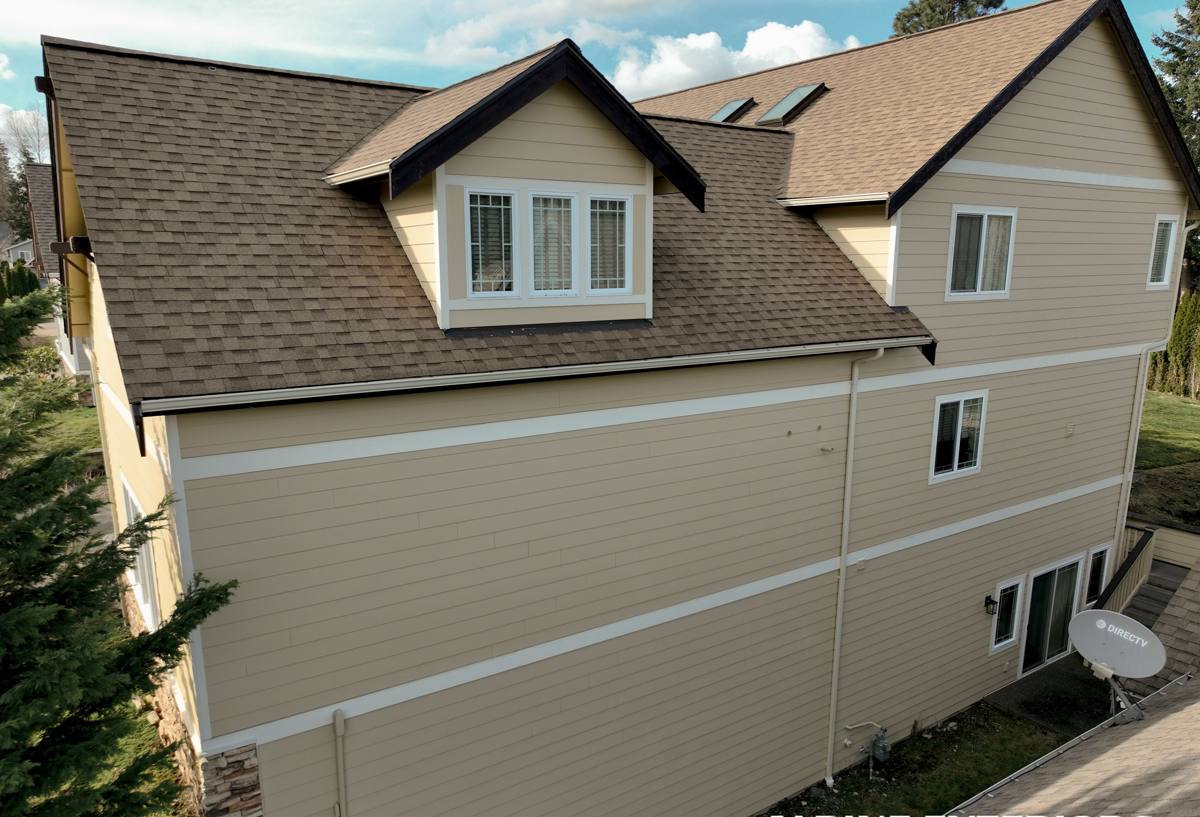
What Salt Air, Driving Rain, and Moss Season Actually Do to Siding
Salt Air
Airborne salt from the surrounding water settles on exterior surfaces year-round, not just during storms. On some siding materials this accelerates surface breakdown and fastener corrosion; on painted wood and some engineered wood products it can work into seams and edges and speed up swelling and delamination. It's a slow, cumulative problem — the kind of thing that doesn't show up as a warranty claim in year two, but shows up as a full re-side ten years earlier than it should have.
Driving Rain
Point Roberts gets the same wind-driven rain pattern common across the outer edges of the Pacific Northwest, where storms come off open water with enough force to push moisture sideways into wall assemblies, not just down. That means siding, flashing, and joints have to shed water that's hitting them at an angle, not just falling on them vertically. Poorly lapped siding, gapped trim, or caulk used in place of proper flashing tends to get found out here faster than in more sheltered inland neighborhoods.
Moss Season
Whatcom County's wet season runs long, and shaded or north-facing walls on Point Roberts properties — especially those tucked behind trees or facing away from the sun — stay damp for extended periods. That's exactly the environment moss and algae need to take hold. On absorbent or poorly sealed siding materials, sustained moss growth holds moisture against the wall surface, which is a slow but real threat to whatever's underneath.
Why James Hardie Is the Product We Put on These Homes
James Hardie fiber cement is manufactured from cement, sand, and cellulose fiber — an inert, non-combustible material that doesn't absorb and hold water the way wood-based products can. That matters directly for a peninsula environment: it doesn't swell, rot, or delaminate from sustained moisture exposure the way engineered wood siding can, and it doesn't provide the same food source for moss and mildew that untreated or lightly primed wood products do.
James Hardie also engineers specific product formulations for different climate zones through its HZ5 and HZ10 lines, and the products used in Western Washington are formulated for the wetter, milder Pacific climate zone rather than a hot, dry, or freeze-heavy one. On top of that, Hardie's ColorPlus factory-applied finish is baked on in a controlled environment and backed by its own finish warranty — which matters here specifically, because field-applied paint on siding exposed to salt air and constant damp tends to need touch-up and recoating far sooner than a factory finish does.
We don't install LP SmartSide, vinyl, or other fiber cement brands like Allura or Cemplank. Vinyl can warp and fade under sustained coastal sun and salt exposure, and its seams and J-channels give wind-driven rain more opportunities to get behind the cladding. Engineered wood products carry real fire and moisture-sensitivity trade-offs that we're not comfortable putting behind us with a warranty on a coastal property. Other fiber cement brands may be reasonable products, but we've chosen to specialize in one system — parts, fasteners, finish, and warranty — so every job we do, we do the same way, with materials engineered specifically for this climate.
What a Correct Installation Involves Here
Fiber cement siding is only as good as the assembly behind it. A rushed or generic install can undercut even the best material, and on an exposed property that shows up faster than it would elsewhere. For Point Roberts homes, that means:
- A drainage plane and weather-resistive barrier installed correctly behind the siding, so any moisture that does get past the cladding has somewhere to go besides the sheathing.
- Rainscreen furring where conditions call for it, creating an air gap that lets walls dry out between rain events instead of staying saturated.
- Proper flashing at every penetration — windows, doors, vents, and roof-to-wall intersections — using flashing and integrated water management, not caulk as a substitute for it.
- Correct fastening patterns and clearances per Hardie's published installation instructions, including minimum ground clearance and gaps at butt joints to allow for material movement.
- Factory-finished cut edges sealed with the appropriate Hardie touch-up product, so field cuts don't become the one unprotected surface on the whole house.
Skipping any one of these doesn't usually cause a visible problem right away. It shows up years later as a moisture issue behind the wall, which is a far more expensive fix than doing it right the first time.
James Hardie Product Lines: Which Fits a Point Roberts Home
| Product | Best Suited For | Notes for This Climate |
|---|---|---|
| HardiePlank lap siding | Most single-family homes; classic horizontal look | Widely used, straightforward water-shedding lap profile, good baseline choice for coastal exposure |
| HardiePanel vertical siding | Modern facades, accent walls, gable ends | Fewer horizontal laps means fewer potential water-entry points on exposed elevations |
| HardieShingle siding | Cottage or craftsman-style homes, accent sections | More seams than lap siding, so correct installation detail matters more on rain-exposed walls |
| HardieTrim boards | Corners, window and door trim, fascia | Non-combustible, dimensionally stable trim that won't feed moss growth like painted wood trim can |
Most Point Roberts projects end up as a mix — lap siding as the field material with trim boards at corners and openings, sometimes shingle or panel accents on gables or entry features. We'll walk through the options during your estimate rather than pushing a single look on every house.
How We Approach a Point Roberts Job
Assessment First
Before we talk product, we look at the existing siding and, where it's coming off, the sheathing underneath. On a peninsula property, checking for existing moisture damage behind old siding is not optional — it changes the scope of the job, and we'd rather find it during the estimate than after demo has started.
Logistics That Matter Here
Point Roberts is a Washington community, but reaching it means crossing the border twice each way. That affects how we plan material delivery and crew scheduling compared to a job in Ferndale proper — we batch trips, order materials with enough lead time to account for crossing delays, and plan the job so a crew isn't making unnecessary back-and-forth trips mid-project. A contractor who hasn't worked Point Roberts before often underestimates this and it shows up as delays once the job is underway.
Installation and Inspection
We follow Hardie's published fastening, clearance, and flashing specifications on every job — not as a minimum, but as the standard, because it's what keeps the manufacturer's warranty valid and keeps the wall assembly working the way it's designed to. We walk the finished job with the homeowner before we consider it done.
Living With Hardie Siding on a Coastal Property
Correctly installed James Hardie siding is genuinely low-maintenance, but "low-maintenance" doesn't mean "zero attention" on a property exposed to this much salt air and rain. A little seasonal care goes a long way:
- Rinse accumulated salt residue and grime off exterior walls periodically, especially on elevations facing open water.
- Keep gutters and downspouts clear so roof runoff isn't sheeting down siding faces or pooling near the base of walls.
- Trim back vegetation and tree cover where practical to let shaded, moss-prone walls get more light and air movement.
- Inspect caulking at trim joints, windows, and penetrations annually and have any cracked or failed sealant replaced.
- Touch up any exposed cut edges or minor finish damage with the correct Hardie touch-up product rather than generic exterior paint.
Why Hiring a Crew That Already Works This Peninsula Matters
Siding installation isn't identical everywhere in Whatcom County. A crew that mostly works sheltered inland lots in Ferndale or Bellingham may not default to rainscreen detailing or the flashing sequence that a directly water-exposed Point Roberts wall actually needs, simply because they don't run into that exposure level as often. A crew that already works this peninsula knows the wind and rain patterns, knows to check for moisture issues before they're visible, and has already worked out the border-crossing logistics so your project doesn't stall out waiting on materials or a delayed crew. That familiarity isn't a marketing point — it's the difference between a siding job that's built for this specific environment and one that's just built.
Cost Factors on a Point Roberts Siding Project
| Factor | Why It Matters Here |
|---|---|
| Existing siding removal and disposal | Tear-off scope and any sheathing repair found underneath affects total labor |
| Home size and wall complexity | Corners, gables, and dormers add trim and cut work |
| Product mix chosen | Lap, panel, shingle, and trim combinations price differently |
| Rainscreen or drainage plane upgrades | Added moisture protection recommended for directly exposed elevations |
| Material delivery logistics | Cross-border scheduling affects lead time, not typically total cost |
We don't quote a job sight unseen — every Point Roberts estimate starts with an actual look at the house so the numbers reflect your property, not a generic average.
If you're planning a siding project on Point Roberts and want a straight answer about what your home actually needs, we're glad to come take a look. The estimate is free, there's no pressure, and you'll get a clear explanation of what we see and why we'd handle it the way we would — use the form below to get started.