 Ferndale Siding
 Building Decks for Semiahmoo's Waterfront Conditions
Semiahmoo sits right where Whatcom County land meets open water, and that location shapes everything about how a deck should be built there. Homes on or near the spit get more direct exposure to salt-laden wind, driving rain off the bay, and a damp, shaded growing season for moss than most inland Ferndale properties see. A deck that would hold up fine a few miles inland can start showing corrosion, soft spots, or slick green growth within a couple of seasons if it wasn't built with this specific environment in mind.
We're a Ferndale-based crew, and we treat a Semiahmoo deck project differently from a standard build the moment we scope it. That means different fastener specs, different attention to the ledger connection, and different material recommendations than we'd give for a deck tucked away from the water. This page walks through what that actually looks like — not sales language, just what we've learned building and repairing decks in this stretch of Whatcom County.
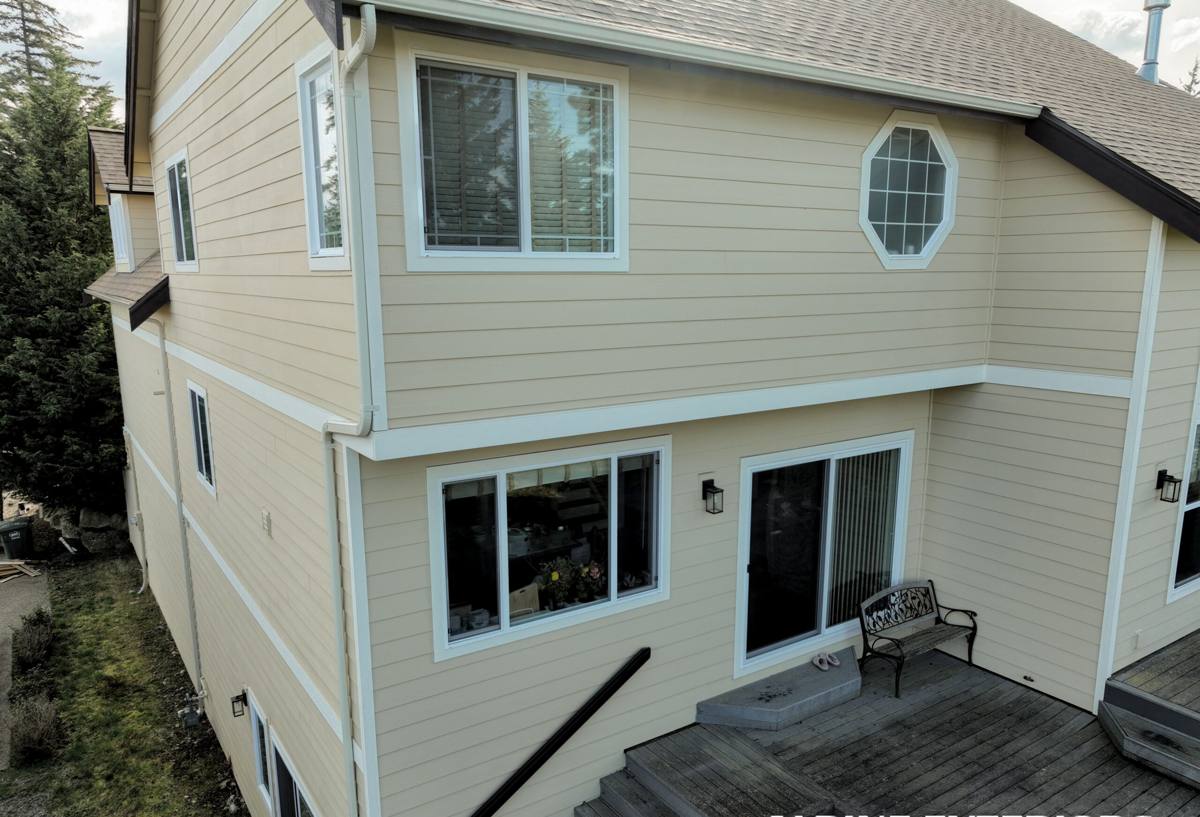
What Salt Air and Driving Rain Actually Do to a Deck
Salt air is corrosive to metal, full stop. On a waterfront or near-waterfront property, that means standard galvanized fasteners, joist hangers, and screws can start rusting years ahead of schedule. Once a fastener corrodes, it loses holding strength long before the rust is visible from the surface, which is exactly why so many deck failures near the water trace back to hardware, not the decking boards themselves.
Driving rain adds a second problem: water intrusion at the points where the deck meets the house. Wind-driven rain doesn't fall straight down — it gets pushed sideways and upward into gaps that a calm-weather deck in a sheltered yard would never have to deal with. The ledger board (the piece that bolts the deck to the house framing) is the single most common point of rot and hidden water damage on a poorly built deck, and it's almost always because flashing was skipped or installed wrong, not because the wood itself failed.
Together, salt exposure and wind-driven rain mean a Semiahmoo deck needs corrosion-resistant hardware throughout and a ledger detail that actually sheds water away from the house, not just a board bolted to the siding.
Moss, Shade, and Ferndale's Long Wet Season
Whatcom County's wet season runs long, and a lot of Semiahmoo-area lots have mature trees or neighboring structures that keep parts of a deck shaded through the winter and spring. Shade plus moisture plus mild temperatures is exactly the recipe moss needs, and once it takes hold on a deck surface it does more than look bad — it holds moisture against the boards and turns the walking surface slick and genuinely dangerous, especially on stairs.
Moss isn't just a cosmetic problem to be pressure-washed away once a year. The right response starts at the design stage: board spacing that allows real airflow underneath, a structure with enough ventilation below the joists, and decking material chosen with the shade pattern of that specific yard in mind. A deck built without accounting for where the sun does and doesn't reach will fight moss every single year regardless of how it's cleaned.
Choosing the Right Decking Material for This Environment
There's no single "best" decking material — the right call depends on how much sun exposure the deck gets, how close it is to the water, and how much upkeep the homeowner actually wants to do. Here's how the common options stack up for a Semiahmoo-area project specifically:
| Material | Salt Air / Moisture Behavior | Moss & Maintenance | Typical Cost Tier |
|---|---|---|---|
| Pressure-treated wood | Holds up reasonably well if sealed regularly; end grain and fastener points are the weak spots | Needs annual cleaning and periodic re-sealing to resist moss and graying | Lower |
| Cedar | Naturally rot-resistant but softer; benefits from a breathable sealer in wet, shaded spots | Moderate upkeep; can develop moss faster than composite in shaded areas | Mid |
| Capped composite | Excellent moisture and salt resistance; won't absorb water or rot | Low maintenance; still needs occasional cleaning where shaded | Higher |
| Tropical hardwood (e.g. ipe) | Very dense and naturally weather-resistant | Low moss risk but requires periodic oiling to keep color; installation is unforgiving | Highest |
For most Semiahmoo homes we work on, capped composite has become the practical default because it removes the sealing and re-staining cycle entirely, which matters more here than in a drier inland yard. That said, some homeowners want the look and feel of real wood and are willing to keep up a maintenance schedule — that's a legitimate choice too, as long as it's made with clear eyes about the upkeep.
Framing and Fasteners: The Parts You Don't See Matter Most
The decking boards get all the attention, but the framing underneath and the fasteners holding it together are what determine whether a deck is actually safe in five or fifteen years. In a salt-air environment, this is where we deviate most from a standard build:
- Stainless steel or heavy hot-dip galvanized fasteners throughout — not just at the surface, but in every hanger, bolt, and structural screw
- Joist hangers and structural connectors rated for the corrosion exposure of the specific site, matched to the fastener metal to avoid galvanic reaction between dissimilar metals
- Proper ledger flashing that directs water out and away from the house band board, with a gap or drainage plane behind it rather than a direct seal against the siding
- Joist tape or a moisture barrier on top of the framing lumber so standing water doesn't sit directly on cut or drilled wood
- Footings sized and set to the local frost depth and soil conditions, not just "deep enough to look right"
None of this is visible once the deck is finished, which is exactly why it's the part most likely to get shortcut on a lower-bid job. It's also the part that determines whether you're looking at a simple board replacement in ten years or a full structural rebuild.
Railings, Wind Exposure, and Code Requirements
Open, waterfront-adjacent lots around Semiahmoo tend to see more sustained wind than a sheltered inland yard, which affects how railings and any attached structures like pergolas or privacy screens need to be anchored. Railing height, baluster spacing, and guard requirements are set by code regardless of location, but wind exposure changes how robust the post attachment and blocking need to be to hold up over time without loosening.
Whatcom County permitting applies to most new deck construction and many significant repairs or rebuilds, and inspections check the structural connections we've already covered — ledger attachment, footings, and railing anchoring in particular. Building to code isn't a formality here; it's the baseline for a deck that's actually going to be safe to use in the kind of wind and moisture this area gets.
Our Process, Start to Finish
We keep the process straightforward and make sure the homeowner understands what's happening at each stage, especially the parts that get covered up once construction moves forward:
- On-site assessment — we look at sun exposure, drainage, existing structure (for rebuilds), and how the site sits relative to wind and water exposure
- Design and material selection — sized to the space, with decking and hardware matched to the site's actual exposure level, not a one-size-fits-all spec
- Permitting — we handle the Whatcom County paperwork for the scope of work involved
- Demo and framing — including ledger flashing, corrosion-resistant hardware, and footing work done to spec, not shortcuts
- Decking, railing, and finish work — installed with the spacing and fastening approach appropriate to the material chosen
- Final walkthrough and inspection sign-off — so the homeowner knows exactly what was done and what maintenance, if any, it needs going forward
Maintenance Checklist for a Semiahmoo Deck
Even a well-built deck needs some seasonal attention in this environment. Here's what we recommend homeowners actually stay on top of:
- Rinse salt residue and debris off the surface and railings a few times a year, more often if the deck is directly exposed to bay wind
- Clear leaves and organic debris from between boards and in corners before they trap moisture and feed moss growth
- Check fastener heads and railing connections annually for early signs of corrosion or loosening
- Re-seal or re-stain wood decking on the schedule the product actually requires — don't stretch it just because it "still looks fine"
- Keep gutters and downspouts near the deck clear so roof runoff isn't dumping extra water onto or under the structure
- Address any soft spots, discoloration at the ledger connection, or slick green buildup right away rather than waiting for the next scheduled cleaning
Why a Ferndale-Based Crew Matters for a Semiahmoo Build
A crew that works this area regularly already knows what a lot near the Semiahmoo spit is up against — the wind, the salt exposure, the shade patterns that feed moss, and the specific stretch of Whatcom County's permitting process that applies. That's not something you get from a general contractor who mainly works drier, more sheltered neighborhoods and treats every deck the same regardless of site.
It also matters for follow-up. If a fastener needs a look in a few years or a board needs replacing, having a local crew that already knows the project — the material spec, the framing layout, what's underneath the boards — makes that a quick fix instead of a fresh diagnosis from scratch. For a deck in a marine environment, that kind of continuity is worth as much as the initial build quality.
If you're planning a new deck or need to replace one that's showing its age near Semiahmoo, we're happy to come take a look and talk through what your specific site needs — no pressure, no obligation. Use the form below to request a free estimate.