 Ferndale Siding
 Siding Repair Built for Sudden Valley's Exposure
Sudden Valley homes sit against a mix of wooded terrain and open exposure that puts real demands on an exterior wall. Whatcom County's climate does most of the damage over time: salt-laden air moving in off the water, rain that drives sideways as often as it falls straight down, and a moss season that runs long enough to keep north-facing walls damp for months at a stretch. None of that shows up as one dramatic failure. It shows up as a soft spot near a downspout, a cracked panel that started letting water behind the wall two winters ago, or trim that's been quietly rotting under a coat of paint that still looks fine from the driveway.
Siding repair is a different job than new installation, and it's often a more demanding one. Anyone can staple a patch over a hole. Doing the repair right means understanding why that section failed in the first place, checking what's happening behind it, and making sure the fix doesn't just cover up a moisture problem that keeps working on the wall from the inside. That's the standard we hold repair work to on every Sudden Valley property we go out to.
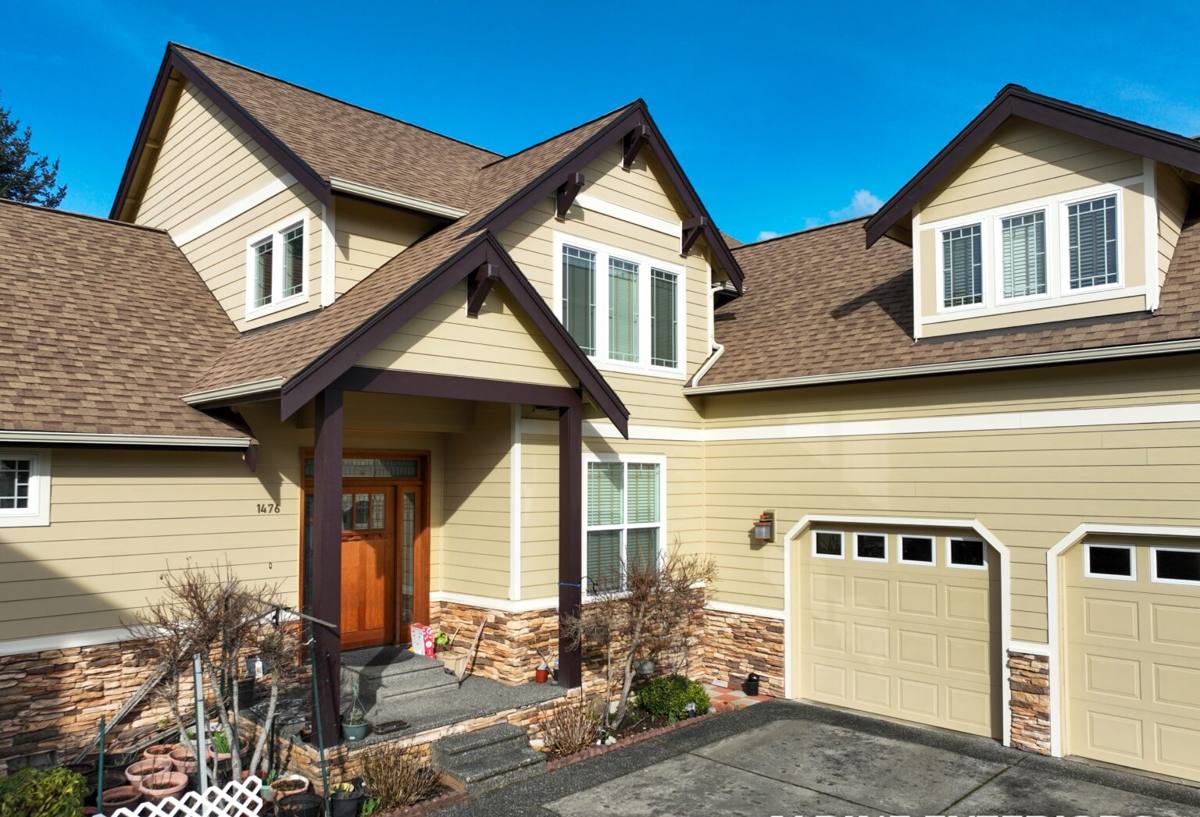
What Whatcom County's Climate Does to Siding Over Time
Salt Air and Slow Corrosion
Even homes that aren't right on the water pick up salt-laden moisture carried inland off Bellingham Bay and the Strait. That air accelerates corrosion in fasteners and flashing and breaks down lower-grade paints and finishes faster than a dry inland climate would. The result is often invisible until a panel comes loose or a nail head rusts through and lets water track behind the board.
Driving Rain Finding the Gaps
Wind-driven rain doesn't behave like a straight-down shower. It gets pushed sideways into lap joints, trim seams, and any spot where flashing has started to fail, which is a harder test than total rainfall alone suggests. A wall that looks fine in a light drizzle can still be taking on water during a windy winter storm, and that water usually finds the weakest seam on the house.
A Long Moss and Mildew Season
Tree cover and near-constant dampness keep moss and mildew active on shaded walls for much of the year in this part of Whatcom County. It's more than a cosmetic issue. Sustained organic growth holds moisture directly against the wall assembly, and that trapped moisture is one of the more common paths to hidden rot behind otherwise normal-looking siding.
Repeated Wet-Dry Cycling
Siding that swells with moisture and then dries out, over and over across a wet season, takes on stress that lower-grade materials don't handle well. Engineered wood and lower-grade composite products are especially prone to cupping, swelling at the edges, or losing their factory coating after enough of these cycles. That's a big part of why the material behind a repair matters as much as the workmanship.
Common Siding Repair Issues We See in Sudden Valley
- Cracked, split, or impact-damaged panels, often from storm debris or tree limbs
- Soft or spongy siding low on the wall or around window and door trim
- Rusting fasteners or corroding flashing that's let water track behind a board
- Moss or dark staining that returns quickly after cleaning, especially on shaded, north-facing walls
- Gaps or separation at seams, corners, and trim joints where caulking has failed
- Bubbling, peeling, or chalky paint that signals the finish has stopped protecting the substrate underneath
- Warped, cupped, or swollen panels on older engineered wood or composite siding
What a Correct Siding Repair Actually Involves
A repair that only replaces the visible damage and stops there is a repair that's likely to fail again. Water damage almost never stays contained to the one board you can see cracked or discolored. Correct repair work on a Sudden Valley home means pulling back enough of the surrounding siding to see what's actually happening underneath before deciding how far the fix needs to go.
Step 1: Find the Actual Source
Visible siding damage is often a symptom, not the root cause. A cracked panel near a window might trace back to failed flashing above it. A soft spot near grade might trace back to a downspout dumping water against the foundation wall. We look at the whole assembly around the damage, not just the damaged board itself, before we start pulling anything off.
Step 2: Check for Hidden Moisture and Rot
Once panels come off, we check the house wrap, sheathing, and framing behind them for softness, staining, or active rot. On a home in this climate, it's common to find that moisture has been tracking behind siding for longer than the visible damage suggests. If we find compromised sheathing or framing, that gets addressed before any new siding goes back on — patching over hidden rot just buys a homeowner a bigger repair bill down the road.
Step 3: Repair or Replace the Water Management Details
Flashing, house wrap, and properly lapped joints are what keep water out of a wall assembly — the siding itself is really the last line of defense, not the only one. A repair that reinstalls new siding over damaged or missing flashing hasn't actually fixed the problem, it's just delayed it until the next wet season.
Step 4: Match and Install New Material Correctly
For homes already sided in James Hardie fiber cement, we match the profile, color, and exposure so the repair blends into the existing wall rather than standing out as an obvious patch. Fastening patterns, clearances from grade and rooflines, and properly lapped and sealed joints all matter just as much on a repair as they do on a full installation — cutting corners here is exactly how a repair ends up needing to be redone.
Repair vs. Replacement: How We Make That Call
| Situation | Usually Points To | Why |
|---|---|---|
| Isolated storm damage or impact to a small section | Repair | Damage is contained and the surrounding wall assembly tests dry and sound |
| Localized rot around one window or a single wall section | Repair, sometimes with partial re-siding of that elevation | Problem is traceable to one flashing or sealant failure, not systemic |
| Widespread moss staining across multiple elevations | Repair plus a maintenance plan, unless sheathing is compromised | Often a surface and moisture-management issue rather than material failure |
| Older non-Hardie siding nearing the end of its service life | Full replacement | Patching aging material usually delays a larger job rather than solving it |
| Rot found behind siding across several sections | Full replacement of that wall or elevation | Piecemeal patching won't catch every compromised area, and callbacks become likely |
Why We Repair With James Hardie Fiber Cement
We install James Hardie fiber cement siding exclusively, and that includes repair work. When a Sudden Valley home already has Hardie siding, matching into it is straightforward and the repaired section performs exactly like the rest of the wall. When a home has an older material that's failing, we'll be honest that a repair is often a short-term fix and explain why we'd recommend re-siding with Hardie instead of continuing to patch a product that's already past its useful life.
- Non-combustible core: Fiber cement doesn't feed a fire the way wood-based siding products can, which matters for household safety and insurance underwriting.
- Factory-applied ColorPlus finish: Color is baked on under controlled conditions rather than brushed on in the field, which holds up against salt air and UV far longer than site-applied paint — a real advantage on repair patches that need to match an existing wall for years, not just on install day.
- Climate-engineered HZ product lines: Hardie's HZ5 formulation is built for regions with heavy, sustained moisture exposure and freeze-thaw cycling, a good match for this part of Whatcom County.
- Dimensional stability: Fiber cement doesn't swell, cup, or warp the way engineered wood siding can after repeated wet-season moisture cycles, which is exactly the kind of damage we're most often asked to repair on other materials.
- Strong transferable warranty: Hardie backs its products with a real warranty structure when installation follows spec, which gives homeowners actual protection rather than a marketing claim.
We don't install LP SmartSide, vinyl siding, Cemplank, Allura, primed spruce, or cedar. Each has its place in the broader market. But after years of repair calls on this climate's worth of wet-dry cycling and moisture exposure, we made a professional decision to stand behind one system rather than split our attention across several — and Hardie is the one that's held up.
Cost Factors for Siding Repair in Sudden Valley
| Factor | What It Affects | Why It Matters Here |
|---|---|---|
| Extent of hidden moisture damage | Whether the job stays a patch or grows into a larger repair | Long-term trapped moisture behind siding is common in shaded, damp sections of this area |
| Material match | Whether new material blends with existing siding | Older or discontinued profiles and colors can be harder to match seamlessly |
| Number and location of affected sections | Labor scope and access requirements | Wooded lots and sloped sites common in Sudden Valley can affect staging and access |
| Condition of flashing and house wrap | Whether water-management details need replacing along with the siding | A repair that skips this step is likely to fail again in the next wet season |
| Repair vs. full re-side | Overall project cost and timeline | Patching aging non-Hardie siding can cost more over time than one properly done re-side |
Every repair is different, and exact costs depend on what we actually find once we open up a section of wall, which is why we look at the property in person before giving a real number instead of quoting off a phone description.
Signs Your Sudden Valley Home Needs a Siding Repair Call
- Moss or dark staining that returns quickly after cleaning, especially on shaded or north-facing walls
- Soft or spongy siding low on the wall or around window and door trim
- Cracked, chipped, lifted, or missing siding sections, especially after a windstorm
- Visible gaps at seams, corners, or trim joints
- Rusting fasteners or corroding flashing
- Bubbling, peeling, or chalky paint on an otherwise intact wall
- A musty smell near an exterior wall, which can point to moisture trapped behind the siding
Why a Local Crew Matters for a Repair Job
Siding repair rewards local knowledge more than new installation does, because so much of the job is diagnostic. A crew that already works Sudden Valley and the surrounding Ferndale area regularly knows which wall orientations hold moisture longest in this terrain, how far storm damage tends to spread once you open up a wall, and which flashing details are the usual culprits behind a repair call in this climate. That experience shortens the guesswork on your property and means fewer surprises once we start pulling boards. It also means we're not learning how salt air and a long moss season behave on the job — we already know, because we deal with it on homes near yours throughout the year.
What to Expect When You Call Us
- An honest inspection of the damaged area and enough of the surrounding wall to see what's actually going on
- A clear explanation of whether you're looking at a straightforward repair, a larger repair, or a case where re-siding makes more sense long-term
- A written estimate before any work starts, with no pressure to sign on the spot
- Repair work matched to your existing James Hardie siding, or an honest recommendation if your current material isn't worth continuing to patch
If your Sudden Valley home has damaged, aging, or failing siding, we're glad to take a look and give you a straight answer about what it actually needs. Reach out using the form below to schedule a free, no-pressure estimate.