 Ferndale Siding
 Why Marietta Roofs Wear Differently Than Roofs Inland
Marietta sits close enough to Bellingham Bay and the Strait of Georgia that salt-laden air is a daily fact of life, not an occasional event. Add Whatcom County's long wet season, driving rain off the water, and shade from mature evergreens on many lots, and you get a roofing environment that's tougher on asphalt shingles than what you'd find twenty miles inland. Salt air accelerates corrosion on exposed metal fasteners and flashing. Constant moisture keeps shingle surfaces damp longer after every rain, which is exactly the condition moss, moss spores, and algae need to take hold. None of this means asphalt shingles are a bad choice here — they're still the most practical, cost-effective roofing material for most Marietta homes. It means the installation details matter more here than they would in a drier climate, and cutting corners shows up faster.
What "Moss Season" Actually Does to a Roof
Moss doesn't just look bad. As it establishes on a shingle surface, its root structure lifts shingle edges and granules, holding moisture directly against the roof deck instead of letting it shed. Over a few seasons, that trapped moisture works its way under shingle tabs and around fasteners, which is where slow leaks usually start — not from one dramatic storm, but from months of a roof that never fully dries out. A roof with the right ventilation, the right underlayment, and shingles suited to this climate will resist moss far longer than a roof that was installed to a generic spec.
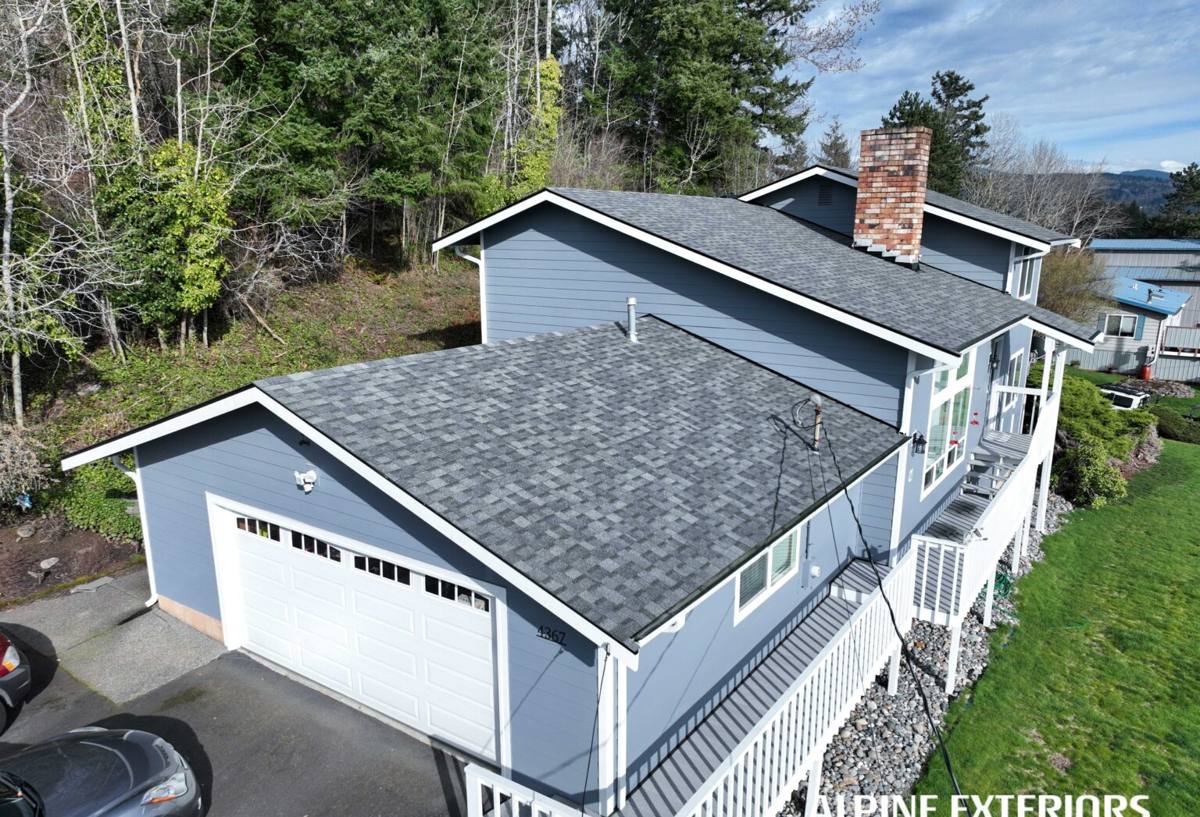
What a Correct Installation Looks Like in This Climate
A roof that's going to hold up in Marietta's conditions needs a few things done right, every time, not just on the parts that show.
- Ice-and-water shield at vulnerable zones: eaves, valleys, and around every penetration, so wind-driven rain that gets under the shingle field still can't reach the deck.
- Synthetic underlayment across the full field: a durable secondary barrier that outperforms old-style felt in wet, humid conditions and doesn't degrade as quickly under repeated moisture cycles.
- Balanced attic ventilation: intake at the eaves and exhaust at the ridge, sized to the attic volume, so the underside of the deck can dry out between rain events instead of staying damp.
- Corrosion-resistant flashing and fasteners: given the salt air near the bay, standard-grade metal corrodes faster here than in inland Whatcom County — we account for that in what we spec.
- Shingles rated for algae and moss resistance where the roof has shade exposure, which describes a large share of Marietta lots with tree cover.
Skip any one of these and the shingles themselves stop mattering much — a premium shingle over inadequate ventilation or thin underlayment will still fail early. This is the part of the job that isn't visible from the street, and it's the part that decides whether a roof lasts 18 years or 30.
Signs a Marietta Roof Needs Attention
Because of the shade and moisture here, roof problems often show up as gradual changes rather than sudden damage. Worth checking for, especially after the wet months:
- Moss or dark algae streaking on north-facing or shaded slopes
- Granules collecting in gutters or at downspout outlets
- Shingle edges that look curled, lifted, or cupped
- Soft spots or sagging when walked on (or visible from the ground)
- Daylight visible through the attic roof deck, or damp insulation below it
- Rust staining around flashing or exposed fasteners
- Ceiling stains inside the home, even faint ones, after a heavy rain
Any one of these on its own isn't necessarily an emergency, but they're worth a professional look before the next wet season rather than after a leak shows up indoors.
Choosing the Right Shingle for This Location
Not every asphalt shingle product is built the same way, and for a Marietta roof under tree cover or exposed to bay winds, the differences matter more than they would in a milder setting.
| Shingle Type | Typical Lifespan | Best Fit for Marietta |
|---|---|---|
| Standard 3-tab | 15–20 years | Budget projects with full sun exposure; less suited to shaded, moss-prone slopes |
| Architectural (laminate) | 25–30 years | Strong general choice; heavier profile sheds water better and handles wind uplift well |
| Algae-resistant architectural | 25–30 years | Best match for shaded lots and roofs facing north or under evergreen cover |
| Impact-rated architectural | 25–30 years | Worth considering on exposed rooflines that take direct wind off the water |
We don't push homeowners toward the most expensive option by default. On a well-shaded Marietta lot, an algae-resistant architectural shingle is usually the better long-term value over a standard laminate, because it directly addresses the moss and algae growth that shortens roof life here — the upgrade cost is modest compared to what an early moss-driven replacement would run.
Our Process, Start to Finish
Inspection and Assessment
We start on the roof, not with a sales pitch. That means checking the deck condition, existing ventilation, flashing points, and how much shade and moisture exposure the specific slopes get. Two roofs on the same street can need different specs depending on tree cover and orientation.
A Written Scope, Not a Vague Estimate
Before any work starts, you get a written scope covering the shingle product, underlayment type, ventilation plan, flashing details, and a realistic timeline. No verbal promises that don't make it onto paper.
Tear-Off and Deck Check
We remove the old roofing down to the deck and inspect it directly — this is the point where hidden moisture damage or rot, if any exists, actually gets found and addressed, rather than covered over.
Installation
Underlayment, flashing, ventilation components, and shingles go in following manufacturer specification, which is also what keeps the material warranty valid. This is not a step where "close enough" is acceptable, particularly on flashing and valley work.
Final Walkthrough
We walk the completed roof and the property with you, cover maintenance basics for this climate, and make sure everything matches the scope we agreed on before starting.
Repair, Recover, or Full Replacement?
Not every roof issue in Marietta calls for a full tear-off. The right call depends on the roof's age, how widespread the damage is, and what condition the deck is in underneath.
| Situation | Likely Fit | Key Factor |
|---|---|---|
| Isolated leak, roof under 10 years old | Targeted repair | Localized flashing or fastener failure, deck likely sound |
| Moss coverage, granule loss, roof 12–18 years old | Evaluate case by case | Depends on deck condition once inspected |
| Widespread curling, multiple leak points, roof 20+ years old | Full replacement | Underlayment and ventilation are also due for an upgrade |
| Visible deck sag or rot | Full replacement | Structural repair required regardless of shingle age |
We'll tell you honestly if a repair is the right call, even when a full replacement would be the bigger job for us. A roof that only needs a repair doesn't need to be sold as a replacement.
Why a Local Crew Matters for This Job
A roofing crew that works Marietta and the surrounding Ferndale area regularly already knows which slopes on which lot types collect moss fastest, how much ventilation a typical attic here actually needs, and what flashing details hold up against wind off the bay. That's not something a crew coming from outside Whatcom County picks up on a single job. It also means we're a known, reachable business if a question comes up two years after installation — not a name from an out-of-area lead generation site.
Maintenance That Actually Extends Roof Life Here
A correctly installed roof still benefits from basic upkeep in this climate:
- Keep gutters clear so water isn't backing up under the shingle edge during heavy rain
- Trim overhanging branches to cut down shade and debris buildup on the roof surface
- Have moss treated or removed before it establishes, rather than after it's visibly thick
- Schedule a walk-through inspection every couple of years, especially after major windstorms
None of this is complicated, but it's the difference between a shingle roof that reaches the top end of its expected lifespan and one that needs early attention because moisture and moss got ahead of it.
Get a Straight Answer on Your Roof
If you're seeing moss, granule loss, or a leak on a Marietta home, or you're just trying to plan ahead before the next wet season, we're happy to take a look and give you an honest read on where things stand. Use the form below to request a free, no-pressure estimate — no obligation, just a clear picture of what your roof actually needs.