 Ferndale Siding
 Why Roofs Around Lynden Take a Beating
Lynden sits in the same wet, wind-exposed weather system as the rest of Whatcom County, and that system is hard on roofs. The salt-laden air moving in off the water corrodes exposed metal faster than it would inland, driving rain gets pushed sideways during winter storms instead of falling straight down, and the long stretch of gray, damp months from fall through spring gives moss and moisture months at a time to work into every seam and lap. None of this means a roof is doomed. It means repairs have to account for how this specific climate attacks a roof, not just patch the spot where water showed up inside the house.
The Moss Problem
Moss is more than a cosmetic issue. Once it establishes on shaded or north-facing slopes, it holds water against the shingle surface long after the rest of the roof has dried. Over months, that trapped moisture works shingle edges loose, breaks down the granule layer that protects the asphalt underneath, and gives roots something to grip as it spreads. A roof that looks fine from the ground can have moss quietly lifting shingle tabs along a shaded valley or under a tree line for a full season before a leak shows up inside.
Wind-Driven Rain
Straight-down rain is easy on a roof — it's rain pushed by wind that causes trouble. Storms coming off the water can drive water sideways and even slightly upward under ridge caps, at wall-to-roof transitions, and around anything that penetrates the roof plane: chimneys, vent pipes, skylights. Standard shingle overlap handles gravity fine. It doesn't always handle wind-forced water, which is why so many local leaks trace back to flashing and transition points rather than the field of the roof itself.
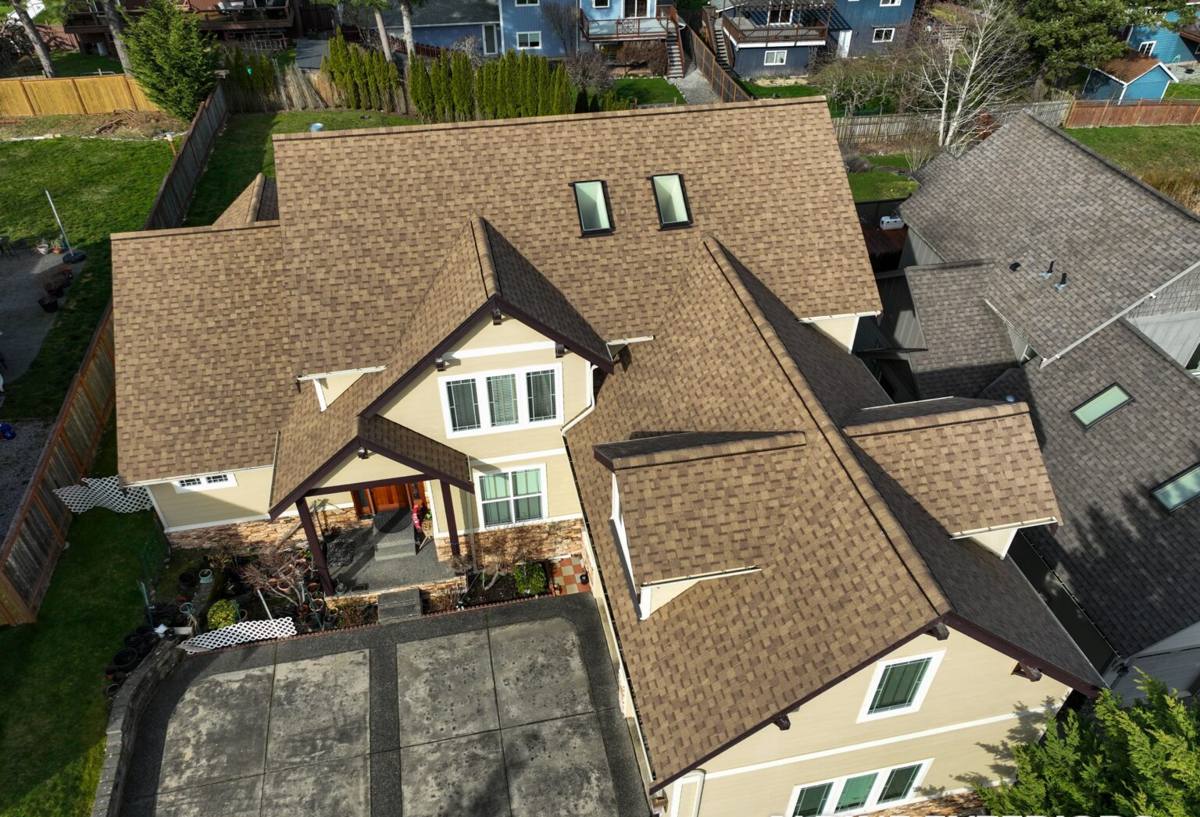
Signs Your Roof Needs Repair, Not a Full Replacement
Most roofs don't fail all at once — they show localized warning signs first. If you're seeing one or two of these, a targeted repair is usually the right call rather than jumping straight to full replacement:
- A ceiling stain that appears only during heavy wind-driven storms, not every rain
- Missing or torn shingles in one area after a windstorm, with the rest of the roof intact
- Visible daylight or gaps around a chimney, skylight, or vent pipe when viewed from the attic
- Granules collecting in gutters from one section of roof more than the rest
- A soft or spongy spot underfoot in a single area, rather than throughout
- Moss buildup concentrated on one slope, especially a shaded or north-facing side
- A roof under 15–20 years old with isolated damage from a storm, falling branch, or old flashing failure
If instead you're dealing with widespread granule loss across every slope, multiple past repairs in different spots, or a roof already past its expected service life, that's a different conversation — and we'll tell you honestly if repair is just delaying an inevitable replacement rather than solving the problem.
What a Correct Roof Repair Actually Involves
A repair done right is more than laying a new shingle over the damaged one. It starts with pulling back enough surrounding material to see what's actually happening underneath — because the visible damage is often smaller than the water intrusion that caused it. That means checking the decking for soft or delaminated spots, inspecting the underlayment for how far moisture has traveled, and understanding why that spot failed in the first place before closing it back up.
Flashing Is Where Most Repairs Are Won or Lost
Step flashing along walls, counter-flashing at chimneys, valley metal, and pipe boots are the parts of a roof most likely to fail before the shingles themselves do — and they're also the parts most likely to get rushed or reused instead of replaced during a cheap repair. Pipe boot rubber cracks with age and sun exposure well before the surrounding shingles wear out. Old step flashing that's been painted over or caulked instead of properly lapped will leak again no matter how many new shingles go around it. A correct repair replaces flashing that's compromised rather than sealing over it.
Matching Materials the Right Way
Shingle color and profile fade and change over the years, so a patch using shingles that don't match won't just look off — mismatched profiles can also sit slightly proud or low against the surrounding field, creating a new spot for wind and water to catch. We source material as close to the existing roof as possible and place new shingles where the color difference will be least noticeable, usually blending into a valley or lower slope rather than a highly visible front-facing plane.
Common Roof Repairs We Handle Around Lynden
| Repair Type | Typical Cause | What the Fix Involves |
|---|---|---|
| Valley leak | Aging or improperly lapped valley metal, debris buildup channeling water sideways | Remove shingles along the valley, replace metal, re-lace shingles with correct overlap |
| Chimney flashing leak | Counter-flashing pulled away from mortar joints, sealant failure | Rebuild step and counter-flashing, re-seat into the chimney properly rather than caulk over gaps |
| Pipe boot failure | UV-cracked rubber collar around vent pipes, common on older boots | Replace the boot assembly, not just re-caulk around it |
| Ridge cap wind damage | High wind lifting or tearing ridge shingles | Replace damaged ridge caps and check underlying ridge vent for damage |
| Moss-related granule loss | Prolonged moisture and shade on one slope | Remove moss, treat the surface, assess and replace affected shingles |
| Skylight flashing leak | Aging flashing kit or original install shortcuts | Remove surrounding shingles, install correct flashing kit for that skylight model |
Repair or Replace? How We Help You Decide
Homeowners understandably want a straight answer on whether a leak means "patch it" or "replace the whole thing." The honest answer depends on a handful of factors we walk through with you on-site rather than guessing over the phone:
| Factor | Repair Usually Makes Sense | Replacement Usually Makes Sense |
|---|---|---|
| Roof age | Under roughly 15–18 years | Approaching or past typical shingle lifespan |
| Extent of damage | Localized to one area or slope | Spread across multiple slopes |
| History of repairs | First or second repair on the roof | Repeated repairs in different spots over recent years |
| Decking condition | Sound, dry decking under the damaged area | Soft, delaminated, or rotted decking found during inspection |
| Underlayment condition | Intact outside the repair zone | Brittle or failing throughout |
We'll show you what we find during the inspection — including photos of anything under the shingles — so the decision is based on the actual condition of your roof, not a sales pitch.
Our Process From Call to Completed Repair
- Initial conversation. Tell us what you're seeing — a stain, a missing shingle, a musty smell in the attic — and we'll ask a few questions to understand the scope before we ever show up.
- On-site inspection. We get on the roof and, when needed, into the attic to trace the leak to its actual source rather than just the spot where it's showing up indoors.
- Written scope and estimate. You get a clear explanation of what's damaged, why, and what the repair involves — no vague line items.
- Repair day. We tear out to sound material, replace flashing and underlayment as needed, and re-shingle with matched material.
- Cleanup and walkthrough. Job site and gutters cleared of debris and old material, and we walk you through exactly what was done.
- Follow-up. If anything doesn't perform the way it should through the next round of weather, we come back and make it right.
Why a Crew That Already Works Lynden Matters
Roofing crews that mainly work other regions often underestimate how aggressively moss and driving rain move through Whatcom County roofs, or they show up without the right flashing stock for the wind-exposure conditions this area sees. A crew that regularly works Lynden and greater Ferndale already knows the difference between a roof that needs a targeted flashing repair and one that's been fighting moss and wind damage long enough to need more. That local familiarity means fewer surprises, a faster read on what's actually wrong, and a repair built for the weather your roof will keep facing, not a generic patch.
It also means a shorter wait when timing matters. A leak that shows up during a winter storm doesn't need to sit for two weeks waiting on a crew driving in from out of the area — being local means we can get eyes on the roof and a tarp up quickly if that's what's needed to stop damage while we plan the permanent repair.
Maintenance That Extends the Life of a Repair
A well-done repair still needs a little upkeep to get its full lifespan, especially in a climate that gives moss and standing water this much time to work. A few habits go a long way between service visits:
- Clean gutters at least twice a year — clogged gutters back water up under the lowest shingle course
- Have moss treated before it spreads, rather than after it's already lifted shingles
- Trim back branches that keep a section of roof shaded and damp longer than the rest
- Check attic ventilation periodically — poor airflow traps moisture that accelerates decking and shingle wear from underneath
- Have the roof looked at after any significant windstorm, even if nothing seems wrong from the ground
None of this replaces a proper inspection, but it reduces how often you need one, and it protects the repair work you've already paid for.
Get a Straight Answer About Your Roof
If you're dealing with a leak, missing shingles, or a soft spot on a Lynden-area roof, we're happy to take a look and give you an honest read on what it actually needs. Reach out for a free, no-pressure estimate using the form below.