 Ferndale Siding
 Deck Repair Built for Point Roberts' Coastal Conditions
A deck in Point Roberts works harder than a deck almost anywhere else in Whatcom County. It sits close to open water, takes wind-driven rain off the Strait of Georgia and Boundary Bay, and spends a good chunk of the year under damp, shaded conditions that favor moss and algae. None of that means a deck is doomed — it means the repair has to account for the environment, not just patch what's visible on the surface.
We repair decks throughout Point Roberts and the surrounding Ferndale area, and the failures we see here follow a pattern: corroded fasteners, soft framing where water has been sitting quietly for a season or two, and slick, moss-covered boards that are more of a safety issue than an eyesore. This page walks through what actually goes wrong, what a correct repair involves, and how we approach the work.
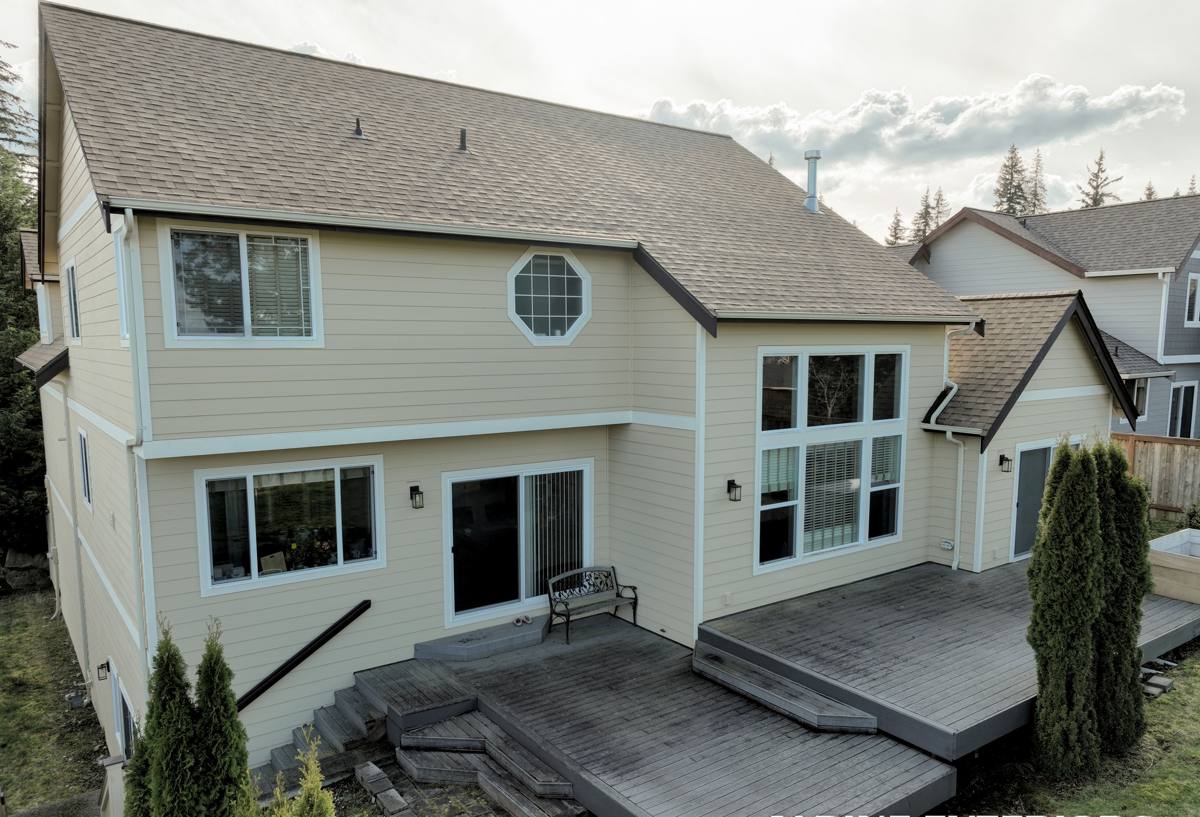
Why Decks Take a Beating in Point Roberts
Salt Air and Metal Fatigue
Salt-laden air accelerates corrosion on anything metal — nails, screws, joist hangers, bolts, and railing hardware. Corrosion doesn't announce itself; a fastener can look fine on the head while the shank underneath has lost most of its strength. On a deck, that's a structural problem, not a cosmetic one, since the ledger board connection and joist hangers are what keep the whole structure attached to the house and holding weight safely.
Driving Rain and Water Intrusion
Rain that comes in sideways off the water finds every gap in flashing, every unsealed screw hole, and every spot where decking meets a house wall. Once water gets behind a ledger board or under a rim joist, it doesn't dry out quickly in our climate — it sits, and the wood underneath starts to break down long before anything looks wrong from above.
A Long Moss Season
Point Roberts gets shade, moisture, and mild temperatures for most of the year — exactly what moss needs. Beyond the green film on the boards, moss holds water against the wood surface far longer than open air would, which speeds up rot in exactly the areas that already stay damp the longest: north-facing sections, spots under overhangs, and anywhere leaves and debris collect.
Signs Your Deck Needs Repair, Not Just a Pressure Wash
Some deck problems are obvious. Others hide under a coat of stain or a rug. Before assuming a cleaning will fix things, check for:
- Soft or spongy spots when you press on decking boards, especially near the house or along the outer edge
- Rust streaks below screw heads or around joist hangers
- Railings or posts that flex or wiggle when pushed
- Visible gaps or dark staining where the deck meets the house (ledger board area)
- Persistent green or black growth that comes right back after cleaning
- Stair stringers that feel spongy or steps that shift underfoot
- Fasteners that are backing out, snapped off, or missing entirely
Any one of these on its own might be minor. Several together, especially near the ledger or stairs, usually mean it's time for a real inspection rather than another round of cleaning.
Common Repairs We Handle
Ledger Board and Structural Connections
The ledger board — where the deck attaches to the house — is the single most important connection on the structure, and it's also the one most exposed to trapped moisture if it wasn't flashed correctly to begin with. We check the ledger, the flashing behind it, and the bolts or lag screws holding it in place. If we find rot or corrosion here, this gets fixed properly before anything else, since it affects the safety of the whole deck.
Rotted or Split Decking Boards
Individual boards that have gone soft, split, or cupped can usually be replaced without touching the rest of the deck, as long as the framing underneath is sound. We match material as closely as possible and check the joists beneath each board we pull.
Railings and Guard Posts
Loose or wobbly railings are a common repair call, and often the cause is corroded fasteners or a post that was never properly anchored to a rim joist. We rebuild the connection, not just tighten what's there, since a railing that looks fixed but isn't structurally solid is a liability.
Stairs and Landings
Stairs take direct rain exposure and constant foot traffic, which makes stringers and treads some of the first parts of a deck to fail. We inspect stringer condition at the base, where water collects, and rebuild sections rather than just resurfacing them when the wood underneath is compromised.
Repair or Replace? What We Look At
Not every deck problem calls for a full rebuild, and not every deck is worth patching indefinitely. The table below outlines the factors that typically point one direction or the other.
| Factor | Usually points to repair | Usually points to replacement |
|---|---|---|
| Ledger board & framing | Solid, no rot found on inspection | Rot or corrosion at multiple structural points |
| Decking boards | A handful of boards affected | Widespread cupping, splitting, or softness |
| Age of structure | Under 15-20 years, built to a reasonable standard | Older, undersized, or built before current fastening practices |
| Railings/posts | Isolated looseness, framing behind them is sound | Multiple posts poorly anchored throughout |
| Moss/staining | Surface-level, wood underneath is firm | Growth has been present long enough to soften the wood |
We'll give you a straight answer on which category your deck falls into, including the option of a partial rebuild — replacing framing and a full section of decking while keeping what's still sound — when that makes more sense than an all-or-nothing choice.
Materials and Fasteners We Use
In a coastal environment like Point Roberts, the fasteners matter as much as the decking material itself. Standard galvanized screws can hold up fine inland but corrode faster with regular salt air exposure. For repair work here, we favor stainless steel or high-grade coated fasteners at connection points that matter most — ledger attachment, joist hangers, and structural hardware — even when it costs a bit more up front, because replacing a fastener is a lot cheaper than replacing framing that failed because of one.
On decking material, we'll talk through the honest trade-offs rather than push one option:
- Pressure-treated lumber — the most economical option and easy to repair in sections, but it needs regular sealing to perform well against driving rain and moss
- Cedar — naturally resistant to rot and attractive, but it's a softer wood that needs consistent maintenance in a wet climate
- Composite decking — higher upfront cost, low maintenance, and strong resistance to moisture and moss staining, which can make sense for a full resurfacing where framing is being redone anyway
We're not going to recommend replacing an entire deck's decking material just to sell a bigger job — if a repair with matched or comparable material solves the problem, that's what we'll propose.
Our Deck Repair Process
- Inspection — We check the ledger board, framing, joist hangers, decking, railings, and stairs, probing suspect areas rather than just looking at the surface.
- Honest assessment — We walk you through what we found, what's structural versus cosmetic, and what your realistic options are.
- Written scope — You get a clear plan covering what's being repaired, replaced, or left alone, and why.
- Repair work — Structural issues are addressed first; decking, railings, and finish work follow once the framing underneath is confirmed sound.
- Final check — We walk the deck with you before calling the job done, so you know exactly what was fixed.
If a repair turns out to require permitting — for example, structural changes to footings or the ledger connection — we'll flag that early so it's handled correctly under Whatcom County requirements, not discovered after the fact.
Why a Crew That Already Works in Point Roberts Matters
Point Roberts is geographically separate from the rest of Whatcom County — the only land route in and out passes through Canada. That's not a small detail when it comes to scheduling a repair. Material deliveries, crew travel, and timing all have to account for the border crossing, and a contractor who hasn't planned around that can turn a simple repair into a scheduling headache.
We factor the crossing into how we plan Point Roberts jobs from the start — grouping tasks, timing material runs, and setting realistic timelines up front instead of discovering the complication mid-project. Combine that with knowing what this specific coastline does to fasteners, framing, and decking, and you get a repair that's sized to the actual conditions your deck faces, not a generic fix.
Maintaining Your Deck Between Repairs
A repaired deck lasts longer with a little seasonal attention. A few habits go a long way in this climate:
- Sweep leaves and debris off the deck regularly, especially in fall, so moisture doesn't sit trapped underneath them
- Rinse or gently clean moss and algae before it has a chance to soften the wood surface
- Check railings and stair treads for movement once or twice a year
- Reseal wood decking on the manufacturer's recommended schedule rather than waiting until it looks weathered
- Keep an eye on the area where the deck meets the house — it's the first place trapped moisture shows up
Catching small issues during a seasonal check is almost always cheaper and simpler than waiting for a board or railing to fail outright.
If your deck is showing any of the signs above, or it's just been a while since anyone looked at it closely, we're happy to come take a look. Fill out the form below for a free, no-pressure estimate on deck repair in Point Roberts.