 Ferndale Siding
 Birch Bay Siding Takes a Different Kind of Beating
Birch Bay sits right on the water in unincorporated Whatcom County, a few minutes from Ferndale, and that waterfront location changes what siding has to deal with. Homes here don't just get rained on — they get salt-laden air blowing off the bay, near-constant wind that drives rain sideways into wall assemblies, and a wet, shaded off-season that keeps moisture sitting on exterior surfaces for months at a time. Add in the moss and algae that thrive in that kind of damp, low-sun environment, and you've got a siding system working harder than it would almost anywhere else in Whatcom County.
Most siding failures we see in Birch Bay aren't dramatic. They're slow: a cracked butt joint that lets water track behind a board, caulking that gave up years ago, a section of trim that's been holding moisture against the wall since last winter. By the time it's visible from the yard, the damage underneath is usually further along than it looks.
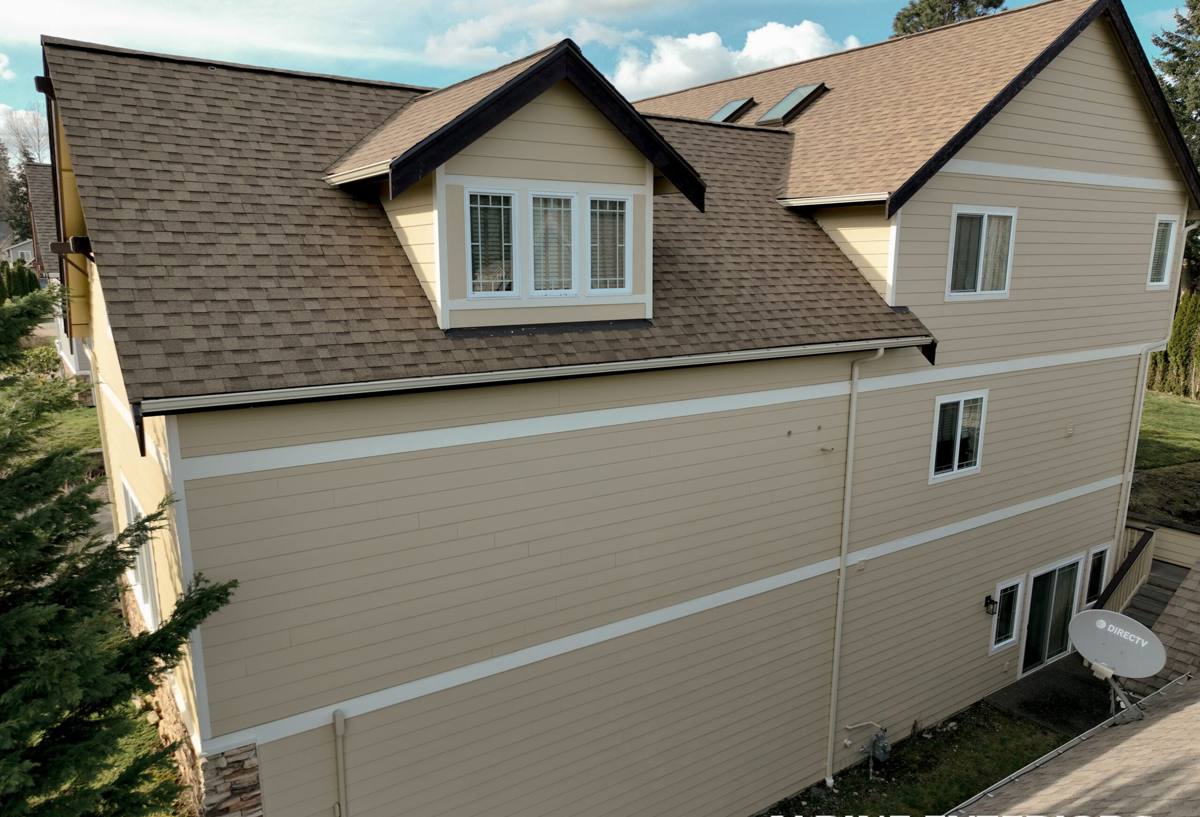
Signs a Birch Bay Home Needs Siding Repair, Not Just Paint
A fresh coat of paint can hide a lot of problems for a season or two, which is part of why siding damage on the coast tends to get discovered later than it should. Here's what actually signals a repair is needed:
- Soft, spongy, or crumbling spots when you press on the siding, especially near the bottom courses and around window and door trim
- Persistent black or green streaking that comes back within weeks of being cleaned
- Visible gaps or separation at butt joints, corners, or where siding meets trim
- Bubbling, peeling, or repeatedly failing paint in the same spots year after year
- Warped, bowed, or buckled panels, particularly on walls that face prevailing wind and rain
- Musty smell or visible moisture staining on interior walls that back up to exterior siding
- Cracked or missing caulking around penetrations — hose bibs, vents, light fixtures, meter boxes
Any one of these on its own might be minor. Two or three together, especially on a wall that takes direct weather off the bay, usually means water has already found a way behind the cladding.
What a Correct Repair Actually Involves
It's Not Just Swapping a Board
The visible siding is the last layer, not the first thing that matters. A repair that only replaces the damaged board and ignores what's behind it is a repair that fails again in a year or two — we've torn into enough Whatcom County walls to know that's not a hypothetical. A correct repair means opening the area up enough to actually see the water-resistive barrier, the flashing, and the sheathing underneath, and dealing with whatever's found there before anything new goes back on.
What We Check Every Time
- Condition of the house wrap or building paper behind the removed section — torn, sagging, or improperly lapped barrier gets replaced, not patched over
- Flashing at windows, doors, and any horizontal trim, since faulty flashing is the single most common source of hidden water intrusion on coastal homes
- Sheathing for soft spots, delamination, or rot — if it's compromised, it gets cut out and replaced before new siding goes up, not covered
- Proper drainage plane and rainscreen gap where the assembly calls for one, so water that does get behind the cladding can actually get back out
- Fastener pattern and clearances matched to manufacturer specs, not just "close enough"
Skipping any of these steps is how a small repair turns into a bigger one two winters later.
Repair or Replace: How We Help You Decide
Not every damaged section needs a full re-side, and not every problem is fixable with a patch. The honest answer depends on how much of the wall is affected and what's found once we open it up.
| Factor | Points Toward Repair | Points Toward Replacement |
|---|---|---|
| Extent of damage | Isolated to one or two wall sections | Recurring issues across multiple walls or elevations |
| Sheathing condition | Solid, dry, no rot found | Soft, delaminated, or rotted sheathing in several spots |
| Age of existing siding | Relatively recent, otherwise sound material | Original siding is decades old and near end of service life |
| Material on the wall now | Existing James Hardie in good condition nearby | Wood, vinyl, or LP-type product showing widespread wear |
| Color/profile match | Close match achievable with ColorPlus stock | Discontinued profile or faded color makes matching impractical |
We'll tell you plainly which side of that table your home falls on. If a targeted repair genuinely solves the problem, that's what we recommend — there's no reason to sell a full re-side to a homeowner who doesn't need one.
Why Repairs Go Back On With James Hardie, Not Whatever Was There
We install and repair with James Hardie fiber cement exclusively. We don't carry LP SmartSide, vinyl, Cemplank, Allura, primed spruce, or cedar, and that matters most on a job like this, where the repaired section has to survive the same salt air and driving rain that damaged the original.
Wood-based siding and trim — cedar, primed spruce, engineered wood products like LP SmartSide — depend on an intact factory coating and diligent caulk maintenance to keep moisture out. In a spot like Birch Bay, where surfaces stay damp for extended stretches and salt accelerates coating breakdown, that maintenance margin shrinks fast. Vinyl doesn't rot, but it expands and contracts more than fiber cement, can warp or crack in sustained wind exposure, and its seams and butt joints are a common path for the exact wind-driven water intrusion coastal walls see most.
James Hardie fiber cement is non-combustible, dimensionally stable, and holds its factory-applied ColorPlus finish far longer than field-applied paint on wood products — which matters on a house that's going to get repainted a lot less often if the siding itself is doing its job. Hardie's HZ5 product line is engineered specifically for climates like ours: freeze-thaw cycling, sustained moisture, and coastal exposure. When we patch into existing Hardie, we're not introducing a weaker material into a wall that's already proven itself; we're matching like with like.
Our Repair Process
- On-site inspection. We walk the exterior, identify every affected area (not just the one you called about — coastal wind damage often shows up in more than one spot), and check for signs of moisture behind the cladding.
- Diagnosis before demo. Where possible, we probe or make a small exploratory opening to see what's happening behind the siding before quoting the full scope, so the estimate reflects reality instead of a guess.
- Written, fixed-price estimate. You'll know what's being repaired, what's being replaced, and what it costs before any work starts — no surprise change orders for problems we should have found up front.
- Removal and inspection of the wall assembly. Damaged siding comes off, and we assess the barrier, flashing, and sheathing underneath.
- Correction of the root cause. Damaged sheathing, torn house wrap, or failed flashing gets replaced — this is the step that determines whether the repair actually lasts.
- Reinstallation to spec. New James Hardie material goes back on following manufacturer fastening, clearance, and finishing requirements, with ColorPlus-matched material wherever possible.
- Final walk-through. We show you what was found and what was done before we consider the job finished.
Why Hiring a Crew That Already Works Birch Bay Matters
Siding repair isn't uniform across Whatcom County. A crew that mostly works inland jobs may not think twice about wind-driven rain intrusion at horizontal trim, or how much faster fasteners and flashing corrode in salt air versus a few miles up the road. Homes right on Birch Bay's waterfront and the near-shore streets around it take weather differently than homes further from the water, and a repair scoped without that in mind tends to undersize the fix — patch the visible board, skip the flashing detail that actually caused the leak, and end up back at the same wall in two years.
Working this stretch of coastline regularly also means we're not guessing at material behavior — we know how James Hardie performs here specifically, what fastening and clearance details hold up against sustained coastal wind, and what moss and algae patterns tend to mean about a wall's moisture history before we even open it up. That's the kind of judgment call that only comes from doing this work in this exact environment, not a general contracting background applied to a coastal job.
After the Repair: Keeping Moss and Salt Air From Coming Back
A correct repair buys you years, but a little upkeep protects that investment, especially given Birch Bay's long moss season and salt exposure.
- Rinse siding — especially north-facing and shaded walls — once or twice a year to keep moss and algae from re-establishing
- Keep gutters clear so overflow doesn't run down the wall face repeatedly
- Trim back vegetation and tree cover that keeps siding shaded and damp longer than it needs to be
- Re-caulk penetrations (vents, fixtures, hose bibs) if you notice cracking, rather than waiting for a leak to show up
- Walk the exterior after major windstorms to catch loosened trim or fasteners early
- Have any new staining or soft spots checked before the next wet season, not after
None of this is complicated, but it's the difference between a repair that holds for decades and one that's fighting the same battle again in a few years.
If you're seeing staining, soft spots, or repeat paint failure on your Birch Bay home, we'll come take a look and give you a straight answer on what's actually needed — repair or replacement — with no pressure either way. The form below gets you a free estimate.